

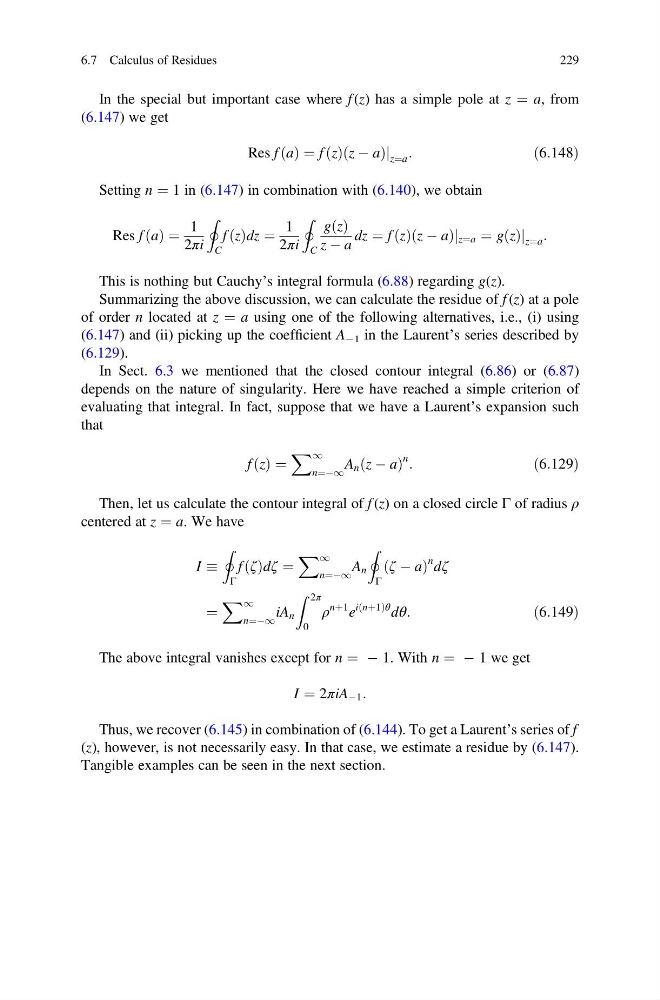
In the special but important case where f (z) has a simple pole at z ¼ a, from
(6.147) we get
Res f a
ð Þ ¼ f z
ð Þ z À a
ð
Þj z¼a :
ð6:148Þ
Setting n ¼ 1 in (6.147) in combination with (6.140), we obtain
Res f a
ð Þ ¼
1
2πi
I
C
f z
ð Þdz ¼
1
2πi
I
C
g z
ð Þ
z À a
dz ¼ f z
ð Þ z À a
ð
Þ z¼a ¼ g z
ð Þ
j
j z¼a :
This is nothing but Cauchy’s integral formula (6.88) regarding g(z).
Summarizing the above discussion, we can calculate the residue of f (z) at a pole
of order n located at z ¼ a using one of the following alternatives, i.e., (i) using
(6.147) and (ii) picking up the coefficient A À1 in the Laurent’s series described by
(6.129).
In Sect. 6.3 we mentioned that the closed contour integral (6.86) or (6.87)
depends on the nature of singularity. Here we have reached a simple criterion of
evaluating that integral. In fact, suppose that we have a Laurent’s expansion such
that
f z
ð Þ ¼
X 1
n¼À1
A n z À a
ð
Þ
n :
ð6:129Þ
Then, let us calculate the contour integral of f (z) on a closed circle Γ of radius ρ
centered at z ¼ a. We have
I
I
Γ
f ζ
ð Þdζ ¼
X 1
n¼À1
A n
I
Γ
ζ À a
ð
Þ
n dζ
¼
X 1
n¼À1
iA n
Z 2π
0
ρ
nþ1 e
i nþ1
ð
Þθ dθ:
ð6:149Þ
The above integral vanishes except for n ¼ À 1. With n ¼ À 1 we get
I ¼ 2πiA À1 :
Thus, we recover (6.145) in combination of (6.144). To get a Laurent’s series of f
(z), however, is not necessarily easy. In that case, we estimate a residue by (6.147).
Tangible examples can be seen in the next section.
6.7 Calculus of Residues
229
(6.147) we get
Res f a
ð Þ ¼ f z
ð Þ z À a
ð
Þj z¼a :
ð6:148Þ
Setting n ¼ 1 in (6.147) in combination with (6.140), we obtain
Res f a
ð Þ ¼
1
2πi
I
C
f z
ð Þdz ¼
1
2πi
I
C
g z
ð Þ
z À a
dz ¼ f z
ð Þ z À a
ð
Þ z¼a ¼ g z
ð Þ
j
j z¼a :
This is nothing but Cauchy’s integral formula (6.88) regarding g(z).
Summarizing the above discussion, we can calculate the residue of f (z) at a pole
of order n located at z ¼ a using one of the following alternatives, i.e., (i) using
(6.147) and (ii) picking up the coefficient A À1 in the Laurent’s series described by
(6.129).
In Sect. 6.3 we mentioned that the closed contour integral (6.86) or (6.87)
depends on the nature of singularity. Here we have reached a simple criterion of
evaluating that integral. In fact, suppose that we have a Laurent’s expansion such
that
f z
ð Þ ¼
X 1
n¼À1
A n z À a
ð
Þ
n :
ð6:129Þ
Then, let us calculate the contour integral of f (z) on a closed circle Γ of radius ρ
centered at z ¼ a. We have
I
I
Γ
f ζ
ð Þdζ ¼
X 1
n¼À1
A n
I
Γ
ζ À a
ð
Þ
n dζ
¼
X 1
n¼À1
iA n
Z 2π
0
ρ
nþ1 e
i nþ1
ð
Þθ dθ:
ð6:149Þ
The above integral vanishes except for n ¼ À 1. With n ¼ À 1 we get
I ¼ 2πiA À1 :
Thus, we recover (6.145) in combination of (6.144). To get a Laurent’s series of f
(z), however, is not necessarily easy. In that case, we estimate a residue by (6.147).
Tangible examples can be seen in the next section.
6.7 Calculus of Residues
229