

1
ζ À z
¼
1
ζ À a À z À a
ð
Þ
¼
À1
z À a
1 þ
ζ À a
z À a
þ
ζ À a
ð
Þ
2
z À a
ð
Þ
2
þ Á Á Á
"
#
ð6:125Þ
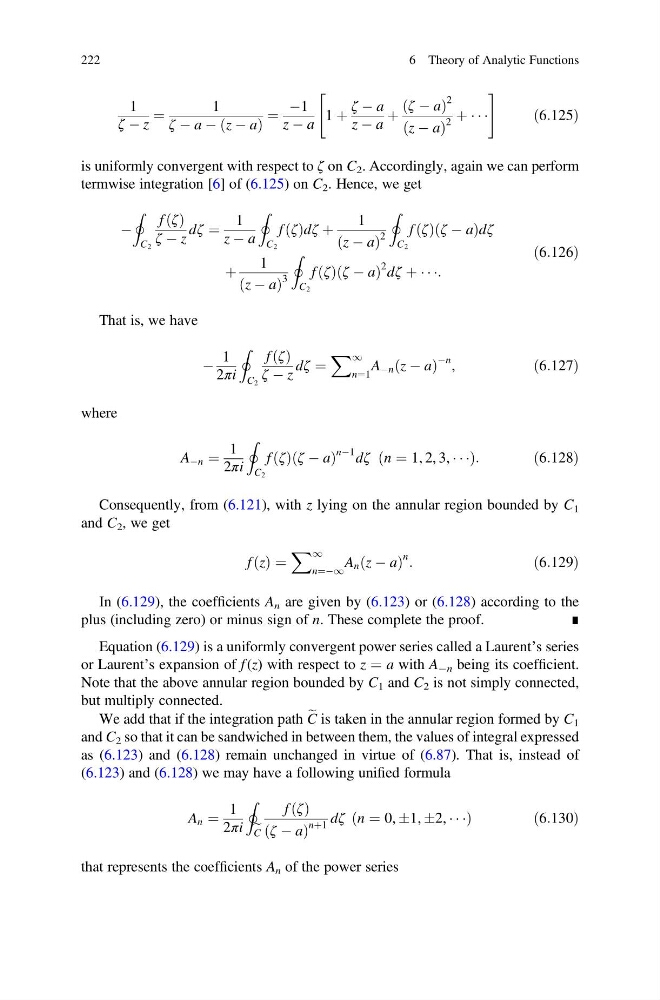
is uniformly convergent with respect to ζ on C 2 . Accordingly, again we can perform
termwise integration [6] of (6.125) on C 2 . Hence, we get
À
I
C 2
f ζ
ð Þ
ζ À z
dζ ¼
1
z À a
I
C 2
f ζ
ð Þdζ þ
1
z À a
ð
Þ
2
I
C 2
f ζ
ð Þ ζ À a
ð
Þdζ
þ
1
z À a
ð
Þ
3
I
C 2
f ζ
ð Þ ζ À a
ð
Þ
2 dζ þ Á Á Á:
ð6:126Þ
That is, we have
À
1
2πi
I
C 2
f ζ
ð Þ
ζ À z
dζ ¼
X 1
n¼1
A Àn z À a
ð
Þ
Àn ,
ð6:127Þ
where
A Àn ¼
1
2πi
I
C 2
f ζ
ð Þ ζ À a
ð
Þ
nÀ1 dζ n ¼ 1, 2, 3, Á Á Á
ð
Þ :
ð6:128Þ
Consequently, from (6.121), with z lying on the annular region bounded by C 1
and C 2 , we get
f z
ð Þ ¼
X 1
n¼À1
A n z À a
ð
Þ
n :
ð6:129Þ
In (6.129), the coefficients A n are given by (6.123) or (6.128) according to the
plus (including zero) or minus sign of n. These complete the proof.
∎
Equation (6.129) is a uniformly convergent power series called a Laurent’s series
or Laurent’s expansion of f (z) with respect to z ¼ a with A Àn being its coefficient.
Note that the above annular region bounded by C 1 and C 2 is not simply connected,
but multiply connected.
We add that if the integration path e
C is taken in the annular region formed by C 1
and C 2 so that it can be sandwiched in between them, the values of integral expressed
as (6.123) and (6.128) remain unchanged in virtue of (6.87). That is, instead of
(6.123) and (6.128) we may have a following unified formula
A n ¼
1
2πi
I
e C
f ζ
ð Þ
ζ À a
ð
Þ
nþ1
dζ n ¼ 0, Æ1, Æ2, Á Á Á
ð
Þ
ð 6:130Þ
that represents the coefficients A n of the power series
222
6 Theory of Analytic Functions
ζ À z
¼
1
ζ À a À z À a
ð
Þ
¼
À1
z À a
1 þ
ζ À a
z À a
þ
ζ À a
ð
Þ
2
z À a
ð
Þ
2
þ Á Á Á
"
#
ð6:125Þ
is uniformly convergent with respect to ζ on C 2 . Accordingly, again we can perform
termwise integration [6] of (6.125) on C 2 . Hence, we get
À
I
C 2
f ζ
ð Þ
ζ À z
dζ ¼
1
z À a
I
C 2
f ζ
ð Þdζ þ
1
z À a
ð
Þ
2
I
C 2
f ζ
ð Þ ζ À a
ð
Þdζ
þ
1
z À a
ð
Þ
3
I
C 2
f ζ
ð Þ ζ À a
ð
Þ
2 dζ þ Á Á Á:
ð6:126Þ
That is, we have
À
1
2πi
I
C 2
f ζ
ð Þ
ζ À z
dζ ¼
X 1
n¼1
A Àn z À a
ð
Þ
Àn ,
ð6:127Þ
where
A Àn ¼
1
2πi
I
C 2
f ζ
ð Þ ζ À a
ð
Þ
nÀ1 dζ n ¼ 1, 2, 3, Á Á Á
ð
Þ :
ð6:128Þ
Consequently, from (6.121), with z lying on the annular region bounded by C 1
and C 2 , we get
f z
ð Þ ¼
X 1
n¼À1
A n z À a
ð
Þ
n :
ð6:129Þ
In (6.129), the coefficients A n are given by (6.123) or (6.128) according to the
plus (including zero) or minus sign of n. These complete the proof.
∎
Equation (6.129) is a uniformly convergent power series called a Laurent’s series
or Laurent’s expansion of f (z) with respect to z ¼ a with A Àn being its coefficient.
Note that the above annular region bounded by C 1 and C 2 is not simply connected,
but multiply connected.
We add that if the integration path e
C is taken in the annular region formed by C 1
and C 2 so that it can be sandwiched in between them, the values of integral expressed
as (6.123) and (6.128) remain unchanged in virtue of (6.87). That is, instead of
(6.123) and (6.128) we may have a following unified formula
A n ¼
1
2πi
I
e C
f ζ
ð Þ
ζ À a
ð
Þ
nþ1
dζ n ¼ 0, Æ1, Æ2, Á Á Á
ð
Þ
ð 6:130Þ
that represents the coefficients A n of the power series
222
6 Theory of Analytic Functions