

1
2πi
I
Γ
f ζ
ð Þ
ζ À z
dζ ¼
1
2πi
I
C 1
f ζ
ð Þ
ζ À z
dζ À
1
2πi
I
C 2
f ζ
ð Þ
ζ À z
dζ:
ð6:121Þ
From Theorem 6.11, we have
LHS of 6:121
ð
Þ¼f z
ð Þ:
Notice that the region containing Γ and its inside form a simply connected region
in terms of the analyticity of f (z). With the first term of RHS of (6.121), from
Theorem 6.14 we have
1
2πi
I
C 1
f ζ
ð Þ
ζ À z
dζ ¼
X 1
n¼0
A n z À a
ð
Þ
n
ð6:122Þ
with
A n ¼
1
2πi
I
C 1
f ζ
ð Þ
ζ À a
ð
Þ
nþ1
dζ n ¼ 0, 1, 2, Á Á Á
ð
Þ :
ð6:123Þ
In fact, if ζ lies on the circle C 1 , the Taylor’s series is uniformly convergent as in
the case of the proof of Theorem 6.14.
With the second term of RHS of (6.121), however, the situation is different in
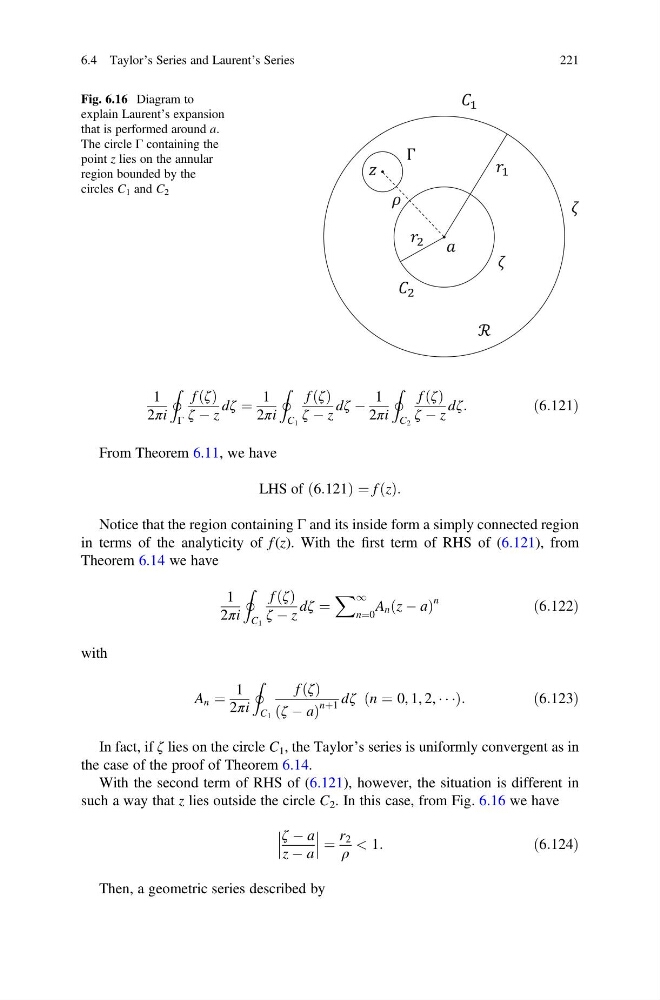
such a way that z lies outside the circle C 2 . In this case, from Fig. 6.16 we have
ζ À a
z À a
¼
r 2
ρ
< 1:
ð6:124Þ
Then, a geometric series described by
Γ
ℛ
Fig. 6.16 Diagram to
explain Laurent’s expansion
that is performed around a.
The circle Γ containing the
point z lies on the annular
region bounded by the
circles C 1 and C 2
6.4 Taylor’s Series and Laurent’s Series
221
2πi
I
Γ
f ζ
ð Þ
ζ À z
dζ ¼
1
2πi
I
C 1
f ζ
ð Þ
ζ À z
dζ À
1
2πi
I
C 2
f ζ
ð Þ
ζ À z
dζ:
ð6:121Þ
From Theorem 6.11, we have
LHS of 6:121
ð
Þ¼f z
ð Þ:
Notice that the region containing Γ and its inside form a simply connected region
in terms of the analyticity of f (z). With the first term of RHS of (6.121), from
Theorem 6.14 we have
1
2πi
I
C 1
f ζ
ð Þ
ζ À z
dζ ¼
X 1
n¼0
A n z À a
ð
Þ
n
ð6:122Þ
with
A n ¼
1
2πi
I
C 1
f ζ
ð Þ
ζ À a
ð
Þ
nþ1
dζ n ¼ 0, 1, 2, Á Á Á
ð
Þ :
ð6:123Þ
In fact, if ζ lies on the circle C 1 , the Taylor’s series is uniformly convergent as in
the case of the proof of Theorem 6.14.
With the second term of RHS of (6.121), however, the situation is different in
such a way that z lies outside the circle C 2 . In this case, from Fig. 6.16 we have
ζ À a
z À a
¼
r 2
ρ
< 1:
ð6:124Þ
Then, a geometric series described by
Γ
ℛ
Fig. 6.16 Diagram to
explain Laurent’s expansion
that is performed around a.
The circle Γ containing the
point z lies on the annular
region bounded by the
circles C 1 and C 2
6.4 Taylor’s Series and Laurent’s Series
221