

f z
ð Þ ¼
X 1
n¼À1
A n z À a
ð
Þ
n :
ð6:129Þ
6.5 Zeros and Singular Points
We described the fundamental theorems of Taylor’s expansion and Laurent’s
expansion. Next, we explain important concepts of zeros and singular points.
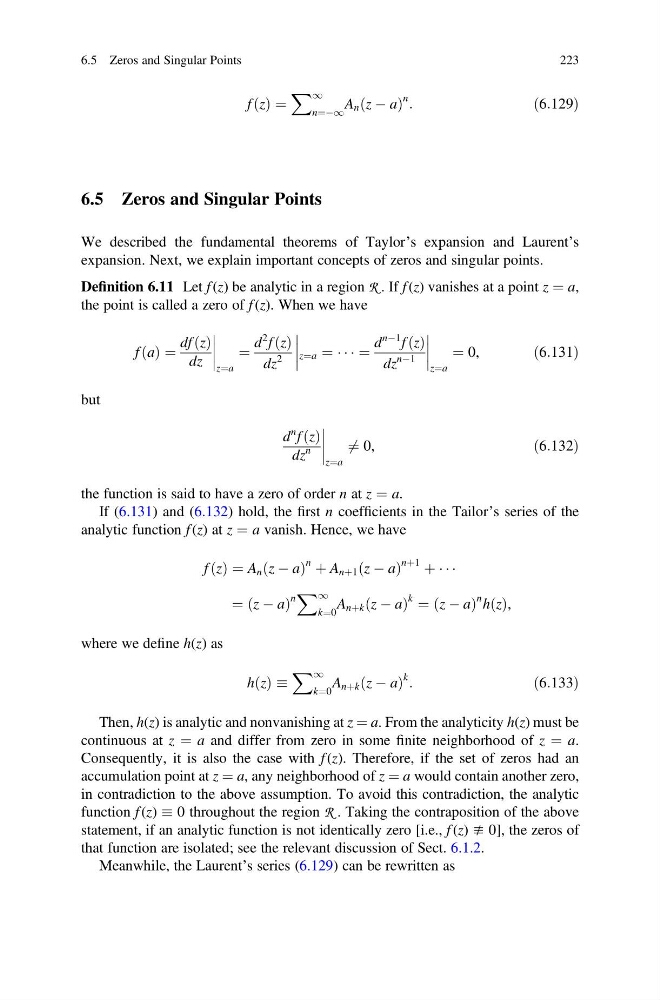
Definition 6.11 Let f (z) be analytic in a region R . If f (z) vanishes at a point z ¼ a,
the point is called a zero of f (z). When we have
f a
ð Þ ¼
df z
ð Þ
dz
z¼a
¼
d
2 f z
ð Þ
dz
2
z¼a ¼ Á Á Á ¼
d
nÀ1 f z
ð Þ
dz
nÀ1
z¼a
¼ 0,
ð6:131Þ
but
d
n f z
ð Þ
dz
n
z¼a
6 ¼ 0,
ð6:132Þ
the function is said to have a zero of order n at z ¼ a.
If (6.131) and (6.132) hold, the first n coefficients in the Tailor’s series of the
analytic function f (z) at z ¼ a vanish. Hence, we have
f z
ð Þ ¼ A n z À a
ð
Þ
n þ A nþ1 z À a
ð
Þ
nþ1 þ Á Á Á
¼ z À a
ð
Þ
n
X 1
k¼0
A nþk z À a
ð
Þ
k ¼ z À a
ð
Þ
n h z
ð Þ,
where we define h(z) as
h z
ð Þ
X 1
k¼0
A nþk z À a
ð
Þ
k :
ð6:133Þ
Then, h(z) is analytic and nonvanishing at z ¼ a. From the analyticity h(z) must be
continuous at z ¼ a and differ from zero in some finite neighborhood of z ¼ a.
Consequently, it is also the case with f (z). Therefore, if the set of zeros had an
accumulation point at z ¼ a, any neighborhood of z ¼ a would contain another zero,
in contradiction to the above assumption. To avoid this contradiction, the analytic
function f (z) 0 throughout the region R . Taking the contraposition of the above
statement, if an analytic function is not identically zero [i.e., f (z) ≢ 0], the zeros of
that function are isolated; see the relevant discussion of Sect. 6.1.2.
Meanwhile, the Laurent’s series (6.129) can be rewritten as
6.5 Zeros and Singular Points
223
ð Þ ¼
X 1
n¼À1
A n z À a
ð
Þ
n :
ð6:129Þ
6.5 Zeros and Singular Points
We described the fundamental theorems of Taylor’s expansion and Laurent’s
expansion. Next, we explain important concepts of zeros and singular points.
Definition 6.11 Let f (z) be analytic in a region R . If f (z) vanishes at a point z ¼ a,
the point is called a zero of f (z). When we have
f a
ð Þ ¼
df z
ð Þ
dz
z¼a
¼
d
2 f z
ð Þ
dz
2
z¼a ¼ Á Á Á ¼
d
nÀ1 f z
ð Þ
dz
nÀ1
z¼a
¼ 0,
ð6:131Þ
but
d
n f z
ð Þ
dz
n
z¼a
6 ¼ 0,
ð6:132Þ
the function is said to have a zero of order n at z ¼ a.
If (6.131) and (6.132) hold, the first n coefficients in the Tailor’s series of the
analytic function f (z) at z ¼ a vanish. Hence, we have
f z
ð Þ ¼ A n z À a
ð
Þ
n þ A nþ1 z À a
ð
Þ
nþ1 þ Á Á Á
¼ z À a
ð
Þ
n
X 1
k¼0
A nþk z À a
ð
Þ
k ¼ z À a
ð
Þ
n h z
ð Þ,
where we define h(z) as
h z
ð Þ
X 1
k¼0
A nþk z À a
ð
Þ
k :
ð6:133Þ
Then, h(z) is analytic and nonvanishing at z ¼ a. From the analyticity h(z) must be
continuous at z ¼ a and differ from zero in some finite neighborhood of z ¼ a.
Consequently, it is also the case with f (z). Therefore, if the set of zeros had an
accumulation point at z ¼ a, any neighborhood of z ¼ a would contain another zero,
in contradiction to the above assumption. To avoid this contradiction, the analytic
function f (z) 0 throughout the region R . Taking the contraposition of the above
statement, if an analytic function is not identically zero [i.e., f (z) ≢ 0], the zeros of
that function are isolated; see the relevant discussion of Sect. 6.1.2.
Meanwhile, the Laurent’s series (6.129) can be rewritten as
6.5 Zeros and Singular Points
223