

f z
ð Þ ¼
X 1
n¼0
1
n!
d
n f a
ð Þ
dz
n
z À a
ð
Þ
n :
This is the same form as that obtained with respect to a real variable.
Equation (6.116) is a uniformly convergent power series called a Taylor’s series
or Taylor’s expansion of f (z) with respect to z ¼ a with A n being its coefficient. In
Theorem 6.14 we have assumed that a union of a circle C and its inside is simply
connected. This topological environment is virtually the same as that of Fig. 6.13. In
Theorem 6.11 (Cauchy’s integral formula) we have shown the integral representation of an analytic function. On the basis of Cauchy’s integral formula, Theorem
6.14 demonstrates that any analytic function is given a tangible functional form.
Example 6.2 Let us think of a function f (z) ¼ 1/z. This function in analytic except
for z ¼ 0. Therefore, it can be expanded in the Taylor’s series in the region ℂ À {0}.
We consider the expansion around z ¼ a (a 6 ¼ 0). Using (6.115), we get the
coefficients of the expansion are
A n ¼
1
2πi
I
C
1
z z À a
ð
Þ
nþ1
dz,
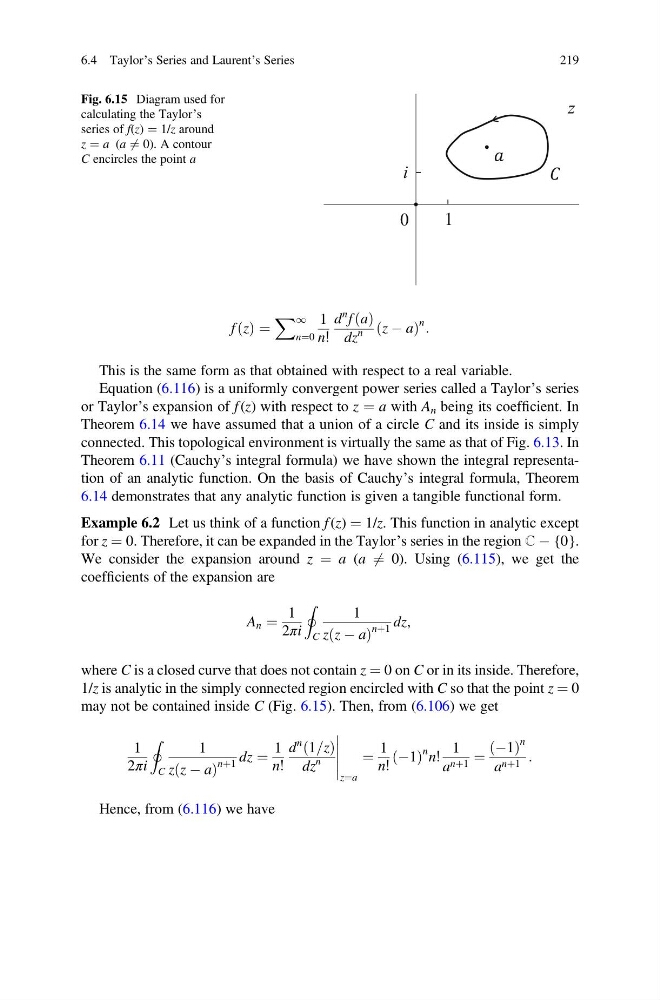
where C is a closed curve that does not contain z ¼ 0 on C or in its inside. Therefore,
1/z is analytic in the simply connected region encircled with C so that the point z ¼ 0
may not be contained inside C (Fig. 6.15). Then, from (6.106) we get
1
2πi
I
C
1
z z À a
ð
Þ
nþ1
dz ¼
1
n!
d
n 1=z
ð Þ
dz
n
z¼a
¼
1
n!
À1
ð Þ
n n!
1
a nþ1 ¼
À1
ð Þ
n
a nþ1 :
Hence, from (6.116) we have
z
1
i
0
Fig. 6.15 Diagram used for
calculating the Taylor’s
series of f(z) ¼ 1/z around
z ¼ a (a 6 ¼ 0). A contour
C encircles the point a
6.4 Taylor’s Series and Laurent’s Series
219
ð Þ ¼
X 1
n¼0
1
n!
d
n f a
ð Þ
dz
n
z À a
ð
Þ
n :
This is the same form as that obtained with respect to a real variable.
Equation (6.116) is a uniformly convergent power series called a Taylor’s series
or Taylor’s expansion of f (z) with respect to z ¼ a with A n being its coefficient. In
Theorem 6.14 we have assumed that a union of a circle C and its inside is simply
connected. This topological environment is virtually the same as that of Fig. 6.13. In
Theorem 6.11 (Cauchy’s integral formula) we have shown the integral representation of an analytic function. On the basis of Cauchy’s integral formula, Theorem
6.14 demonstrates that any analytic function is given a tangible functional form.
Example 6.2 Let us think of a function f (z) ¼ 1/z. This function in analytic except
for z ¼ 0. Therefore, it can be expanded in the Taylor’s series in the region ℂ À {0}.
We consider the expansion around z ¼ a (a 6 ¼ 0). Using (6.115), we get the
coefficients of the expansion are
A n ¼
1
2πi
I
C
1
z z À a
ð
Þ
nþ1
dz,
where C is a closed curve that does not contain z ¼ 0 on C or in its inside. Therefore,
1/z is analytic in the simply connected region encircled with C so that the point z ¼ 0
may not be contained inside C (Fig. 6.15). Then, from (6.106) we get
1
2πi
I
C
1
z z À a
ð
Þ
nþ1
dz ¼
1
n!
d
n 1=z
ð Þ
dz
n
z¼a
¼
1
n!
À1
ð Þ
n n!
1
a nþ1 ¼
À1
ð Þ
n
a nþ1 :
Hence, from (6.116) we have
z
1
i
0
Fig. 6.15 Diagram used for
calculating the Taylor’s
series of f(z) ¼ 1/z around
z ¼ a (a 6 ¼ 0). A contour
C encircles the point a
6.4 Taylor’s Series and Laurent’s Series
219