

X 1
ν¼n
z À a
ð
Þ
ν f ζ
ð Þ
ζ À a
ð
Þ
νþ1
M
r
X 1
ν¼n
ρ
r
ν ¼
M
r
1
1 À
ρ
r
À
1 À
ρ
r
À Á n
1 À
ρ
r
"
#
¼
M
r À ρ
ρ
r
n :
ð6:113Þ
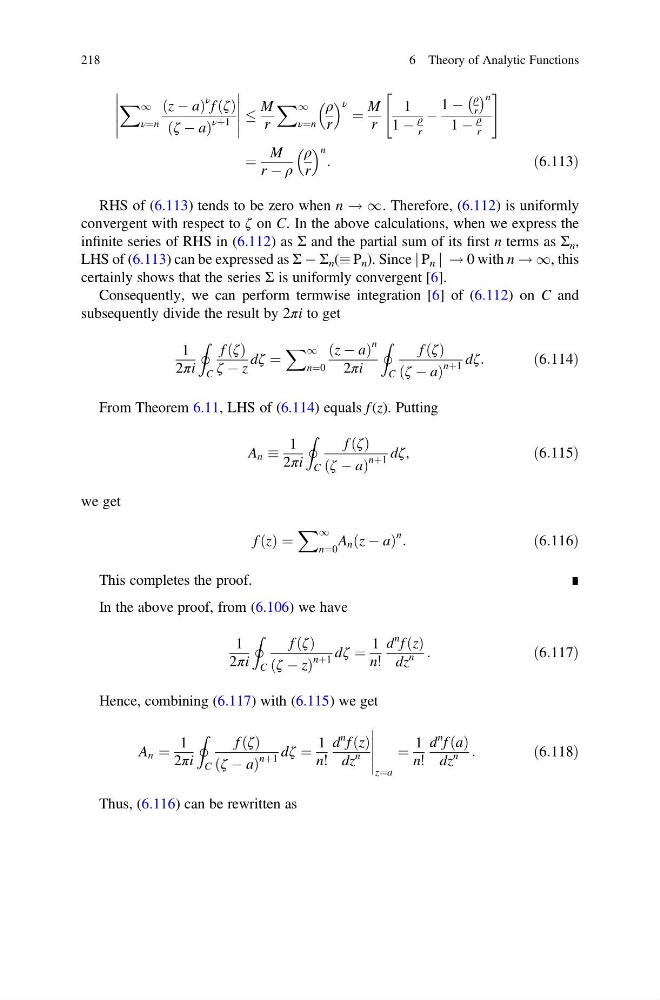
RHS of (6.113) tends to be zero when n ! 1. Therefore, (6.112) is uniformly
convergent with respect to ζ on C. In the above calculations, when we express the
infinite series of RHS in (6.112) as Σ and the partial sum of its first n terms as Σ n ,
LHS of (6.113) can be expressed as Σ À Σ n ( P n ). Since j P n j ! 0 with n ! 1, this
certainly shows that the series Σ is uniformly convergent [6].
Consequently, we can perform termwise integration [6] of (6.112) on C and
subsequently divide the result by 2πi to get
1
2πi
I
C
f ζ
ð Þ
ζ À z
dζ ¼
X 1
n¼0
z À a
ð
Þ
n
2πi
I
C
f ζ
ð Þ
ζ À a
ð
Þ
nþ1
dζ:
ð6:114Þ
From Theorem 6.11, LHS of (6.114) equals f (z). Putting
A n
1
2πi
I
C
f ζ
ð Þ
ζ À a
ð
Þ
nþ1
dζ,
ð6:115Þ
we get
f z
ð Þ ¼
X 1
n¼0
A n z À a
ð
Þ
n :
ð6:116Þ
This completes the proof.
∎
In the above proof, from (6.106) we have
1
2πi
I
C
f ζ
ð Þ
ζ À z
ð
Þ
nþ1
dζ ¼
1
n!
d
n f z
ð Þ
dz
n :
ð6:117Þ
Hence, combining (6.117) with (6.115) we get
A n ¼
1
2πi
I
C
f ζ
ð Þ
ζ À a
ð
Þ
nþ1
dζ ¼
1
n!
d
n f z
ð Þ
dz
n
z¼a
¼
1
n!
d
n f a
ð Þ
dz
n :
ð6:118Þ
Thus, (6.116) can be rewritten as
218
6 Theory of Analytic Functions
ν¼n
z À a
ð
Þ
ν f ζ
ð Þ
ζ À a
ð
Þ
νþ1
M
r
X 1
ν¼n
ρ
r
ν ¼
M
r
1
1 À
ρ
r
À
1 À
ρ
r
À Á n
1 À
ρ
r
"
#
¼
M
r À ρ
ρ
r
n :
ð6:113Þ
RHS of (6.113) tends to be zero when n ! 1. Therefore, (6.112) is uniformly
convergent with respect to ζ on C. In the above calculations, when we express the
infinite series of RHS in (6.112) as Σ and the partial sum of its first n terms as Σ n ,
LHS of (6.113) can be expressed as Σ À Σ n ( P n ). Since j P n j ! 0 with n ! 1, this
certainly shows that the series Σ is uniformly convergent [6].
Consequently, we can perform termwise integration [6] of (6.112) on C and
subsequently divide the result by 2πi to get
1
2πi
I
C
f ζ
ð Þ
ζ À z
dζ ¼
X 1
n¼0
z À a
ð
Þ
n
2πi
I
C
f ζ
ð Þ
ζ À a
ð
Þ
nþ1
dζ:
ð6:114Þ
From Theorem 6.11, LHS of (6.114) equals f (z). Putting
A n
1
2πi
I
C
f ζ
ð Þ
ζ À a
ð
Þ
nþ1
dζ,
ð6:115Þ
we get
f z
ð Þ ¼
X 1
n¼0
A n z À a
ð
Þ
n :
ð6:116Þ
This completes the proof.
∎
In the above proof, from (6.106) we have
1
2πi
I
C
f ζ
ð Þ
ζ À z
ð
Þ
nþ1
dζ ¼
1
n!
d
n f z
ð Þ
dz
n :
ð6:117Þ
Hence, combining (6.117) with (6.115) we get
A n ¼
1
2πi
I
C
f ζ
ð Þ
ζ À a
ð
Þ
nþ1
dζ ¼
1
n!
d
n f z
ð Þ
dz
n
z¼a
¼
1
n!
d
n f a
ð Þ
dz
n :
ð6:118Þ
Thus, (6.116) can be rewritten as
218
6 Theory of Analytic Functions