

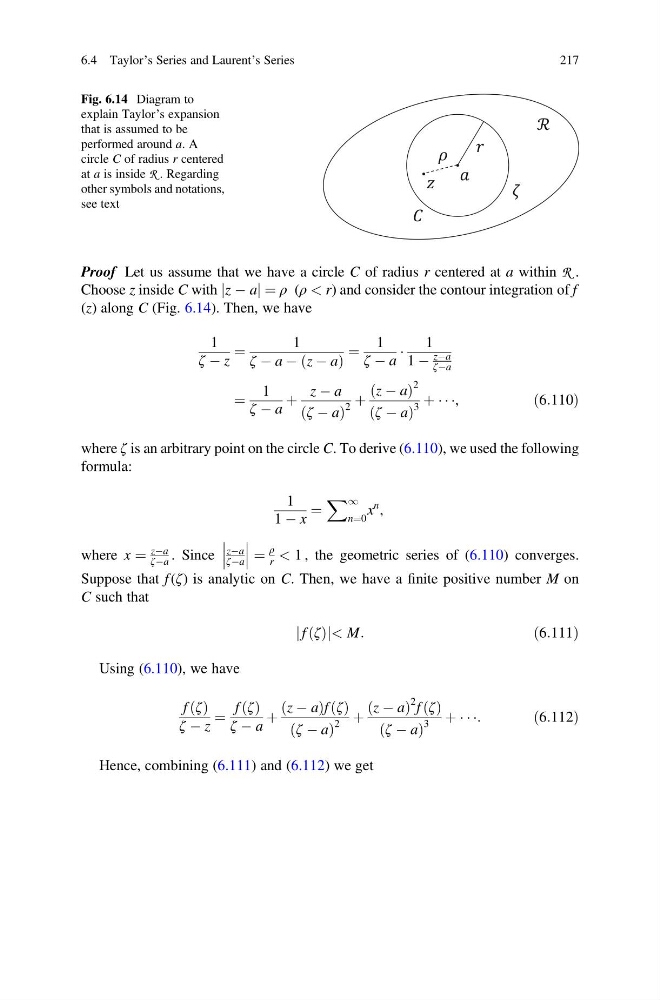
Proof Let us assume that we have a circle C of radius r centered at a within R .
Choose z inside C with jz À aj ¼ ρ (ρ < r) and consider the contour integration of f
(z) along C (Fig. 6.14). Then, we have
1
ζ À z
¼
1
ζ À a À z À a
ð
Þ
¼
1
ζ À a
Á
1
1 À
zÀa
ζÀa
¼
1
ζ À a
þ
z À a
ζ À a
ð
Þ
2
þ
z À a
ð
Þ
2
ζ À a
ð
Þ
3
þ Á Á Á,
ð6:110Þ
where ζ is an arbitrary point on the circle C. To derive (6.110), we used the following
formula:
1
1 À x
¼
X 1
n¼0
x
n ,
where x ¼
zÀa
ζÀa . Since
zÀa
ζÀa
¼
ρ
r < 1 , the geometric series of (6.110) converges.
Suppose that f (ζ) is analytic on C. Then, we have a finite positive number M on
C such that
j f ζ
ð Þj< M:
ð6:111Þ
Using (6.110), we have
f ζ
ð Þ
ζ À z
¼
f ζ
ð Þ
ζ À a
þ
z À a
ð
Þf ζ
ð Þ
ζ À a
ð
Þ
2
þ
z À a
ð
Þ
2 f ζ
ð Þ
ζ À a
ð
Þ
3
þ Á Á Á:
ð6:112Þ
Hence, combining (6.111) and (6.112) we get
ℛ
Fig. 6.14 Diagram to
explain Taylor’s expansion
that is assumed to be
performed around a. A
circle C of radius r centered
at a is inside R . Regarding
other symbols and notations,
see text
6.4 Taylor’s Series and Laurent’s Series
217
Choose z inside C with jz À aj ¼ ρ (ρ < r) and consider the contour integration of f
(z) along C (Fig. 6.14). Then, we have
1
ζ À z
¼
1
ζ À a À z À a
ð
Þ
¼
1
ζ À a
Á
1
1 À
zÀa
ζÀa
¼
1
ζ À a
þ
z À a
ζ À a
ð
Þ
2
þ
z À a
ð
Þ
2
ζ À a
ð
Þ
3
þ Á Á Á,
ð6:110Þ
where ζ is an arbitrary point on the circle C. To derive (6.110), we used the following
formula:
1
1 À x
¼
X 1
n¼0
x
n ,
where x ¼
zÀa
ζÀa . Since
zÀa
ζÀa
¼
ρ
r < 1 , the geometric series of (6.110) converges.
Suppose that f (ζ) is analytic on C. Then, we have a finite positive number M on
C such that
j f ζ
ð Þj< M:
ð6:111Þ
Using (6.110), we have
f ζ
ð Þ
ζ À z
¼
f ζ
ð Þ
ζ À a
þ
z À a
ð
Þf ζ
ð Þ
ζ À a
ð
Þ
2
þ
z À a
ð
Þ
2 f ζ
ð Þ
ζ À a
ð
Þ
3
þ Á Á Á:
ð6:112Þ
Hence, combining (6.111) and (6.112) we get
ℛ
Fig. 6.14 Diagram to
explain Taylor’s expansion
that is assumed to be
performed around a. A
circle C of radius r centered
at a is inside R . Regarding
other symbols and notations,
see text
6.4 Taylor’s Series and Laurent’s Series
217