

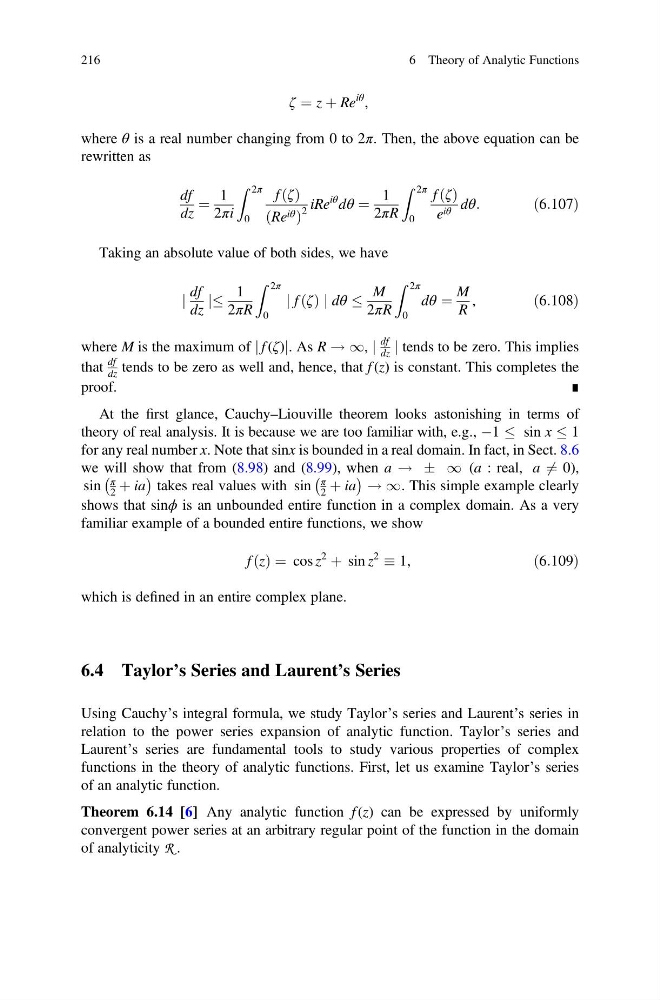
ζ ¼ z þ Re
iθ ,
where θ is a real number changing from 0 to 2π. Then, the above equation can be
rewritten as
df
dz
¼
1
2πi
Z 2π
0
f ζ
ð Þ
Re iθ
ð
Þ
2
iRe
iθ dθ ¼
1
2πR
Z 2π
0
f ζ
ð Þ
e iθ dθ:
ð6:107Þ
Taking an absolute value of both sides, we have
j
df
dz
j
1
2πR
Z 2π
0
j f ζ
ð Þ j dθ
M
2πR
Z 2π
0
dθ ¼
M
R
,
ð6:108Þ
where M is the maximum of j f (ζ)j. As R ! 1, j
df
dz j tends to be zero. This implies
that
df
dz tends to be zero as well and, hence, that f (z) is constant. This completes the
proof.
∎
At the first glance, Cauchy–Liouville theorem looks astonishing in terms of
theory of real analysis. It is because we are too familiar with, e.g., À1
sin x 1
for any real number x. Note that sinx is bounded in a real domain. In fact, in Sect. 8.6
we will show that from (8.98) and (8.99), when a ! Æ 1 (a : real, a 6 ¼ 0),
sin
π
2 þ ia
À
Á
takes real values with sin
π
2 þ ia
À
Á ! 1. This simple example clearly
shows that sinϕ is an unbounded entire function in a complex domain. As a very
familiar example of a bounded entire functions, we show
f z
ð Þ ¼ cos z
2
þ sin z
2
1,
ð6:109Þ
which is defined in an entire complex plane.
6.4 Taylor’s Series and Laurent’s Series
Using Cauchy’s integral formula, we study Taylor’s series and Laurent’s series in
relation to the power series expansion of analytic function. Taylor’s series and
Laurent’s series are fundamental tools to study various properties of complex
functions in the theory of analytic functions. First, let us examine Taylor’s series
of an analytic function.
Theorem 6.14 [6] Any analytic function f (z) can be expressed by uniformly
convergent power series at an arbitrary regular point of the function in the domain
of analyticity R .
216
6 Theory of Analytic Functions
iθ ,
where θ is a real number changing from 0 to 2π. Then, the above equation can be
rewritten as
df
dz
¼
1
2πi
Z 2π
0
f ζ
ð Þ
Re iθ
ð
Þ
2
iRe
iθ dθ ¼
1
2πR
Z 2π
0
f ζ
ð Þ
e iθ dθ:
ð6:107Þ
Taking an absolute value of both sides, we have
j
df
dz
j
1
2πR
Z 2π
0
j f ζ
ð Þ j dθ
M
2πR
Z 2π
0
dθ ¼
M
R
,
ð6:108Þ
where M is the maximum of j f (ζ)j. As R ! 1, j
df
dz j tends to be zero. This implies
that
df
dz tends to be zero as well and, hence, that f (z) is constant. This completes the
proof.
∎
At the first glance, Cauchy–Liouville theorem looks astonishing in terms of
theory of real analysis. It is because we are too familiar with, e.g., À1
sin x 1
for any real number x. Note that sinx is bounded in a real domain. In fact, in Sect. 8.6
we will show that from (8.98) and (8.99), when a ! Æ 1 (a : real, a 6 ¼ 0),
sin
π
2 þ ia
À
Á
takes real values with sin
π
2 þ ia
À
Á ! 1. This simple example clearly
shows that sinϕ is an unbounded entire function in a complex domain. As a very
familiar example of a bounded entire functions, we show
f z
ð Þ ¼ cos z
2
þ sin z
2
1,
ð6:109Þ
which is defined in an entire complex plane.
6.4 Taylor’s Series and Laurent’s Series
Using Cauchy’s integral formula, we study Taylor’s series and Laurent’s series in
relation to the power series expansion of analytic function. Taylor’s series and
Laurent’s series are fundamental tools to study various properties of complex
functions in the theory of analytic functions. First, let us examine Taylor’s series
of an analytic function.
Theorem 6.14 [6] Any analytic function f (z) can be expressed by uniformly
convergent power series at an arbitrary regular point of the function in the domain
of analyticity R .
216
6 Theory of Analytic Functions