

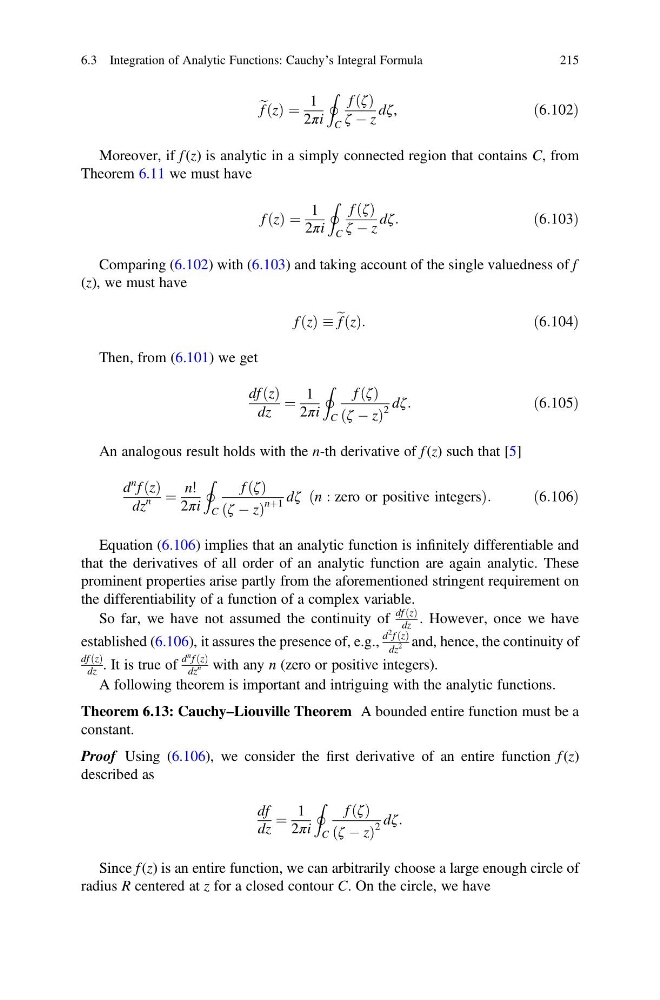
e f z
ð Þ ¼
1
2πi
I
C
f ζ
ð Þ
ζ À z
dζ,
ð6:102Þ
Moreover, if f (z) is analytic in a simply connected region that contains C, from
Theorem 6.11 we must have
f z
ð Þ ¼
1
2πi
I
C
f ζ
ð Þ
ζ À z
dζ:
ð6:103Þ
Comparing (6.102) with (6.103) and taking account of the single valuedness of f
(z), we must have
f z
ð Þ e f z
ð Þ:
ð6:104Þ
Then, from (6.101) we get
df z
ð Þ
dz
¼
1
2πi
I
C
f ζ
ð Þ
ζ À z
ð
Þ
2
dζ:
ð6:105Þ
An analogous result holds with the n-th derivative of f (z) such that [5]
d
n f z
ð Þ
dz
n ¼
n!
2πi
I
C
f ζ
ð Þ
ζ À z
ð
Þ
nþ1
dζ n : zero or positive integers
ð
Þ :
ð6:106Þ
Equation (6.106) implies that an analytic function is infinitely differentiable and
that the derivatives of all order of an analytic function are again analytic. These
prominent properties arise partly from the aforementioned stringent requirement on
the differentiability of a function of a complex variable.
So far, we have not assumed the continuity of
df z
ð Þ
dz . However, once we have
established (6.106), it assures the presence of, e.g.,
d
2 f z
ð Þ
dz
2 and, hence, the continuity of
df z
ð Þ
dz . It is true of
d
n f z
ð Þ
dz
n
with any n (zero or positive integers).
A following theorem is important and intriguing with the analytic functions.
Theorem 6.13: Cauchy–Liouville Theorem A bounded entire function must be a
constant.
Proof Using (6.106), we consider the first derivative of an entire function f (z)
described as
df
dz
¼
1
2πi
I
C
f ζ
ð Þ
ζ À z
ð
Þ
2
dζ:
Since f (z) is an entire function, we can arbitrarily choose a large enough circle of
radius R centered at z for a closed contour C. On the circle, we have
6.3 Integration of Analytic Functions: Cauchy’s Integral Formula
215
ð Þ ¼
1
2πi
I
C
f ζ
ð Þ
ζ À z
dζ,
ð6:102Þ
Moreover, if f (z) is analytic in a simply connected region that contains C, from
Theorem 6.11 we must have
f z
ð Þ ¼
1
2πi
I
C
f ζ
ð Þ
ζ À z
dζ:
ð6:103Þ
Comparing (6.102) with (6.103) and taking account of the single valuedness of f
(z), we must have
f z
ð Þ e f z
ð Þ:
ð6:104Þ
Then, from (6.101) we get
df z
ð Þ
dz
¼
1
2πi
I
C
f ζ
ð Þ
ζ À z
ð
Þ
2
dζ:
ð6:105Þ
An analogous result holds with the n-th derivative of f (z) such that [5]
d
n f z
ð Þ
dz
n ¼
n!
2πi
I
C
f ζ
ð Þ
ζ À z
ð
Þ
nþ1
dζ n : zero or positive integers
ð
Þ :
ð6:106Þ
Equation (6.106) implies that an analytic function is infinitely differentiable and
that the derivatives of all order of an analytic function are again analytic. These
prominent properties arise partly from the aforementioned stringent requirement on
the differentiability of a function of a complex variable.
So far, we have not assumed the continuity of
df z
ð Þ
dz . However, once we have
established (6.106), it assures the presence of, e.g.,
d
2 f z
ð Þ
dz
2 and, hence, the continuity of
df z
ð Þ
dz . It is true of
d
n f z
ð Þ
dz
n
with any n (zero or positive integers).
A following theorem is important and intriguing with the analytic functions.
Theorem 6.13: Cauchy–Liouville Theorem A bounded entire function must be a
constant.
Proof Using (6.106), we consider the first derivative of an entire function f (z)
described as
df
dz
¼
1
2πi
I
C
f ζ
ð Þ
ζ À z
ð
Þ
2
dζ:
Since f (z) is an entire function, we can arbitrarily choose a large enough circle of
radius R centered at z for a closed contour C. On the circle, we have
6.3 Integration of Analytic Functions: Cauchy’s Integral Formula
215