

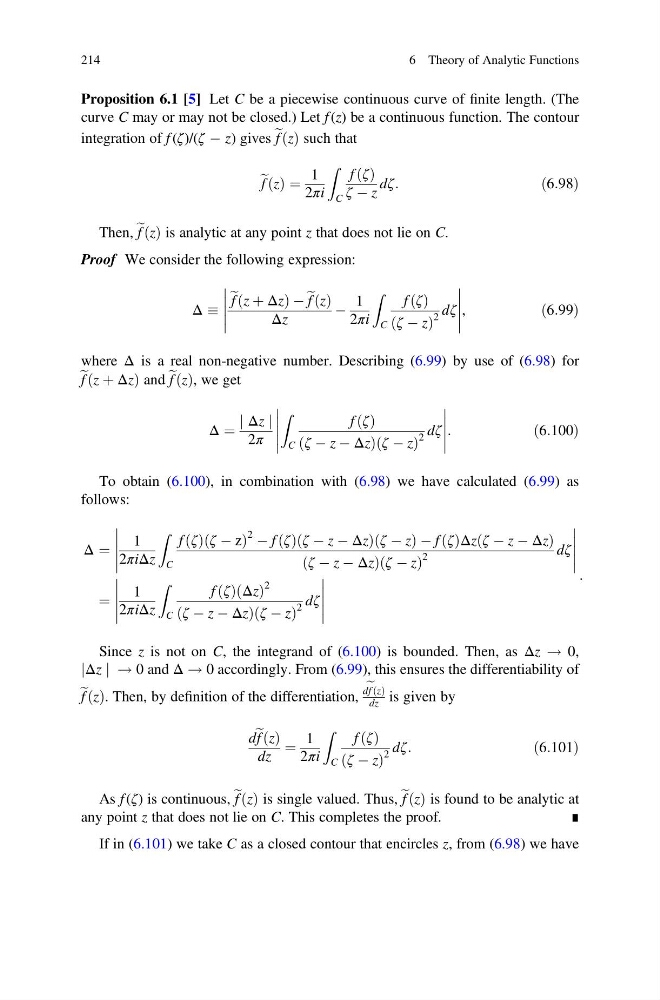
Proposition 6.1 [5] Let C be a piecewise continuous curve of finite length. (The
curve C may or may not be closed.) Let f (z) be a continuous function. The contour
integration of f (ζ)/(ζ À z) gives e f z
ð Þ such that
e f z
ð Þ ¼
1
2πi
Z
C
f ζ
ð Þ
ζ À z
dζ:
ð6:98Þ
Then, e f z
ð Þ is analytic at any point z that does not lie on C.
Proof We consider the following expression:
Δ
e f z þ Δz
ð
ÞÀ e f z
ð Þ
Δz
À
1
2πi
Z
C
f ζ
ð Þ
ζ À z
ð
Þ
2
dζ
,
ð6:99Þ
where Δ is a real non-negative number. Describing (6.99) by use of (6.98) for
e f z þ Δz
ð
Þand e f z
ð Þ, we get
Δ ¼
j Δz j
2π
Z
C
f ζ
ð Þ
ζ À z À Δz
ð
Þζ À z
ð
Þ
2
dζ
:
ð6:100Þ
To obtain (6.100), in combination with (6.98) we have calculated (6.99) as
follows:
Δ ¼
1
2πiΔz
Z
C
f ζ
ð Þ ζ À z
ð
Þ
2 À f ζ
ð Þ ζ À z À Δz
ð
Þζ À z
ð
ÞÀf ζ
ð ÞΔz ζ À z À Δz
ð
Þ
ζ À z À Δz
ð
Þζ À z
ð
Þ
2
dζ
¼
1
2πiΔz
Z
C
f ζ
ð Þ Δz
ð Þ
2
ζ À z À Δz
ð
Þζ À z
ð
Þ
2
dζ
:
Since z is not on C, the integrand of (6.100) is bounded. Then, as Δz ! 0,
jΔz j ! 0 and Δ ! 0 accordingly. From (6.99), this ensures the differentiability of
e f z
ð Þ. Then, by definition of the differentiation,
d e f z
ð Þ
dz is given by
d e f z
ð Þ
dz
¼
1
2πi
Z
C
f ζ
ð Þ
ζ À z
ð
Þ
2
dζ:
ð6:101Þ
As f (ζ) is continuous, e f z
ð Þ is single valued. Thus, e f z
ð Þ is found to be analytic at
any point z that does not lie on C. This completes the proof.
∎
If in (6.101) we take C as a closed contour that encircles z, from (6.98) we have
214
6 Theory of Analytic Functions
curve C may or may not be closed.) Let f (z) be a continuous function. The contour
integration of f (ζ)/(ζ À z) gives e f z
ð Þ such that
e f z
ð Þ ¼
1
2πi
Z
C
f ζ
ð Þ
ζ À z
dζ:
ð6:98Þ
Then, e f z
ð Þ is analytic at any point z that does not lie on C.
Proof We consider the following expression:
Δ
e f z þ Δz
ð
ÞÀ e f z
ð Þ
Δz
À
1
2πi
Z
C
f ζ
ð Þ
ζ À z
ð
Þ
2
dζ
,
ð6:99Þ
where Δ is a real non-negative number. Describing (6.99) by use of (6.98) for
e f z þ Δz
ð
Þand e f z
ð Þ, we get
Δ ¼
j Δz j
2π
Z
C
f ζ
ð Þ
ζ À z À Δz
ð
Þζ À z
ð
Þ
2
dζ
:
ð6:100Þ
To obtain (6.100), in combination with (6.98) we have calculated (6.99) as
follows:
Δ ¼
1
2πiΔz
Z
C
f ζ
ð Þ ζ À z
ð
Þ
2 À f ζ
ð Þ ζ À z À Δz
ð
Þζ À z
ð
ÞÀf ζ
ð ÞΔz ζ À z À Δz
ð
Þ
ζ À z À Δz
ð
Þζ À z
ð
Þ
2
dζ
¼
1
2πiΔz
Z
C
f ζ
ð Þ Δz
ð Þ
2
ζ À z À Δz
ð
Þζ À z
ð
Þ
2
dζ
:
Since z is not on C, the integrand of (6.100) is bounded. Then, as Δz ! 0,
jΔz j ! 0 and Δ ! 0 accordingly. From (6.99), this ensures the differentiability of
e f z
ð Þ. Then, by definition of the differentiation,
d e f z
ð Þ
dz is given by
d e f z
ð Þ
dz
¼
1
2πi
Z
C
f ζ
ð Þ
ζ À z
ð
Þ
2
dζ:
ð6:101Þ
As f (ζ) is continuous, e f z
ð Þ is single valued. Thus, e f z
ð Þ is found to be analytic at
any point z that does not lie on C. This completes the proof.
∎
If in (6.101) we take C as a closed contour that encircles z, from (6.98) we have
214
6 Theory of Analytic Functions