

j
Z
C
f z
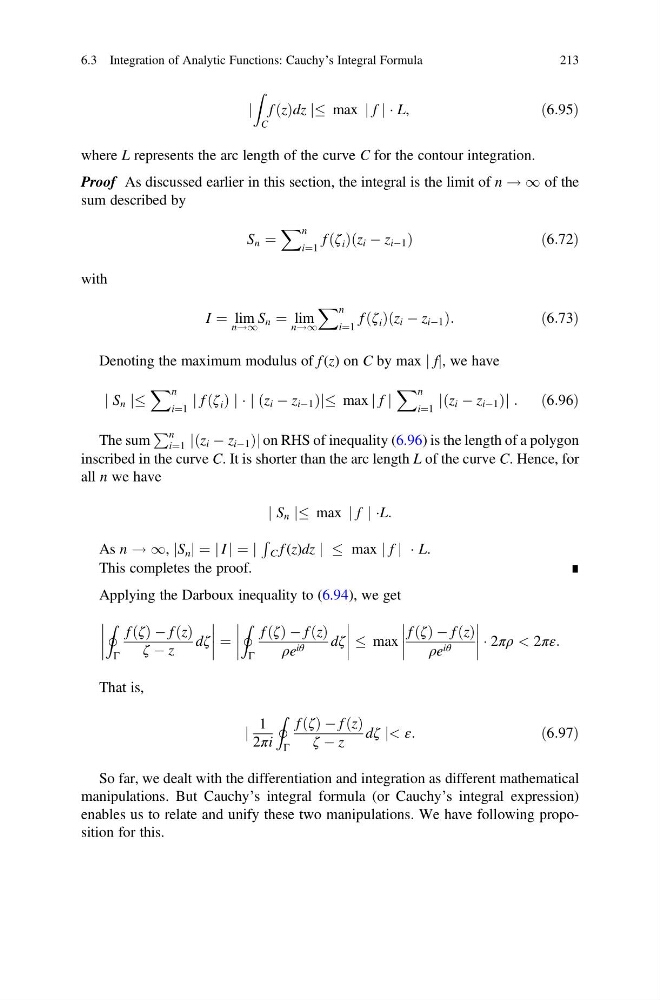
ð Þdz j max j f j Á L,
ð6:95Þ
where L represents the arc length of the curve C for the contour integration.
Proof As discussed earlier in this section, the integral is the limit of n ! 1 of the
sum described by
S n ¼
X n
i¼1
f ζ i
ð Þ z i À z iÀ1
ð
Þ
ð 6:72Þ
with
I ¼ lim
n!1
S n ¼ lim
n!1
X n
i¼1
f ζ i
ð Þ z i À z iÀ1
ð
Þ :
ð6:73Þ
Denoting the maximum modulus of f (z) on C by max j fj, we have
j S n j
X n
i¼1
j f ζ i
ð Þ j Á j z i À z iÀ1
ð
Þ j max j f j
X n
i¼1
j z i À z iÀ1
ð
Þ j:
ð6:96Þ
The sum
P n
i¼1 j z i À z iÀ1
ð
Þ jon RHS of inequality (6.96) is the length of a polygon
inscribed in the curve C. It is shorter than the arc length L of the curve C. Hence, for
all n we have
j S n j max j f j ÁL:
As n ! 1, jS n j ¼ j I j ¼ j
R
C f (z)dz j
max j f j Á L.
This completes the proof.
∎
Applying the Darboux inequality to (6.94), we get
I
Γ
f ζ
ð Þ À f z
ð Þ
ζ À z
dζ
¼
I
Γ
f ζ
ð Þ À f z
ð Þ
ρe iθ
dζ
max
f ζ
ð Þ À f z
ð Þ
ρe iθ
Á 2πρ < 2πε:
That is,
j
1
2πi
I
Γ
f ζ
ð Þ À f z
ð Þ
ζ À z
dζ j< ε:
ð6:97Þ
So far, we dealt with the differentiation and integration as different mathematical
manipulations. But Cauchy’s integral formula (or Cauchy’s integral expression)
enables us to relate and unify these two manipulations. We have following proposition for this.
6.3 Integration of Analytic Functions: Cauchy’s Integral Formula
213
Z
C
f z
ð Þdz j max j f j Á L,
ð6:95Þ
where L represents the arc length of the curve C for the contour integration.
Proof As discussed earlier in this section, the integral is the limit of n ! 1 of the
sum described by
S n ¼
X n
i¼1
f ζ i
ð Þ z i À z iÀ1
ð
Þ
ð 6:72Þ
with
I ¼ lim
n!1
S n ¼ lim
n!1
X n
i¼1
f ζ i
ð Þ z i À z iÀ1
ð
Þ :
ð6:73Þ
Denoting the maximum modulus of f (z) on C by max j fj, we have
j S n j
X n
i¼1
j f ζ i
ð Þ j Á j z i À z iÀ1
ð
Þ j max j f j
X n
i¼1
j z i À z iÀ1
ð
Þ j:
ð6:96Þ
The sum
P n
i¼1 j z i À z iÀ1
ð
Þ jon RHS of inequality (6.96) is the length of a polygon
inscribed in the curve C. It is shorter than the arc length L of the curve C. Hence, for
all n we have
j S n j max j f j ÁL:
As n ! 1, jS n j ¼ j I j ¼ j
R
C f (z)dz j
max j f j Á L.
This completes the proof.
∎
Applying the Darboux inequality to (6.94), we get
I
Γ
f ζ
ð Þ À f z
ð Þ
ζ À z
dζ
¼
I
Γ
f ζ
ð Þ À f z
ð Þ
ρe iθ
dζ
max
f ζ
ð Þ À f z
ð Þ
ρe iθ
Á 2πρ < 2πε:
That is,
j
1
2πi
I
Γ
f ζ
ð Þ À f z
ð Þ
ζ À z
dζ j< ε:
ð6:97Þ
So far, we dealt with the differentiation and integration as different mathematical
manipulations. But Cauchy’s integral formula (or Cauchy’s integral expression)
enables us to relate and unify these two manipulations. We have following proposition for this.
6.3 Integration of Analytic Functions: Cauchy’s Integral Formula
213