

I
Γ
dζ
ζ À z
¼
Z 2π
0
idθ ¼ 2πi:
ð6:92Þ
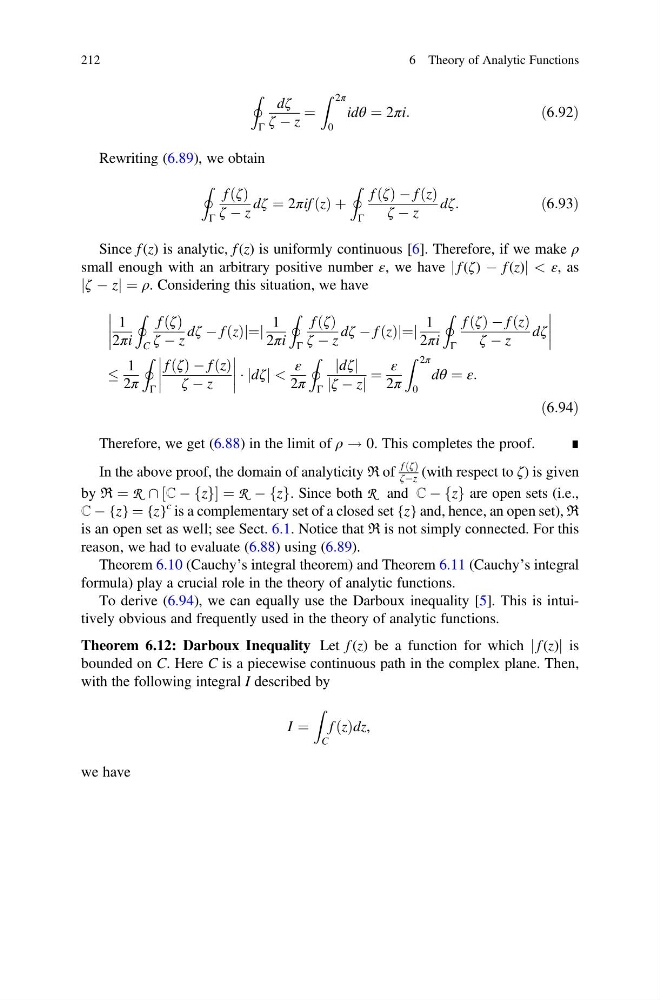
Rewriting (6.89), we obtain
I
Γ
f ζ
ð Þ
ζ À z
dζ ¼ 2πif z
ð Þ þ
I
Γ
f ζ
ð Þ À f z
ð Þ
ζ À z
dζ:
ð6:93Þ
Since f (z) is analytic, f (z) is uniformly continuous [6]. Therefore, if we make ρ
small enough with an arbitrary positive number ε, we have j f (ζ) À f (z)j < ε, as
jζ À zj ¼ ρ. Considering this situation, we have
1
2πi
I
C
f ζ
ð Þ
ζ À z
dζ À f z
ð Þ ¼
j j
1
2πi
I
Γ
f ζ
ð Þ
ζ À z
dζ À f z
ð Þ ¼
j j
1
2πi
I
Γ
f ζ
ð Þ À f z
ð Þ
ζ À z
dζ
1
2π
I
Γ
f ζ
ð Þ À f z
ð Þ
ζ À z
Á dζ
j j <
ε
2π
I
Γ
dζ
j j
ζ À z
j
j
¼
ε
2π
Z 2π
0
dθ ¼ ε:
ð6:94Þ
Therefore, we get (6.88) in the limit of ρ ! 0. This completes the proof.
∎
In the above proof, the domain of analyticity R of
f ζ
ð Þ
ζÀz (with respect to ζ) is given
by R ¼ R \ ℂ À z
f g
½
¼R À z
f g. Since both R and ℂ À z
f g are open sets (i.e.,
ℂ À {z} ¼ {z}
c is a complementary set of a closed set {z} and, hence, an open set), R
is an open set as well; see Sect. 6.1. Notice that R is not simply connected. For this
reason, we had to evaluate (6.88) using (6.89).
Theorem 6.10 (Cauchy’s integral theorem) and Theorem 6.11 (Cauchy’s integral
formula) play a crucial role in the theory of analytic functions.
To derive (6.94), we can equally use the Darboux inequality [5]. This is intuitively obvious and frequently used in the theory of analytic functions.
Theorem 6.12: Darboux Inequality Let f (z) be a function for which j f (z)j is
bounded on C. Here C is a piecewise continuous path in the complex plane. Then,
with the following integral I described by
I ¼
Z
C
f z
ð Þdz,
we have
212
6 Theory of Analytic Functions
Γ
dζ
ζ À z
¼
Z 2π
0
idθ ¼ 2πi:
ð6:92Þ
Rewriting (6.89), we obtain
I
Γ
f ζ
ð Þ
ζ À z
dζ ¼ 2πif z
ð Þ þ
I
Γ
f ζ
ð Þ À f z
ð Þ
ζ À z
dζ:
ð6:93Þ
Since f (z) is analytic, f (z) is uniformly continuous [6]. Therefore, if we make ρ
small enough with an arbitrary positive number ε, we have j f (ζ) À f (z)j < ε, as
jζ À zj ¼ ρ. Considering this situation, we have
1
2πi
I
C
f ζ
ð Þ
ζ À z
dζ À f z
ð Þ ¼
j j
1
2πi
I
Γ
f ζ
ð Þ
ζ À z
dζ À f z
ð Þ ¼
j j
1
2πi
I
Γ
f ζ
ð Þ À f z
ð Þ
ζ À z
dζ
1
2π
I
Γ
f ζ
ð Þ À f z
ð Þ
ζ À z
Á dζ
j j <
ε
2π
I
Γ
dζ
j j
ζ À z
j
j
¼
ε
2π
Z 2π
0
dθ ¼ ε:
ð6:94Þ
Therefore, we get (6.88) in the limit of ρ ! 0. This completes the proof.
∎
In the above proof, the domain of analyticity R of
f ζ
ð Þ
ζÀz (with respect to ζ) is given
by R ¼ R \ ℂ À z
f g
½
¼R À z
f g. Since both R and ℂ À z
f g are open sets (i.e.,
ℂ À {z} ¼ {z}
c is a complementary set of a closed set {z} and, hence, an open set), R
is an open set as well; see Sect. 6.1. Notice that R is not simply connected. For this
reason, we had to evaluate (6.88) using (6.89).
Theorem 6.10 (Cauchy’s integral theorem) and Theorem 6.11 (Cauchy’s integral
formula) play a crucial role in the theory of analytic functions.
To derive (6.94), we can equally use the Darboux inequality [5]. This is intuitively obvious and frequently used in the theory of analytic functions.
Theorem 6.12: Darboux Inequality Let f (z) be a function for which j f (z)j is
bounded on C. Here C is a piecewise continuous path in the complex plane. Then,
with the following integral I described by
I ¼
Z
C
f z
ð Þdz,
we have
212
6 Theory of Analytic Functions