

where Γ i is taken so that it can encircle individual singular points. Reflecting the
nature of singularity, we get different results with (6.87). We will come back to this
point later.
On the basis of Cauchy’s integral theorem, we show an integral representation of
an analytic function that is well known as Cauchy’s integral formula.
Theorem 6.11: Cauchy’s Integral Formula Let f (z) be analytic in a simply
connected region R . Let C be an arbitrary closed curve within R that encircles z.
Then, we have
f z
ð Þ ¼
1
2πi
I
C
f ζ
ð Þ
ζ À z
dζ,
ð6:88Þ
where the contour integration along C is taken in the counterclockwise direction.
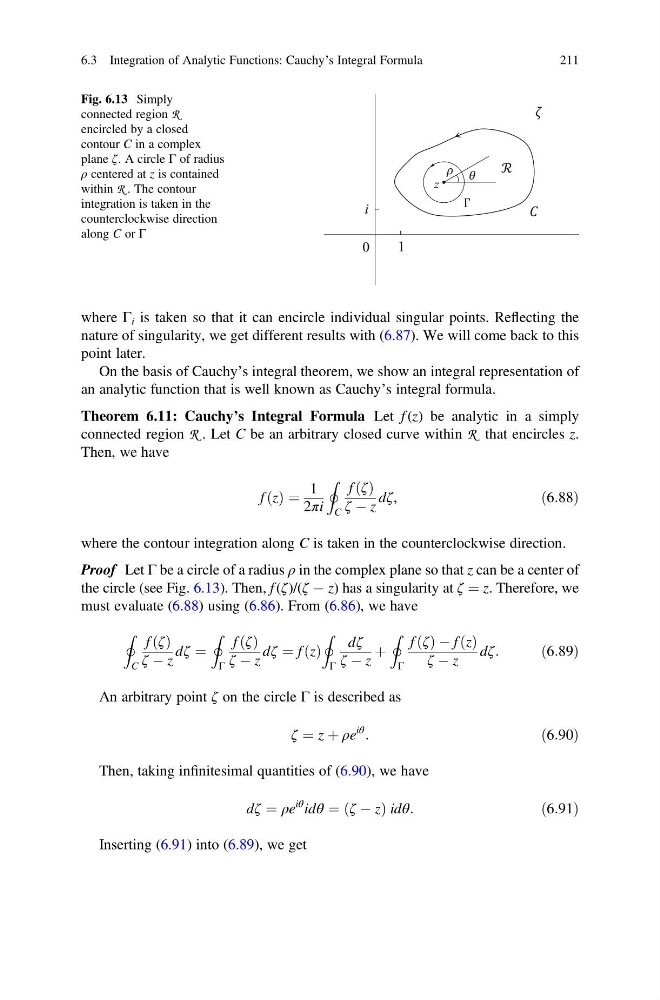
Proof Let Γ be a circle of a radius ρ in the complex plane so that z can be a center of
the circle (see Fig. 6.13). Then, f (ζ)/(ζ À z) has a singularity at ζ ¼ z. Therefore, we
must evaluate (6.88) using (6.86). From (6.86), we have
I
C
f ζ
ð Þ
ζ À z
dζ ¼
I
Γ
f ζ
ð Þ
ζ À z
dζ ¼ f z
ð Þ
I
Γ
dζ
ζ À z
þ
I
Γ
f ζ
ð Þ À f z
ð Þ
ζ À z
dζ:
ð6:89Þ
An arbitrary point ζ on the circle Γ is described as
ζ ¼ z þ ρe
iθ
:
ð6:90Þ
Then, taking infinitesimal quantities of (6.90), we have
dζ ¼ ρe
iθ idθ ¼ ζ À z
ð
Þidθ:
ð6:91Þ
Inserting (6.91) into (6.89), we get
1
i
0
z
Γ
ℛ
Fig. 6.13 Simply
connected region R
encircled by a closed
contour C in a complex
plane ζ. A circle Γ of radius
ρ centered at z is contained
within R . The contour
integration is taken in the
counterclockwise direction
along C or Γ
6.3 Integration of Analytic Functions: Cauchy’s Integral Formula
211
nature of singularity, we get different results with (6.87). We will come back to this
point later.
On the basis of Cauchy’s integral theorem, we show an integral representation of
an analytic function that is well known as Cauchy’s integral formula.
Theorem 6.11: Cauchy’s Integral Formula Let f (z) be analytic in a simply
connected region R . Let C be an arbitrary closed curve within R that encircles z.
Then, we have
f z
ð Þ ¼
1
2πi
I
C
f ζ
ð Þ
ζ À z
dζ,
ð6:88Þ
where the contour integration along C is taken in the counterclockwise direction.
Proof Let Γ be a circle of a radius ρ in the complex plane so that z can be a center of
the circle (see Fig. 6.13). Then, f (ζ)/(ζ À z) has a singularity at ζ ¼ z. Therefore, we
must evaluate (6.88) using (6.86). From (6.86), we have
I
C
f ζ
ð Þ
ζ À z
dζ ¼
I
Γ
f ζ
ð Þ
ζ À z
dζ ¼ f z
ð Þ
I
Γ
dζ
ζ À z
þ
I
Γ
f ζ
ð Þ À f z
ð Þ
ζ À z
dζ:
ð6:89Þ
An arbitrary point ζ on the circle Γ is described as
ζ ¼ z þ ρe
iθ
:
ð6:90Þ
Then, taking infinitesimal quantities of (6.90), we have
dζ ¼ ρe
iθ idθ ¼ ζ À z
ð
Þidθ:
ð6:91Þ
Inserting (6.91) into (6.89), we get
1
i
0
z
Γ
ℛ
Fig. 6.13 Simply
connected region R
encircled by a closed
contour C in a complex
plane ζ. A circle Γ of radius
ρ centered at z is contained
within R . The contour
integration is taken in the
counterclockwise direction
along C or Γ
6.3 Integration of Analytic Functions: Cauchy’s Integral Formula
211