

contained in the domain of analyticity of f (z) and that f (z) can be analytic in the
entire region R . Moreover, we must choose R so that the whole region inside any
closed paths within R can contain only the points that belong to the domain of
analyticity of f (z). That is, the region R must be simply connected in terms of the
analyticity of f (z) (see Sect. 6.1). For a region R to be simply connected ensures that
(6.80) holds with any pair of points z a and z b in R , so far as the integration path with
respect to (6.80) is contained in R .
From (6.80), we further get
Z z b
z a
f z
ð Þdz þ
Z z a
z b
f z
ð Þdz ¼ 0:
ð6:81Þ
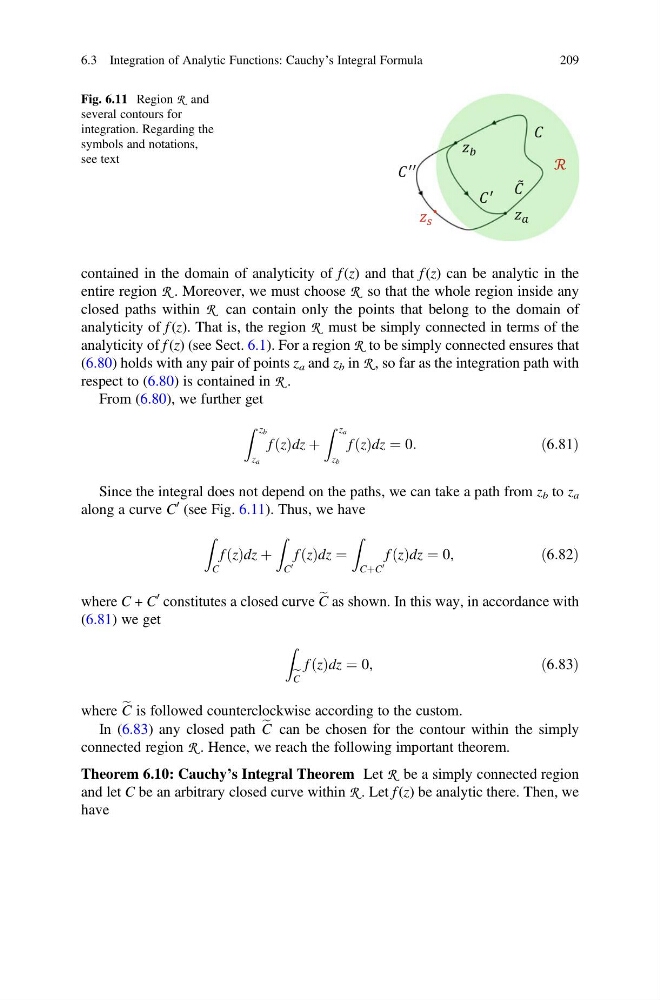
Since the integral does not depend on the paths, we can take a path from z b to z a
along a curve C
0 (see Fig. 6.11). Thus, we have
Z
C
f z
ð Þdz þ
Z
C
0
f z
ð Þdz ¼
Z
CþC
0
f z
ð Þdz ¼ 0,
ð6:82Þ
where C + C
0 constitutes a closed curve e
C as shown. In this way, in accordance with
(6.81) we get
Z
e C
f z
ð Þdz ¼ 0,
ð6:83Þ
where e
C is followed counterclockwise according to the custom.
In (6.83) any closed path e
C can be chosen for the contour within the simply
connected region R . Hence, we reach the following important theorem.
Theorem 6.10: Cauchy’s Integral Theorem Let R be a simply connected region
and let C be an arbitrary closed curve within R . Let f (z) be analytic there. Then, we
have
ℛ
Fig. 6.11 Region R and
several contours for
integration. Regarding the
symbols and notations,
see text
6.3 Integration of Analytic Functions: Cauchy’s Integral Formula
209
entire region R . Moreover, we must choose R so that the whole region inside any
closed paths within R can contain only the points that belong to the domain of
analyticity of f (z). That is, the region R must be simply connected in terms of the
analyticity of f (z) (see Sect. 6.1). For a region R to be simply connected ensures that
(6.80) holds with any pair of points z a and z b in R , so far as the integration path with
respect to (6.80) is contained in R .
From (6.80), we further get
Z z b
z a
f z
ð Þdz þ
Z z a
z b
f z
ð Þdz ¼ 0:
ð6:81Þ
Since the integral does not depend on the paths, we can take a path from z b to z a
along a curve C
0 (see Fig. 6.11). Thus, we have
Z
C
f z
ð Þdz þ
Z
C
0
f z
ð Þdz ¼
Z
CþC
0
f z
ð Þdz ¼ 0,
ð6:82Þ
where C + C
0 constitutes a closed curve e
C as shown. In this way, in accordance with
(6.81) we get
Z
e C
f z
ð Þdz ¼ 0,
ð6:83Þ
where e
C is followed counterclockwise according to the custom.
In (6.83) any closed path e
C can be chosen for the contour within the simply
connected region R . Hence, we reach the following important theorem.
Theorem 6.10: Cauchy’s Integral Theorem Let R be a simply connected region
and let C be an arbitrary closed curve within R . Let f (z) be analytic there. Then, we
have
ℛ
Fig. 6.11 Region R and
several contours for
integration. Regarding the
symbols and notations,
see text
6.3 Integration of Analytic Functions: Cauchy’s Integral Formula
209