

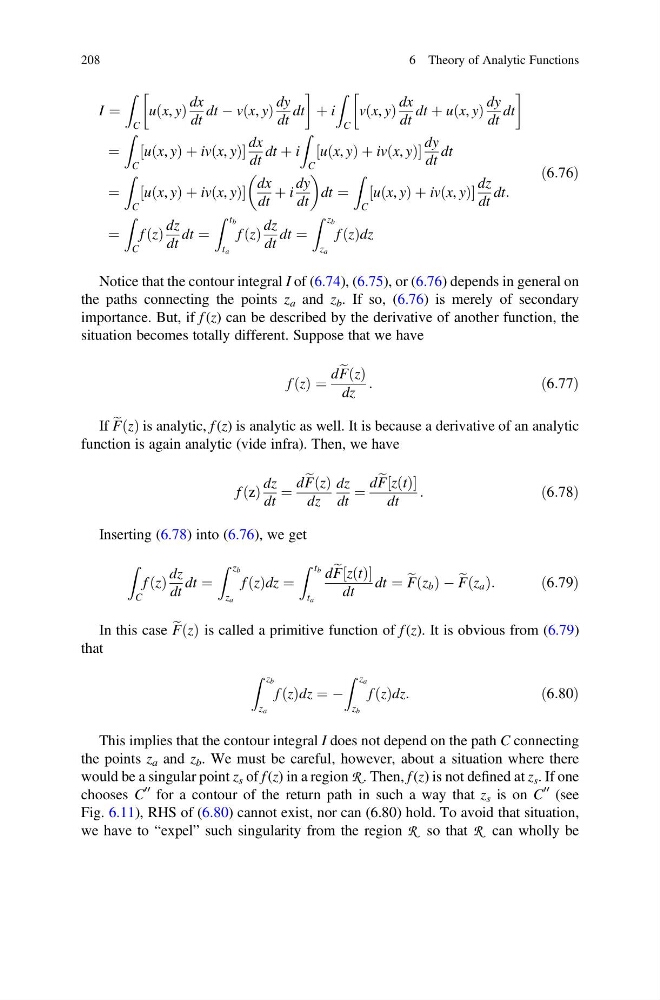
I ¼
Z
C
u x, y
ð Þ
dx
dt
dt À v x, y
ð Þ
dy
dt
dt
!
þ i
Z
C
v x, y
ð Þ
dx
dt
dt þ u x, y
ð Þ
dy
dt
dt
!
¼
Z
C
u x, y
ð Þþiv x, y
ð Þ
½
dx
dt
dt þ i
Z
C
u x, y
ð Þþiv x, y
ð Þ
½
dy
dt
dt
¼
Z
C
u x, y
ð Þþiv x, y
ð Þ
½
dx
dt
þ i
dy
dt
dt ¼
Z
C
u x, y
ð Þþiv x, y
ð Þ
½
dz
dt
dt:
¼
Z
C
f z
ð Þ
dz
dt
dt ¼
Z t b
t a
f z
ð Þ
dz
dt
dt ¼
Z z b
z a
f z
ð Þdz
ð6:76Þ
Notice that the contour integral I of (6.74), (6.75), or (6.76) depends in general on
the paths connecting the points z a and z b . If so, (6.76) is merely of secondary
importance. But, if f (z) can be described by the derivative of another function, the
situation becomes totally different. Suppose that we have
f z
ð Þ ¼
d e
F z
ð Þ
dz
:
ð6:77Þ
If e
F z
ð Þ is analytic, f (z) is analytic as well. It is because a derivative of an analytic
function is again analytic (vide infra). Then, we have
f z
ð Þ
dz
dt
¼
d e
F z
ð Þ
dz
dz
dt
¼
d e
F z t
ð Þ
½
dt
:
ð6:78Þ
Inserting (6.78) into (6.76), we get
Z
C
f z
ð Þ
dz
dt
dt ¼
Z z b
z a
f z
ð Þdz ¼
Z t b
t a
d e
F z t
ð Þ
½
dt
dt ¼ e
F z b
ð Þ À e
F z a
ð Þ:
ð6:79Þ
In this case e
F z
ð Þ is called a primitive function of f (z). It is obvious from (6.79)
that
Z z b
z a
f z
ð Þdz ¼ À
Z z a
z b
f z
ð Þdz:
ð6:80Þ
This implies that the contour integral I does not depend on the path C connecting
the points z a and z b . We must be careful, however, about a situation where there
would be a singular point z s of f (z) in a region R . Then, f (z) is not defined at z s . If one
chooses C
00 for a contour of the return path in such a way that z s is on C
00 (see
Fig. 6.11), RHS of (6.80) cannot exist, nor can (6.80) hold. To avoid that situation,
we have to “expel” such singularity from the region R so that R can wholly be
208
6 Theory of Analytic Functions
Z
C
u x, y
ð Þ
dx
dt
dt À v x, y
ð Þ
dy
dt
dt
!
þ i
Z
C
v x, y
ð Þ
dx
dt
dt þ u x, y
ð Þ
dy
dt
dt
!
¼
Z
C
u x, y
ð Þþiv x, y
ð Þ
½
dx
dt
dt þ i
Z
C
u x, y
ð Þþiv x, y
ð Þ
½
dy
dt
dt
¼
Z
C
u x, y
ð Þþiv x, y
ð Þ
½
dx
dt
þ i
dy
dt
dt ¼
Z
C
u x, y
ð Þþiv x, y
ð Þ
½
dz
dt
dt:
¼
Z
C
f z
ð Þ
dz
dt
dt ¼
Z t b
t a
f z
ð Þ
dz
dt
dt ¼
Z z b
z a
f z
ð Þdz
ð6:76Þ
Notice that the contour integral I of (6.74), (6.75), or (6.76) depends in general on
the paths connecting the points z a and z b . If so, (6.76) is merely of secondary
importance. But, if f (z) can be described by the derivative of another function, the
situation becomes totally different. Suppose that we have
f z
ð Þ ¼
d e
F z
ð Þ
dz
:
ð6:77Þ
If e
F z
ð Þ is analytic, f (z) is analytic as well. It is because a derivative of an analytic
function is again analytic (vide infra). Then, we have
f z
ð Þ
dz
dt
¼
d e
F z
ð Þ
dz
dz
dt
¼
d e
F z t
ð Þ
½
dt
:
ð6:78Þ
Inserting (6.78) into (6.76), we get
Z
C
f z
ð Þ
dz
dt
dt ¼
Z z b
z a
f z
ð Þdz ¼
Z t b
t a
d e
F z t
ð Þ
½
dt
dt ¼ e
F z b
ð Þ À e
F z a
ð Þ:
ð6:79Þ
In this case e
F z
ð Þ is called a primitive function of f (z). It is obvious from (6.79)
that
Z z b
z a
f z
ð Þdz ¼ À
Z z a
z b
f z
ð Þdz:
ð6:80Þ
This implies that the contour integral I does not depend on the path C connecting
the points z a and z b . We must be careful, however, about a situation where there
would be a singular point z s of f (z) in a region R . Then, f (z) is not defined at z s . If one
chooses C
00 for a contour of the return path in such a way that z s is on C
00 (see
Fig. 6.11), RHS of (6.80) cannot exist, nor can (6.80) hold. To avoid that situation,
we have to “expel” such singularity from the region R so that R can wholly be
208
6 Theory of Analytic Functions