

df z
ð Þ
dz
¼
∂F z, z
Ã
ð
Þ
∂x
¼
∂
∂z
þ
∂
∂z Ã
F z, z
Ã
ð
Þ ¼
∂F z, z
Ã
ð
Þ
∂z
þ
∂F z, z
Ã
ð
Þ
∂z à :
ð6:61Þ
Similarly, we get
df z
ð Þ
dz
¼ Ài
∂F z, z
Ã
ð
Þ
∂y
¼
∂
∂z
À
∂
∂z Ã
F z, z
Ã
ð
Þ ¼
∂F z, z
Ã
ð
Þ
∂z
À
∂F z, z
Ã
ð
Þ
∂z à : ð6:62Þ
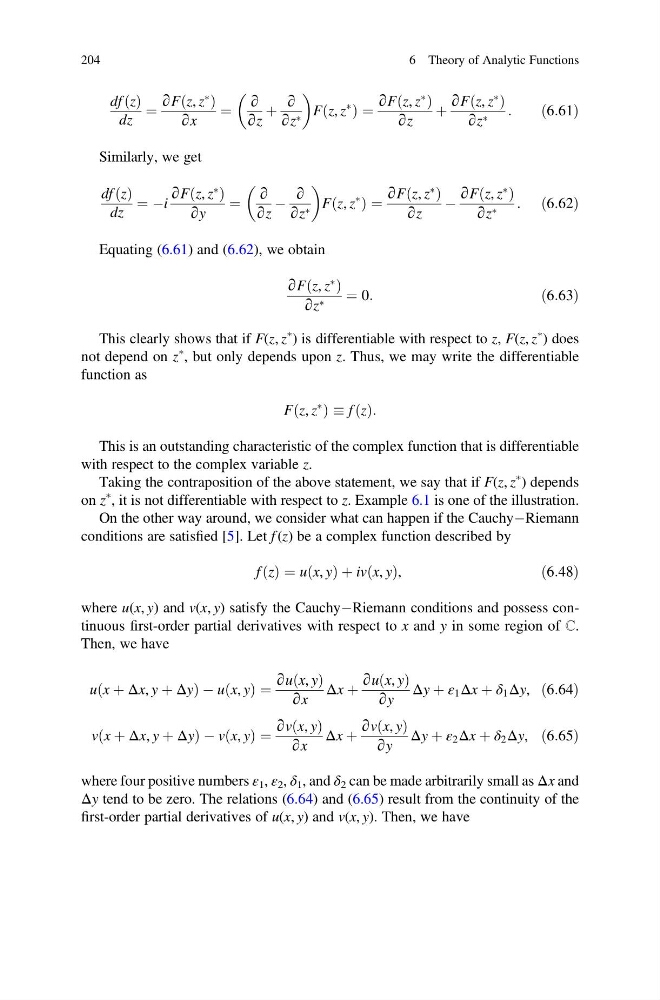
Equating (6.61) and (6.62), we obtain
∂F z, z
Ã
ð
Þ
∂z à ¼ 0:
ð6:63Þ
This clearly shows that if F(z, z
à ) is differentiable with respect to z, F(z, z
à ) does
not depend on z
à , but only depends upon z. Thus, we may write the differentiable
function as
F z, z
Ã
ð
Þ f z
ð Þ:
This is an outstanding characteristic of the complex function that is differentiable
with respect to the complex variable z.
Taking the contraposition of the above statement, we say that if F(z, z
à ) depends
on z
à , it is not differentiable with respect to z. Example 6.1 is one of the illustration.
On the other way around, we consider what can happen if the CauchyÀRiemann
conditions are satisfied [5]. Let f (z) be a complex function described by
f z
ð Þ ¼ u x, y
ð Þþiv x, y
ð Þ,
ð6:48Þ
where u(x, y) and v(x, y) satisfy the CauchyÀRiemann conditions and possess continuous first-order partial derivatives with respect to x and y in some region of ℂ.
Then, we have
u x þ Δx, y þ Δy
ð
Þ À u x, y
ð Þ ¼
∂u x, y
ð Þ
∂x
Δx þ
∂u x, y
ð Þ
∂y
Δy þ ε 1 Δx þ δ 1 Δy, ð6:64Þ
v x þ Δx, y þ Δy
ð
Þ À v x, y
ð Þ ¼
∂v x, y
ð Þ
∂x
Δx þ
∂v x, y
ð Þ
∂y
Δy þ ε 2 Δx þ δ 2 Δy, ð6:65Þ
where four positive numbers ε 1 , ε 2 , δ 1 , and δ 2 can be made arbitrarily small as Δx and
Δy tend to be zero. The relations (6.64) and (6.65) result from the continuity of the
first-order partial derivatives of u(x, y) and v(x, y). Then, we have
204
6 Theory of Analytic Functions
ð Þ
dz
¼
∂F z, z
Ã
ð
Þ
∂x
¼
∂
∂z
þ
∂
∂z Ã
F z, z
Ã
ð
Þ ¼
∂F z, z
Ã
ð
Þ
∂z
þ
∂F z, z
Ã
ð
Þ
∂z à :
ð6:61Þ
Similarly, we get
df z
ð Þ
dz
¼ Ài
∂F z, z
Ã
ð
Þ
∂y
¼
∂
∂z
À
∂
∂z Ã
F z, z
Ã
ð
Þ ¼
∂F z, z
Ã
ð
Þ
∂z
À
∂F z, z
Ã
ð
Þ
∂z à : ð6:62Þ
Equating (6.61) and (6.62), we obtain
∂F z, z
Ã
ð
Þ
∂z à ¼ 0:
ð6:63Þ
This clearly shows that if F(z, z
à ) is differentiable with respect to z, F(z, z
à ) does
not depend on z
à , but only depends upon z. Thus, we may write the differentiable
function as
F z, z
Ã
ð
Þ f z
ð Þ:
This is an outstanding characteristic of the complex function that is differentiable
with respect to the complex variable z.
Taking the contraposition of the above statement, we say that if F(z, z
à ) depends
on z
à , it is not differentiable with respect to z. Example 6.1 is one of the illustration.
On the other way around, we consider what can happen if the CauchyÀRiemann
conditions are satisfied [5]. Let f (z) be a complex function described by
f z
ð Þ ¼ u x, y
ð Þþiv x, y
ð Þ,
ð6:48Þ
where u(x, y) and v(x, y) satisfy the CauchyÀRiemann conditions and possess continuous first-order partial derivatives with respect to x and y in some region of ℂ.
Then, we have
u x þ Δx, y þ Δy
ð
Þ À u x, y
ð Þ ¼
∂u x, y
ð Þ
∂x
Δx þ
∂u x, y
ð Þ
∂y
Δy þ ε 1 Δx þ δ 1 Δy, ð6:64Þ
v x þ Δx, y þ Δy
ð
Þ À v x, y
ð Þ ¼
∂v x, y
ð Þ
∂x
Δx þ
∂v x, y
ð Þ
∂y
Δy þ ε 2 Δx þ δ 2 Δy, ð6:65Þ
where four positive numbers ε 1 , ε 2 , δ 1 , and δ 2 can be made arbitrarily small as Δx and
Δy tend to be zero. The relations (6.64) and (6.65) result from the continuity of the
first-order partial derivatives of u(x, y) and v(x, y). Then, we have
204
6 Theory of Analytic Functions