

∂v x, y
ð Þ
∂x
¼ À
∂u x, y
ð Þ
∂y
:
ð6:53Þ
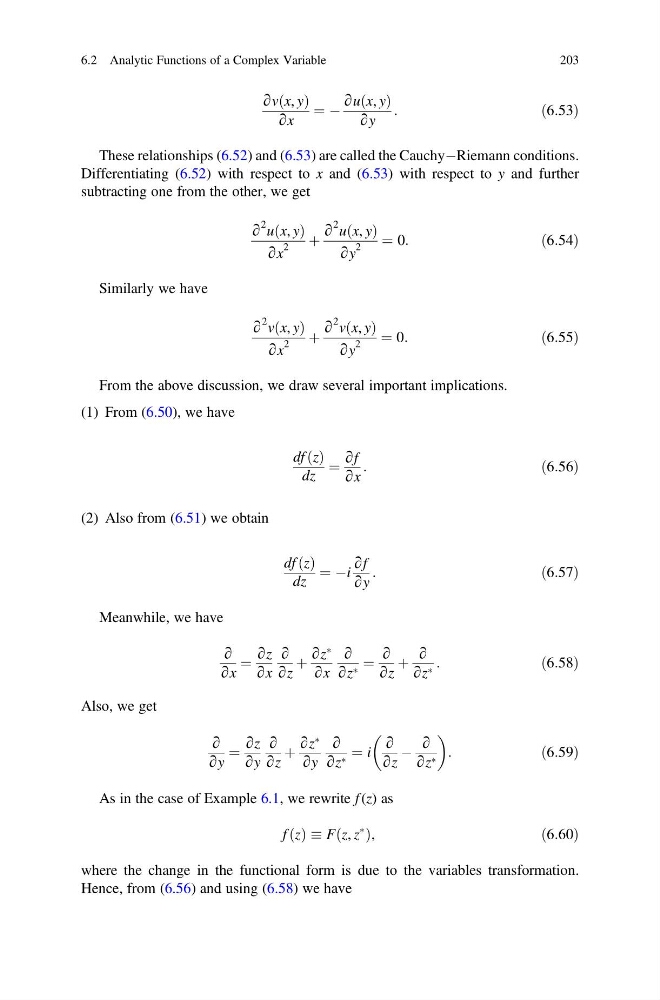
These relationships (6.52) and (6.53) are called the CauchyÀRiemann conditions.
Differentiating (6.52) with respect to x and (6.53) with respect to y and further
subtracting one from the other, we get
∂
2 u x, y
ð Þ
∂x
2
þ
∂
2 u x, y
ð Þ
∂y
2
¼ 0:
ð6:54Þ
Similarly we have
∂
2 v x, y
ð Þ
∂x
2
þ
∂
2 v x, y
ð Þ
∂y
2
¼ 0:
ð6:55Þ
From the above discussion, we draw several important implications.
(1) From (6.50), we have
df z
ð Þ
dz
¼
∂f
∂x
:
ð6:56Þ
(2) Also from (6.51) we obtain
df z
ð Þ
dz
¼ Ài
∂f
∂y
:
ð6:57Þ
Meanwhile, we have
∂
∂x
¼
∂z
∂x
∂
∂z
þ
∂z
Ã
∂x
∂
∂z à ¼
∂
∂z
þ
∂
∂z à :
ð6:58Þ
Also, we get
∂
∂y
¼
∂z
∂y
∂
∂z
þ
∂z
Ã
∂y
∂
∂z à ¼ i
∂
∂z
À
∂
∂z Ã
:
ð6:59Þ
As in the case of Example 6.1, we rewrite f (z) as
f z
ð Þ F z, z
Ã
ð
Þ,
ð6:60Þ
where the change in the functional form is due to the variables transformation.
Hence, from (6.56) and using (6.58) we have
6.2 Analytic Functions of a Complex Variable
203
ð Þ
∂x
¼ À
∂u x, y
ð Þ
∂y
:
ð6:53Þ
These relationships (6.52) and (6.53) are called the CauchyÀRiemann conditions.
Differentiating (6.52) with respect to x and (6.53) with respect to y and further
subtracting one from the other, we get
∂
2 u x, y
ð Þ
∂x
2
þ
∂
2 u x, y
ð Þ
∂y
2
¼ 0:
ð6:54Þ
Similarly we have
∂
2 v x, y
ð Þ
∂x
2
þ
∂
2 v x, y
ð Þ
∂y
2
¼ 0:
ð6:55Þ
From the above discussion, we draw several important implications.
(1) From (6.50), we have
df z
ð Þ
dz
¼
∂f
∂x
:
ð6:56Þ
(2) Also from (6.51) we obtain
df z
ð Þ
dz
¼ Ài
∂f
∂y
:
ð6:57Þ
Meanwhile, we have
∂
∂x
¼
∂z
∂x
∂
∂z
þ
∂z
Ã
∂x
∂
∂z à ¼
∂
∂z
þ
∂
∂z à :
ð6:58Þ
Also, we get
∂
∂y
¼
∂z
∂y
∂
∂z
þ
∂z
Ã
∂y
∂
∂z à ¼ i
∂
∂z
À
∂
∂z Ã
:
ð6:59Þ
As in the case of Example 6.1, we rewrite f (z) as
f z
ð Þ F z, z
Ã
ð
Þ,
ð6:60Þ
where the change in the functional form is due to the variables transformation.
Hence, from (6.56) and using (6.58) we have
6.2 Analytic Functions of a Complex Variable
203