

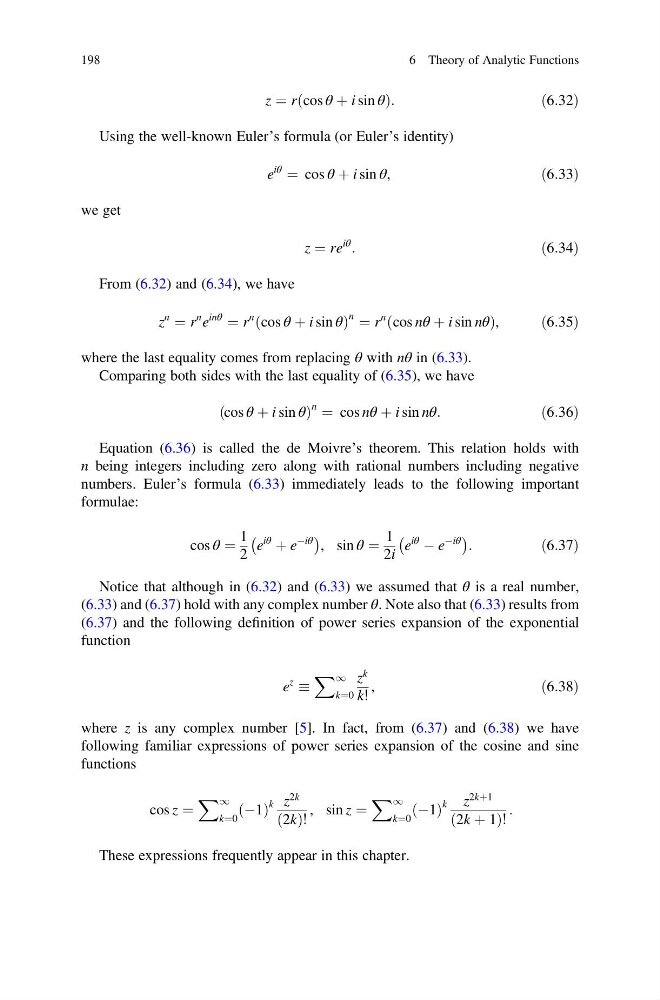
z ¼ r cos θ þ i sin θ
ð
Þ :
ð6:32Þ
Using the well-known Euler’s formula (or Euler’s identity)
e
iθ
¼ cos θ þ i sin θ,
ð6:33Þ
we get
z ¼ re
iθ
:
ð6:34Þ
From (6.32) and (6.34), we have
z
n
¼ r
n e
inθ
¼ r
n cos θ þ i sin θ
ð
Þ
n ¼ r
n cos nθ þ i sin nθ
ð
Þ ,
ð6:35Þ
where the last equality comes from replacing θ with nθ in (6.33).
Comparing both sides with the last equality of (6.35), we have
cos θ þ i sin θ
ð
Þ
n ¼ cos nθ þ i sin nθ:
ð6:36Þ
Equation (6.36) is called the de Moivre’s theorem. This relation holds with
n being integers including zero along with rational numbers including negative
numbers. Euler’s formula (6.33) immediately leads to the following important
formulae:
cos θ ¼
1
2
e
iθ
þ e
Àiθ
À
Á
, sin θ ¼
1
2i
e
iθ
À e
Àiθ
À
Á :
ð6:37Þ
Notice that although in (6.32) and (6.33) we assumed that θ is a real number,
(6.33) and (6.37) hold with any complex number θ. Note also that (6.33) results from
(6.37) and the following definition of power series expansion of the exponential
function
e
z
X 1
k¼0
z
k
k!
,
ð6:38Þ
where z is any complex number [5]. In fact, from (6.37) and (6.38) we have
following familiar expressions of power series expansion of the cosine and sine
functions
cos z ¼
X 1
k¼0
À1
ð Þ
k z
2k
2k
ð Þ!
, sin z ¼
X 1
k¼0
À1
ð Þ
k
z
2kþ1
2k þ 1
ð
Þ!
:
These expressions frequently appear in this chapter.
198
6 Theory of Analytic Functions
ð
Þ :
ð6:32Þ
Using the well-known Euler’s formula (or Euler’s identity)
e
iθ
¼ cos θ þ i sin θ,
ð6:33Þ
we get
z ¼ re
iθ
:
ð6:34Þ
From (6.32) and (6.34), we have
z
n
¼ r
n e
inθ
¼ r
n cos θ þ i sin θ
ð
Þ
n ¼ r
n cos nθ þ i sin nθ
ð
Þ ,
ð6:35Þ
where the last equality comes from replacing θ with nθ in (6.33).
Comparing both sides with the last equality of (6.35), we have
cos θ þ i sin θ
ð
Þ
n ¼ cos nθ þ i sin nθ:
ð6:36Þ
Equation (6.36) is called the de Moivre’s theorem. This relation holds with
n being integers including zero along with rational numbers including negative
numbers. Euler’s formula (6.33) immediately leads to the following important
formulae:
cos θ ¼
1
2
e
iθ
þ e
Àiθ
À
Á
, sin θ ¼
1
2i
e
iθ
À e
Àiθ
À
Á :
ð6:37Þ
Notice that although in (6.32) and (6.33) we assumed that θ is a real number,
(6.33) and (6.37) hold with any complex number θ. Note also that (6.33) results from
(6.37) and the following definition of power series expansion of the exponential
function
e
z
X 1
k¼0
z
k
k!
,
ð6:38Þ
where z is any complex number [5]. In fact, from (6.37) and (6.38) we have
following familiar expressions of power series expansion of the cosine and sine
functions
cos z ¼
X 1
k¼0
À1
ð Þ
k z
2k
2k
ð Þ!
, sin z ¼
X 1
k¼0
À1
ð Þ
k
z
2kþ1
2k þ 1
ð
Þ!
:
These expressions frequently appear in this chapter.
198
6 Theory of Analytic Functions