

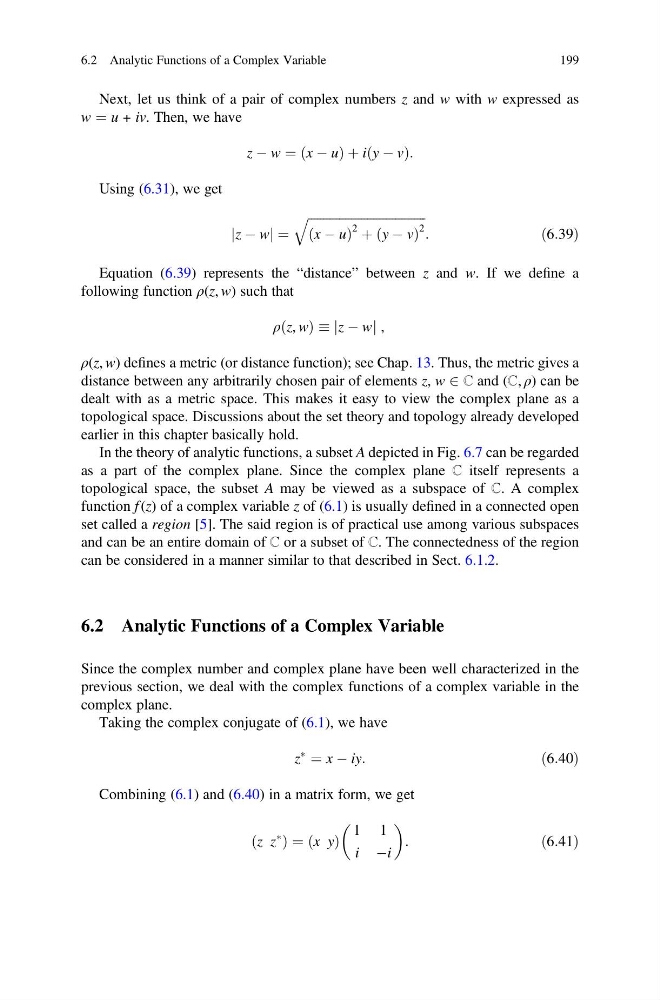
Next, let us think of a pair of complex numbers z and w with w expressed as
w ¼ u + iv. Then, we have
z À w ¼ x À u
ð
Þþi y À v
ð
Þ:
Using (6.31), we get
jz À wj ¼
ffiffiffiffiffiffiffiffiffiffiffiffiffiffiffiffiffiffiffiffiffiffiffiffiffiffiffiffiffiffiffiffiffiffiffiffiffi ffi
x À u
ð
Þ
2 þ y À v
ð
Þ
2
q
:
ð6:39Þ
Equation (6.39) represents the “distance” between z and w. If we define a
following function ρ(z, w) such that
ρ z, w
ð Þ jz À wj ,
ρ(z, w) defines a metric (or distance function); see Chap. 13. Thus, the metric gives a
distance between any arbitrarily chosen pair of elements z, w 2 ℂ and (ℂ, ρ) can be
dealt with as a metric space. This makes it easy to view the complex plane as a
topological space. Discussions about the set theory and topology already developed
earlier in this chapter basically hold.
In the theory of analytic functions, a subset A depicted in Fig. 6.7 can be regarded
as a part of the complex plane. Since the complex plane ℂ itself represents a
topological space, the subset A may be viewed as a subspace of ℂ. A complex
function f (z) of a complex variable z of (6.1) is usually defined in a connected open
set called a region [5]. The said region is of practical use among various subspaces
and can be an entire domain of ℂ or a subset of ℂ. The connectedness of the region
can be considered in a manner similar to that described in Sect. 6.1.2.
6.2 Analytic Functions of a Complex Variable
Since the complex number and complex plane have been well characterized in the
previous section, we deal with the complex functions of a complex variable in the
complex plane.
Taking the complex conjugate of (6.1), we have
z
Ã
¼ x À iy:
ð6:40Þ
Combining (6.1) and (6.40) in a matrix form, we get
z z
Ã
ð
Þ ¼ x y
ð Þ
1 1
i Ài
:
ð6:41Þ
6.2 Analytic Functions of a Complex Variable
199
w ¼ u + iv. Then, we have
z À w ¼ x À u
ð
Þþi y À v
ð
Þ:
Using (6.31), we get
jz À wj ¼
ffiffiffiffiffiffiffiffiffiffiffiffiffiffiffiffiffiffiffiffiffiffiffiffiffiffiffiffiffiffiffiffiffiffiffiffiffi ffi
x À u
ð
Þ
2 þ y À v
ð
Þ
2
q
:
ð6:39Þ
Equation (6.39) represents the “distance” between z and w. If we define a
following function ρ(z, w) such that
ρ z, w
ð Þ jz À wj ,
ρ(z, w) defines a metric (or distance function); see Chap. 13. Thus, the metric gives a
distance between any arbitrarily chosen pair of elements z, w 2 ℂ and (ℂ, ρ) can be
dealt with as a metric space. This makes it easy to view the complex plane as a
topological space. Discussions about the set theory and topology already developed
earlier in this chapter basically hold.
In the theory of analytic functions, a subset A depicted in Fig. 6.7 can be regarded
as a part of the complex plane. Since the complex plane ℂ itself represents a
topological space, the subset A may be viewed as a subspace of ℂ. A complex
function f (z) of a complex variable z of (6.1) is usually defined in a connected open
set called a region [5]. The said region is of practical use among various subspaces
and can be an entire domain of ℂ or a subset of ℂ. The connectedness of the region
can be considered in a manner similar to that described in Sect. 6.1.2.
6.2 Analytic Functions of a Complex Variable
Since the complex number and complex plane have been well characterized in the
previous section, we deal with the complex functions of a complex variable in the
complex plane.
Taking the complex conjugate of (6.1), we have
z
Ã
¼ x À iy:
ð6:40Þ
Combining (6.1) and (6.40) in a matrix form, we get
z z
Ã
ð
Þ ¼ x y
ð Þ
1 1
i Ài
:
ð6:41Þ
6.2 Analytic Functions of a Complex Variable
199