

6.1.4 Complex Numbers and Complex Plane
Returning to (6.1), we further investigate how to represent a complex number. In
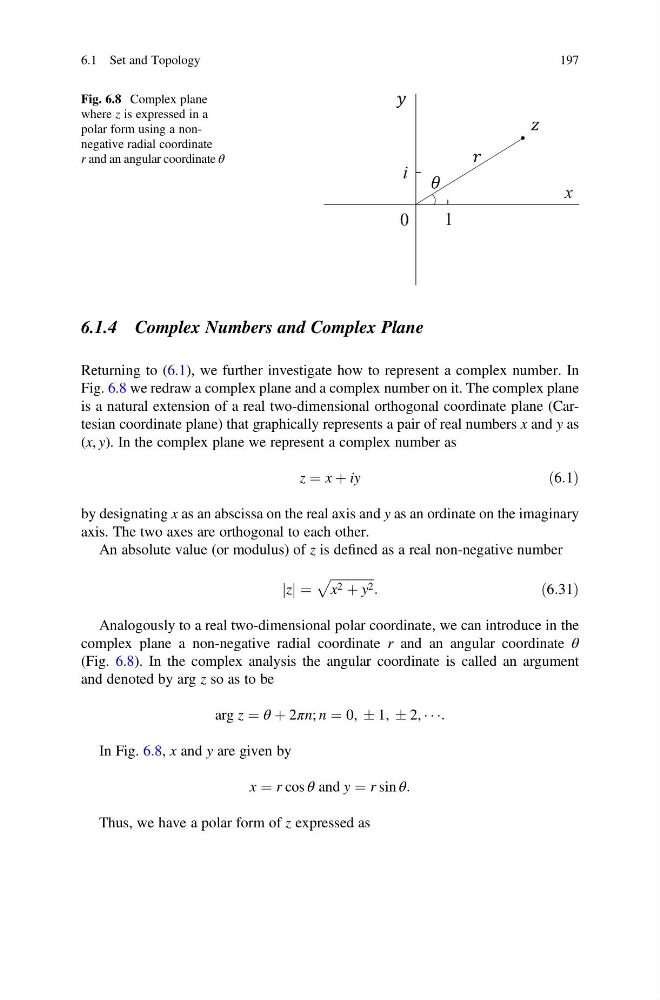
Fig. 6.8 we redraw a complex plane and a complex number on it. The complex plane
is a natural extension of a real two-dimensional orthogonal coordinate plane (Cartesian coordinate plane) that graphically represents a pair of real numbers x and y as
(x, y). In the complex plane we represent a complex number as
z ¼ x þ iy
ð6:1Þ
by designating x as an abscissa on the real axis and y as an ordinate on the imaginary
axis. The two axes are orthogonal to each other.
An absolute value (or modulus) of z is defined as a real non-negative number
z
j j ¼
ffiffiffiffiffiffiffiffiffiffiffiffiffiffi
x 2 þ y 2
p
:
ð6:31Þ
Analogously to a real two-dimensional polar coordinate, we can introduce in the
complex plane a non-negative radial coordinate r and an angular coordinate θ
(Fig. 6.8). In the complex analysis the angular coordinate is called an argument
and denoted by arg z so as to be
arg z ¼ θ þ 2πn; n ¼ 0, Æ 1, Æ 2, Á Á Á:
In Fig. 6.8, x and y are given by
x ¼ r cos θ and y ¼ r sin θ:
Thus, we have a polar form of z expressed as
1
i
0
x
Fig. 6.8 Complex plane
where z is expressed in a
polar form using a nonnegative radial coordinate
r and an angular coordinate θ
6.1 Set and Topology
197
Returning to (6.1), we further investigate how to represent a complex number. In
Fig. 6.8 we redraw a complex plane and a complex number on it. The complex plane
is a natural extension of a real two-dimensional orthogonal coordinate plane (Cartesian coordinate plane) that graphically represents a pair of real numbers x and y as
(x, y). In the complex plane we represent a complex number as
z ¼ x þ iy
ð6:1Þ
by designating x as an abscissa on the real axis and y as an ordinate on the imaginary
axis. The two axes are orthogonal to each other.
An absolute value (or modulus) of z is defined as a real non-negative number
z
j j ¼
ffiffiffiffiffiffiffiffiffiffiffiffiffiffi
x 2 þ y 2
p
:
ð6:31Þ
Analogously to a real two-dimensional polar coordinate, we can introduce in the
complex plane a non-negative radial coordinate r and an angular coordinate θ
(Fig. 6.8). In the complex analysis the angular coordinate is called an argument
and denoted by arg z so as to be
arg z ¼ θ þ 2πn; n ¼ 0, Æ 1, Æ 2, Á Á Á:
In Fig. 6.8, x and y are given by
x ¼ r cos θ and y ¼ r sin θ:
Thus, we have a polar form of z expressed as
1
i
0
x
Fig. 6.8 Complex plane
where z is expressed in a
polar form using a nonnegative radial coordinate
r and an angular coordinate θ
6.1 Set and Topology
197