

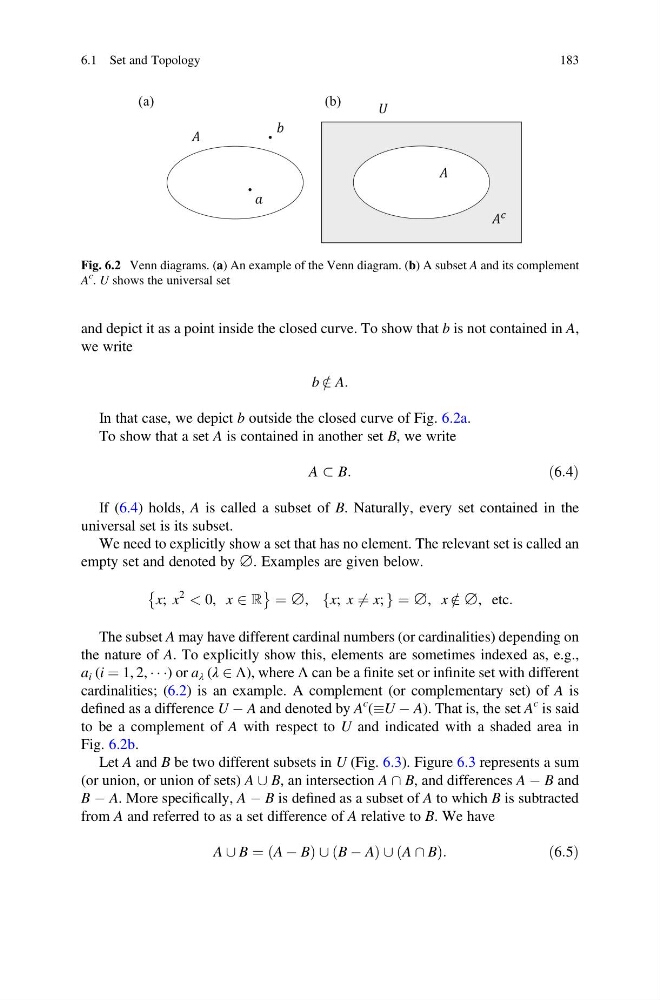
and depict it as a point inside the closed curve. To show that b is not contained in A,
we write
b =
2 A:
In that case, we depict b outside the closed curve of Fig. 6.2a.
To show that a set A is contained in another set B, we write
A ⊂ B:
ð6:4Þ
If (6.4) holds, A is called a subset of B. Naturally, every set contained in the
universal set is its subset.
We need to explicitly show a set that has no element. The relevant set is called an
empty set and denoted by ∅. Examples are given below.
x; x
2
< 0, x 2 ℝ
È
É ¼ ∅, x; x 6 ¼ x;
f
g¼ ∅, x =
2 ∅, etc:
The subset A may have different cardinal numbers (or cardinalities) depending on
the nature of A. To explicitly show this, elements are sometimes indexed as, e.g.,
a i (i ¼ 1, 2, Á Á Á) or a λ (λ 2 Λ), where Λ can be a finite set or infinite set with different
cardinalities; (6.2) is an example. A complement (or complementary set) of A is
defined as a difference U À A and denoted by A
c
(U À A). That is, the set A
c is said
to be a complement of A with respect to U and indicated with a shaded area in
Fig. 6.2b.
Let A and B be two different subsets in U (Fig. 6.3). Figure 6.3 represents a sum
(or union, or union of sets) A [ B, an intersection A \ B, and differences A À B and
B À A. More specifically, A À B is defined as a subset of A to which B is subtracted
from A and referred to as a set difference of A relative to B. We have
A [ B ¼ A À B
ð
Þ[ B À A
ð
Þ[ A \ B
ð
Þ:
ð6:5Þ
(a)
(b)
Fig. 6.2 Venn diagrams. (a) An example of the Venn diagram. (b) A subset A and its complement
A
c . U shows the universal set
6.1 Set and Topology
183
we write
b =
2 A:
In that case, we depict b outside the closed curve of Fig. 6.2a.
To show that a set A is contained in another set B, we write
A ⊂ B:
ð6:4Þ
If (6.4) holds, A is called a subset of B. Naturally, every set contained in the
universal set is its subset.
We need to explicitly show a set that has no element. The relevant set is called an
empty set and denoted by ∅. Examples are given below.
x; x
2
< 0, x 2 ℝ
È
É ¼ ∅, x; x 6 ¼ x;
f
g¼ ∅, x =
2 ∅, etc:
The subset A may have different cardinal numbers (or cardinalities) depending on
the nature of A. To explicitly show this, elements are sometimes indexed as, e.g.,
a i (i ¼ 1, 2, Á Á Á) or a λ (λ 2 Λ), where Λ can be a finite set or infinite set with different
cardinalities; (6.2) is an example. A complement (or complementary set) of A is
defined as a difference U À A and denoted by A
c
(U À A). That is, the set A
c is said
to be a complement of A with respect to U and indicated with a shaded area in
Fig. 6.2b.
Let A and B be two different subsets in U (Fig. 6.3). Figure 6.3 represents a sum
(or union, or union of sets) A [ B, an intersection A \ B, and differences A À B and
B À A. More specifically, A À B is defined as a subset of A to which B is subtracted
from A and referred to as a set difference of A relative to B. We have
A [ B ¼ A À B
ð
Þ[ B À A
ð
Þ[ A \ B
ð
Þ:
ð6:5Þ
(a)
(b)
Fig. 6.2 Venn diagrams. (a) An example of the Venn diagram. (b) A subset A and its complement
A
c . U shows the universal set
6.1 Set and Topology
183