

If A has no element in common with B, A À B ¼ A and B À A ¼ B with A \ B ¼ ∅.
Then, (6.5) trivially holds. Notice also that A [ B is the smallest set that contains both
A and B. In (6.5) the elements must not be doubly counted. Thus, we have
A [ A ¼ A:
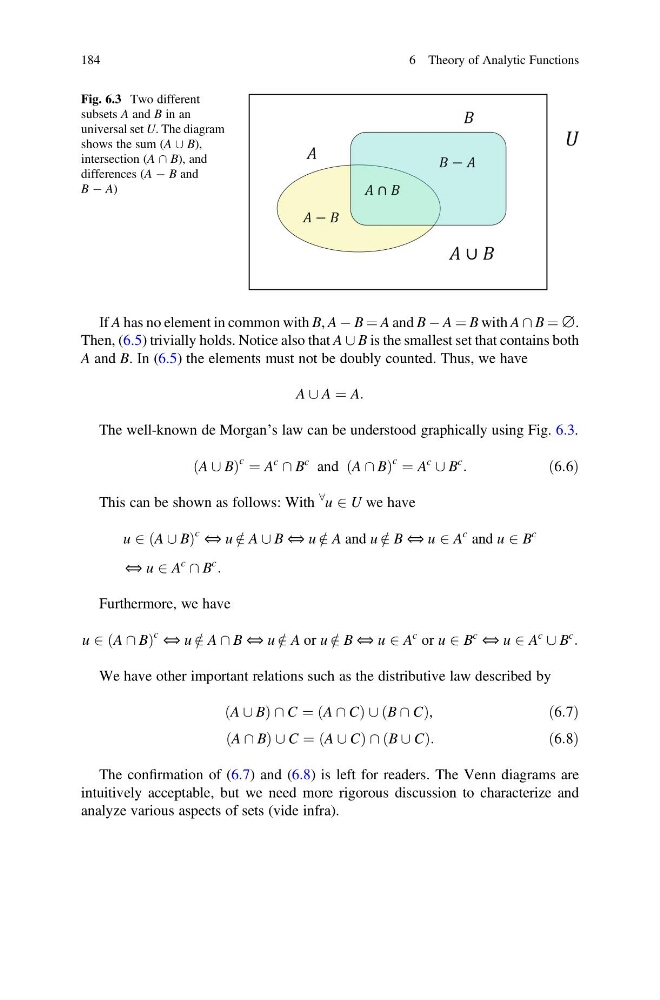
The well-known de Morgan’s law can be understood graphically using Fig. 6.3.
A [ B
ð
Þ
c ¼ A
c
\ B
c and A \ B
ð
Þ
c ¼ A
c
[ B
c
:
ð6:6Þ
This can be shown as follows: With
8
u 2 U we have
u 2 A [ B
ð
Þ
c ⟺ u =
2 A [ B ⟺ u =
2 A and u =
2 B ⟺ u 2 A
c and u 2 B
c
⟺ u 2 A
c
\ B
c
:
Furthermore, we have
u 2 A \ B
ð
Þ
c ⟺ u =
2 A \ B ⟺ u =
2 A or u =
2 B ⟺ u 2 A
c or u 2 B
c
⟺ u 2 A
c
[ B
c
:
We have other important relations such as the distributive law described by
A [ B
ð
Þ\C ¼ A \ C
ð
Þ[ B \ C
ð
Þ,
ð6:7Þ
A \ B
ð
Þ[C ¼ A [ C
ð
Þ\ B [ C
ð
Þ:
ð6:8Þ
The confirmation of (6.7) and (6.8) is left for readers. The Venn diagrams are
intuitively acceptable, but we need more rigorous discussion to characterize and
analyze various aspects of sets (vide infra).
−
−
∩
∪
Fig. 6.3 Two different
subsets A and B in an
universal set U. The diagram
shows the sum (A [ B),
intersection (A \ B), and
differences (A À B and
B À A)
184
6 Theory of Analytic Functions
Then, (6.5) trivially holds. Notice also that A [ B is the smallest set that contains both
A and B. In (6.5) the elements must not be doubly counted. Thus, we have
A [ A ¼ A:
The well-known de Morgan’s law can be understood graphically using Fig. 6.3.
A [ B
ð
Þ
c ¼ A
c
\ B
c and A \ B
ð
Þ
c ¼ A
c
[ B
c
:
ð6:6Þ
This can be shown as follows: With
8
u 2 U we have
u 2 A [ B
ð
Þ
c ⟺ u =
2 A [ B ⟺ u =
2 A and u =
2 B ⟺ u 2 A
c and u 2 B
c
⟺ u 2 A
c
\ B
c
:
Furthermore, we have
u 2 A \ B
ð
Þ
c ⟺ u =
2 A \ B ⟺ u =
2 A or u =
2 B ⟺ u 2 A
c or u 2 B
c
⟺ u 2 A
c
[ B
c
:
We have other important relations such as the distributive law described by
A [ B
ð
Þ\C ¼ A \ C
ð
Þ[ B \ C
ð
Þ,
ð6:7Þ
A \ B
ð
Þ[C ¼ A [ C
ð
Þ\ B [ C
ð
Þ:
ð6:8Þ
The confirmation of (6.7) and (6.8) is left for readers. The Venn diagrams are
intuitively acceptable, but we need more rigorous discussion to characterize and
analyze various aspects of sets (vide infra).
−
−
∩
∪
Fig. 6.3 Two different
subsets A and B in an
universal set U. The diagram
shows the sum (A [ B),
intersection (A \ B), and
differences (A À B and
B À A)
184
6 Theory of Analytic Functions