

functions. Such a diagram provides a good subject for study of the set theory and
topology. Before developing the theory of complex numbers and analytic functions,
we briefly mention the basic notions as well as notations and meanings of sets and
topology.
6.1.1 Basic Notions and Notations
A set comprises numbers (either real or complex) or mathematical objects, more
generally. The latter include, e.g., vectors, their transformation, etc., as we shall see
various illustrations in Parts III and IV. The set A is described such that
A ¼ 1, 2, 3, Á Á Á, 10
f
g or B ¼ x; a < x < b, a, b 2 ℝ
f
g ,
ð6:2Þ
where A contains ten elements in the former case and uncountably infinite elements
are contained in the latter set B. In the latter case (sometimes in the former case as
well), the elements are usually called points.
When we speak of the sets, a universal set [1] is implied in the background. This
set contains all the sets in consideration of the study and is usually clearly defined in
the context of the discussion. For example, with the real analysis the universal set is
ℝ and with the complex analysis it is ℂ (an entire complex plane). In the latter case a
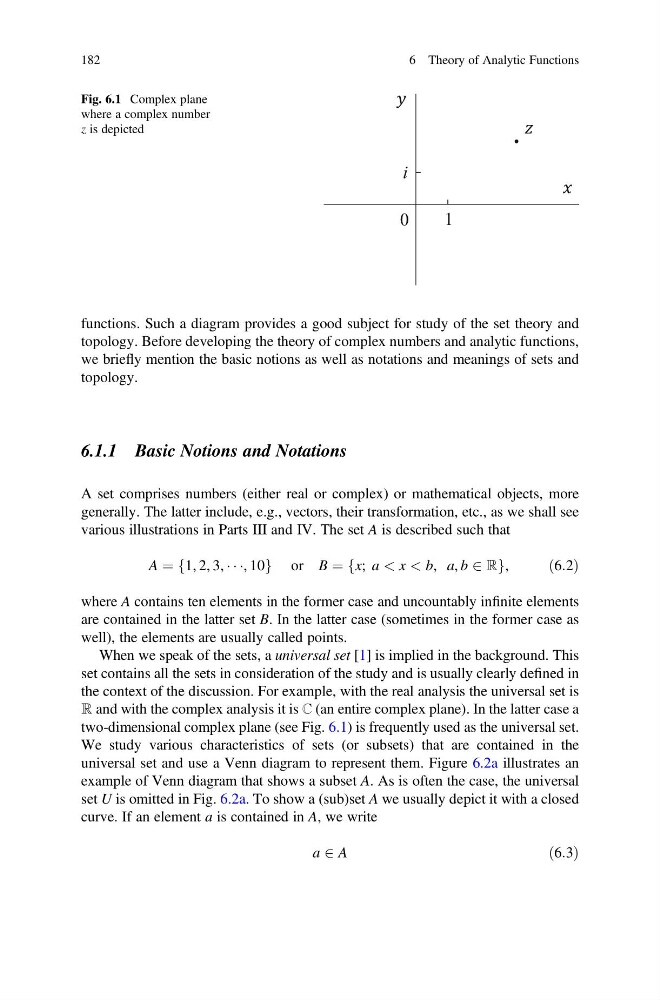
two-dimensional complex plane (see Fig. 6.1) is frequently used as the universal set.
We study various characteristics of sets (or subsets) that are contained in the
universal set and use a Venn diagram to represent them. Figure 6.2a illustrates an
example of Venn diagram that shows a subset A. As is often the case, the universal
set U is omitted in Fig. 6.2a. To show a (sub)set A we usually depict it with a closed
curve. If an element a is contained in A, we write
a 2 A
ð6:3Þ
1
i
0
Fig. 6.1 Complex plane
where a complex number
z is depicted
182
6 Theory of Analytic Functions
topology. Before developing the theory of complex numbers and analytic functions,
we briefly mention the basic notions as well as notations and meanings of sets and
topology.
6.1.1 Basic Notions and Notations
A set comprises numbers (either real or complex) or mathematical objects, more
generally. The latter include, e.g., vectors, their transformation, etc., as we shall see
various illustrations in Parts III and IV. The set A is described such that
A ¼ 1, 2, 3, Á Á Á, 10
f
g or B ¼ x; a < x < b, a, b 2 ℝ
f
g ,
ð6:2Þ
where A contains ten elements in the former case and uncountably infinite elements
are contained in the latter set B. In the latter case (sometimes in the former case as
well), the elements are usually called points.
When we speak of the sets, a universal set [1] is implied in the background. This
set contains all the sets in consideration of the study and is usually clearly defined in
the context of the discussion. For example, with the real analysis the universal set is
ℝ and with the complex analysis it is ℂ (an entire complex plane). In the latter case a
two-dimensional complex plane (see Fig. 6.1) is frequently used as the universal set.
We study various characteristics of sets (or subsets) that are contained in the
universal set and use a Venn diagram to represent them. Figure 6.2a illustrates an
example of Venn diagram that shows a subset A. As is often the case, the universal
set U is omitted in Fig. 6.2a. To show a (sub)set A we usually depict it with a closed
curve. If an element a is contained in A, we write
a 2 A
ð6:3Þ
1
i
0
Fig. 6.1 Complex plane
where a complex number
z is depicted
182
6 Theory of Analytic Functions