

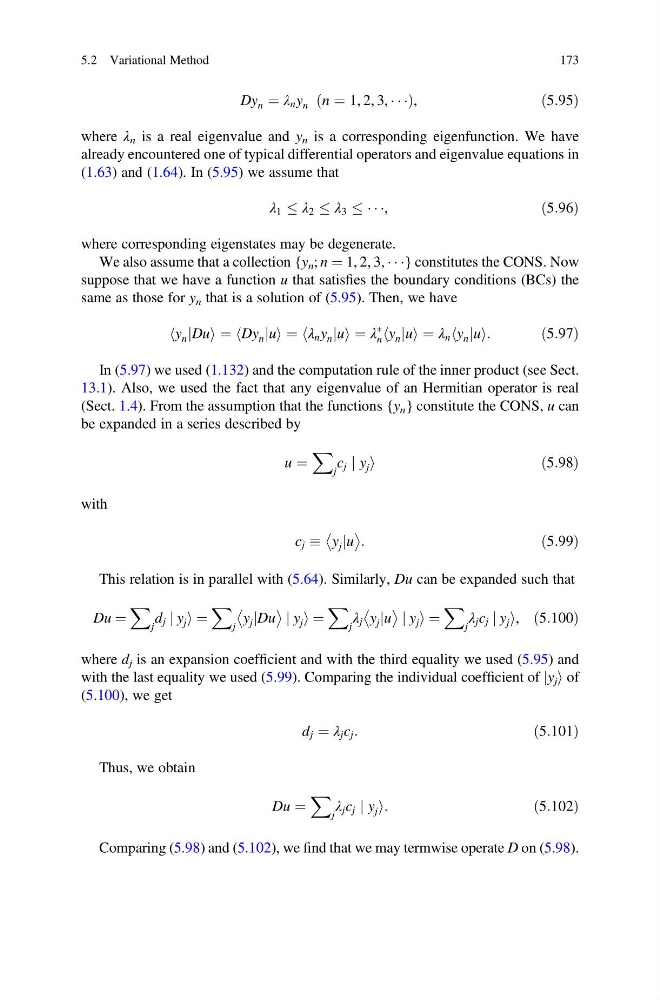
Dy n ¼ λ n y n n ¼ 1, 2, 3, Á Á Á
ð
Þ ,
ð5:95Þ
where λ n is a real eigenvalue and y n is a corresponding eigenfunction. We have
already encountered one of typical differential operators and eigenvalue equations in
(1.63) and (1.64). In (5.95) we assume that
λ 1 λ 2 λ 3 Á Á Á,
ð5:96Þ
where corresponding eigenstates may be degenerate.
We also assume that a collection {y n ; n ¼ 1, 2, 3, Á Á Á} constitutes the CONS. Now
suppose that we have a function u that satisfies the boundary conditions (BCs) the
same as those for y n that is a solution of (5.95). Then, we have
y n jDu
h
i¼ Dy n ju
h
i¼ λ n y n ju
h
i¼ λ
Ã
n y n ju
h
i ¼ λ n y n ju
h
i:
ð5:97Þ
In (5.97) we used (1.132) and the computation rule of the inner product (see Sect.
13.1). Also, we used the fact that any eigenvalue of an Hermitian operator is real
(Sect. 1.4). From the assumption that the functions {y n } constitute the CONS, u can
be expanded in a series described by
u ¼
X
j
c j j y j i
ð 5:98Þ
with
c j y j ju
:
ð5:99Þ
This relation is in parallel with (5.64). Similarly, Du can be expanded such that
Du ¼
X
j
d j j y j i ¼
X
j
y j jDu
j y j i ¼
X
j
λ j y j ju
j y j i ¼
X
j
λ j c j j y j i, ð5:100Þ
where d j is an expansion coefficient and with the third equality we used (5.95) and
with the last equality we used (5.99). Comparing the individual coefficient of jy j i of
(5.100), we get
d j ¼ λ j c j :
ð5:101Þ
Thus, we obtain
Du ¼
X
j
λ j c j j y j i:
ð5:102Þ
Comparing (5.98) and (5.102), we find that we may termwise operate D on (5.98).
5.2 Variational Method
173
ð
Þ ,
ð5:95Þ
where λ n is a real eigenvalue and y n is a corresponding eigenfunction. We have
already encountered one of typical differential operators and eigenvalue equations in
(1.63) and (1.64). In (5.95) we assume that
λ 1 λ 2 λ 3 Á Á Á,
ð5:96Þ
where corresponding eigenstates may be degenerate.
We also assume that a collection {y n ; n ¼ 1, 2, 3, Á Á Á} constitutes the CONS. Now
suppose that we have a function u that satisfies the boundary conditions (BCs) the
same as those for y n that is a solution of (5.95). Then, we have
y n jDu
h
i¼ Dy n ju
h
i¼ λ n y n ju
h
i¼ λ
Ã
n y n ju
h
i ¼ λ n y n ju
h
i:
ð5:97Þ
In (5.97) we used (1.132) and the computation rule of the inner product (see Sect.
13.1). Also, we used the fact that any eigenvalue of an Hermitian operator is real
(Sect. 1.4). From the assumption that the functions {y n } constitute the CONS, u can
be expanded in a series described by
u ¼
X
j
c j j y j i
ð 5:98Þ
with
c j y j ju
:
ð5:99Þ
This relation is in parallel with (5.64). Similarly, Du can be expanded such that
Du ¼
X
j
d j j y j i ¼
X
j
y j jDu
j y j i ¼
X
j
λ j y j ju
j y j i ¼
X
j
λ j c j j y j i, ð5:100Þ
where d j is an expansion coefficient and with the third equality we used (5.95) and
with the last equality we used (5.99). Comparing the individual coefficient of jy j i of
(5.100), we get
d j ¼ λ j c j :
ð5:101Þ
Thus, we obtain
Du ¼
X
j
λ j c j j y j i:
ð5:102Þ
Comparing (5.98) and (5.102), we find that we may termwise operate D on (5.98).
5.2 Variational Method
173