

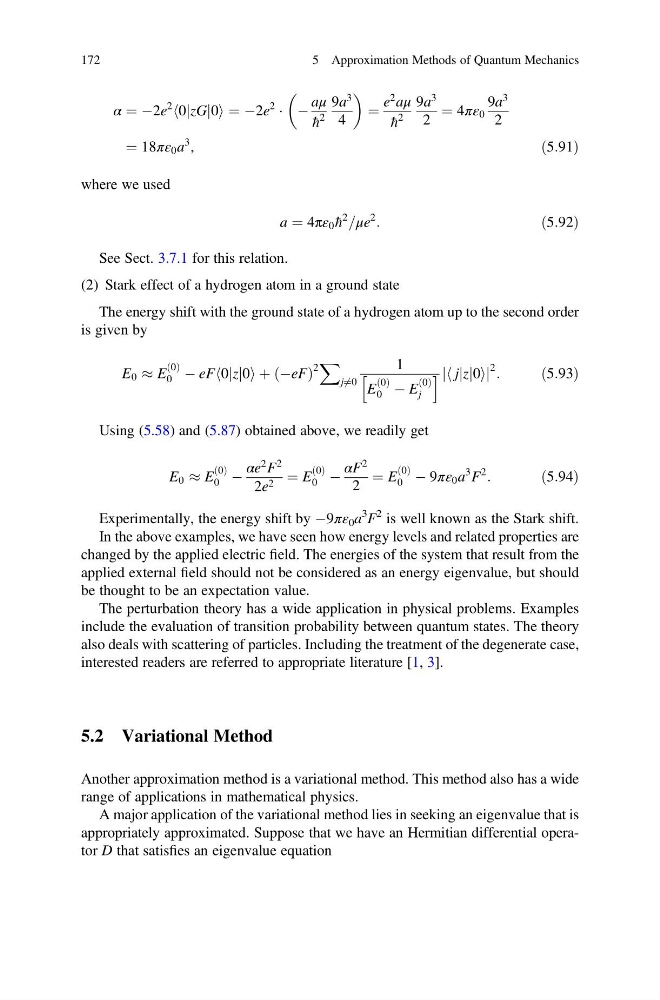
α ¼ À2e
2 0
h zG
j j0i ¼ À2e
2
Á À
aμ
h
2
9a
3
4
¼
e
2 aμ
h
2
9a
3
2
¼ 4πε 0
9a
3
2
¼ 18πε 0 a
3 ,
ð5:91Þ
where we used
a ¼ 4πε 0 h
2
=μe
2
:
ð5:92Þ
See Sect. 3.7.1 for this relation.
(2) Stark effect of a hydrogen atom in a ground state
The energy shift with the ground state of a hydrogen atom up to the second order
is given by
E 0 % E
0
ð Þ
0 À eF 0jzj0
h
iþ ÀeF
ð
Þ
2
X
j6 ¼0
1
E
0
ð Þ
0 À E
0
ð Þ
j
h
i jjzj0
h
i
j
j
2 :
ð5:93Þ
Using (5.58) and (5.87) obtained above, we readily get
E 0 % E
0
ð Þ
0 À
αe
2 F
2
2e 2 ¼ E
0
ð Þ
0 À
αF
2
2
¼ E
0
ð Þ
0 À 9πε 0 a
3 F
2
:
ð5:94Þ
Experimentally, the energy shift by À9πε 0 a
3 F
2 is well known as the Stark shift.
In the above examples, we have seen how energy levels and related properties are
changed by the applied electric field. The energies of the system that result from the
applied external field should not be considered as an energy eigenvalue, but should
be thought to be an expectation value.
The perturbation theory has a wide application in physical problems. Examples
include the evaluation of transition probability between quantum states. The theory
also deals with scattering of particles. Including the treatment of the degenerate case,
interested readers are referred to appropriate literature [1, 3].
5.2 Variational Method
Another approximation method is a variational method. This method also has a wide
range of applications in mathematical physics.
A major application of the variational method lies in seeking an eigenvalue that is
appropriately approximated. Suppose that we have an Hermitian differential operator D that satisfies an eigenvalue equation
172
5 Approximation Methods of Quantum Mechanics
2 0
h zG
j j0i ¼ À2e
2
Á À
aμ
h
2
9a
3
4
¼
e
2 aμ
h
2
9a
3
2
¼ 4πε 0
9a
3
2
¼ 18πε 0 a
3 ,
ð5:91Þ
where we used
a ¼ 4πε 0 h
2
=μe
2
:
ð5:92Þ
See Sect. 3.7.1 for this relation.
(2) Stark effect of a hydrogen atom in a ground state
The energy shift with the ground state of a hydrogen atom up to the second order
is given by
E 0 % E
0
ð Þ
0 À eF 0jzj0
h
iþ ÀeF
ð
Þ
2
X
j6 ¼0
1
E
0
ð Þ
0 À E
0
ð Þ
j
h
i jjzj0
h
i
j
j
2 :
ð5:93Þ
Using (5.58) and (5.87) obtained above, we readily get
E 0 % E
0
ð Þ
0 À
αe
2 F
2
2e 2 ¼ E
0
ð Þ
0 À
αF
2
2
¼ E
0
ð Þ
0 À 9πε 0 a
3 F
2
:
ð5:94Þ
Experimentally, the energy shift by À9πε 0 a
3 F
2 is well known as the Stark shift.
In the above examples, we have seen how energy levels and related properties are
changed by the applied electric field. The energies of the system that result from the
applied external field should not be considered as an energy eigenvalue, but should
be thought to be an expectation value.
The perturbation theory has a wide application in physical problems. Examples
include the evaluation of transition probability between quantum states. The theory
also deals with scattering of particles. Including the treatment of the degenerate case,
interested readers are referred to appropriate literature [1, 3].
5.2 Variational Method
Another approximation method is a variational method. This method also has a wide
range of applications in mathematical physics.
A major application of the variational method lies in seeking an eigenvalue that is
appropriately approximated. Suppose that we have an Hermitian differential operator D that satisfies an eigenvalue equation
172
5 Approximation Methods of Quantum Mechanics