

0
h zG
j j0i ¼
X
j
0
h z
j j ji j
h G
j j0i ¼
X
j6 ¼0
0
h z
j j ji j
h z
j j0i
E
0
ð Þ
0 À E
0
ð Þ
j
h
i¼
X
j6 ¼0
jjzj0
h
i
j
j
2
E
0
ð Þ
0 À E
0
ð Þ
j
h
i
¼ À
α
2e 2 ,
ð5:87Þ
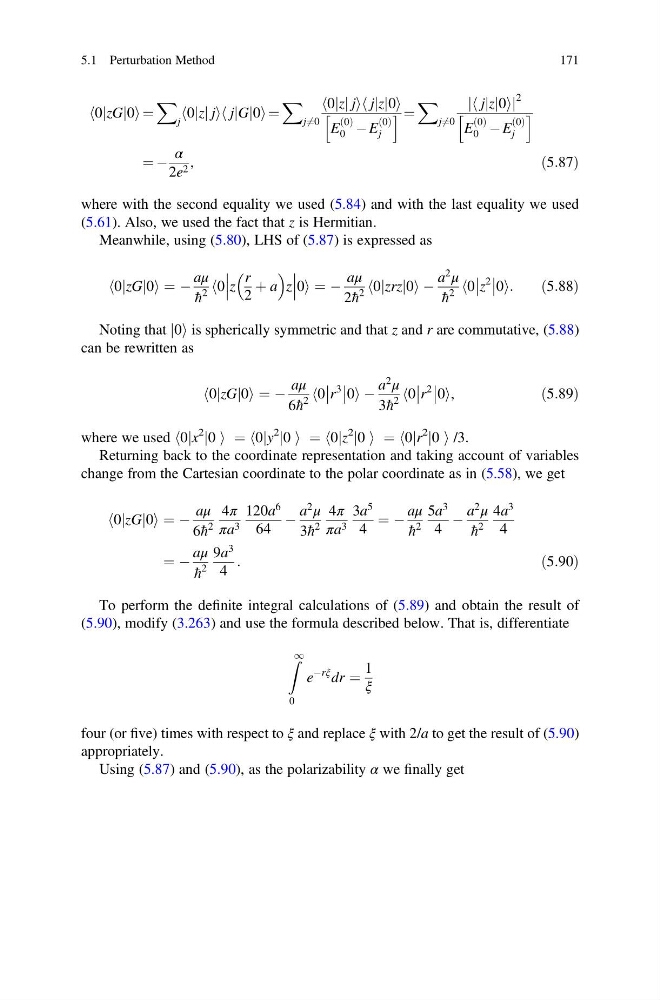
where with the second equality we used (5.84) and with the last equality we used
(5.61). Also, we used the fact that z is Hermitian.
Meanwhile, using (5.80), LHS of (5.87) is expressed as
0
h zG
j j0i ¼ À
aμ
h
2
0
h z
r
2
þ a
z
0i ¼ À
aμ
2h
2
0
h zrz
j j0i À
a
2
μ
h
2
0
h z
2
0i:
ð5:88Þ
Noting that j0i is spherically symmetric and that z and r are commutative, (5.88)
can be rewritten as
0
h zG
j j0i ¼ À
aμ
6h
2
0
h r
3
0i À
a
2
μ
3h
2
0
h r
2
0i,
ð5:89Þ
where we used h0jx
2
j0 i ¼ h0jy
2
j0 i ¼ h0jz
2
j0 i ¼ h0jr
2
j0 i /3.
Returning back to the coordinate representation and taking account of variables
change from the Cartesian coordinate to the polar coordinate as in (5.58), we get
0
h zG
j j0i ¼ À
aμ
6h
2
4π
πa 3
120a
6
64
À
a
2
μ
3h
2
4π
πa 3
3a
5
4
¼ À
aμ
h
2
5a
3
4
À
a
2
μ
h
2
4a
3
4
¼ À
aμ
h
2
9a
3
4
:
ð5:90Þ
To perform the definite integral calculations of (5.89) and obtain the result of
(5.90), modify (3.263) and use the formula described below. That is, differentiate
Z 1
0
e
Àrξ dr ¼
1
ξ
four (or five) times with respect to ξ and replace ξ with 2/a to get the result of (5.90)
appropriately.
Using (5.87) and (5.90), as the polarizability α we finally get
5.1 Perturbation Method
171
h zG
j j0i ¼
X
j
0
h z
j j ji j
h G
j j0i ¼
X
j6 ¼0
0
h z
j j ji j
h z
j j0i
E
0
ð Þ
0 À E
0
ð Þ
j
h
i¼
X
j6 ¼0
jjzj0
h
i
j
j
2
E
0
ð Þ
0 À E
0
ð Þ
j
h
i
¼ À
α
2e 2 ,
ð5:87Þ
where with the second equality we used (5.84) and with the last equality we used
(5.61). Also, we used the fact that z is Hermitian.
Meanwhile, using (5.80), LHS of (5.87) is expressed as
0
h zG
j j0i ¼ À
aμ
h
2
0
h z
r
2
þ a
z
0i ¼ À
aμ
2h
2
0
h zrz
j j0i À
a
2
μ
h
2
0
h z
2
0i:
ð5:88Þ
Noting that j0i is spherically symmetric and that z and r are commutative, (5.88)
can be rewritten as
0
h zG
j j0i ¼ À
aμ
6h
2
0
h r
3
0i À
a
2
μ
3h
2
0
h r
2
0i,
ð5:89Þ
where we used h0jx
2
j0 i ¼ h0jy
2
j0 i ¼ h0jz
2
j0 i ¼ h0jr
2
j0 i /3.
Returning back to the coordinate representation and taking account of variables
change from the Cartesian coordinate to the polar coordinate as in (5.58), we get
0
h zG
j j0i ¼ À
aμ
6h
2
4π
πa 3
120a
6
64
À
a
2
μ
3h
2
4π
πa 3
3a
5
4
¼ À
aμ
h
2
5a
3
4
À
a
2
μ
h
2
4a
3
4
¼ À
aμ
h
2
9a
3
4
:
ð5:90Þ
To perform the definite integral calculations of (5.89) and obtain the result of
(5.90), modify (3.263) and use the formula described below. That is, differentiate
Z 1
0
e
Àrξ dr ¼
1
ξ
four (or five) times with respect to ξ and replace ξ with 2/a to get the result of (5.90)
appropriately.
Using (5.87) and (5.90), as the polarizability α we finally get
5.1 Perturbation Method
171