

g r
ð Þ ¼ À
aμ
h
2
r
2
þ a
r:
ð5:79Þ
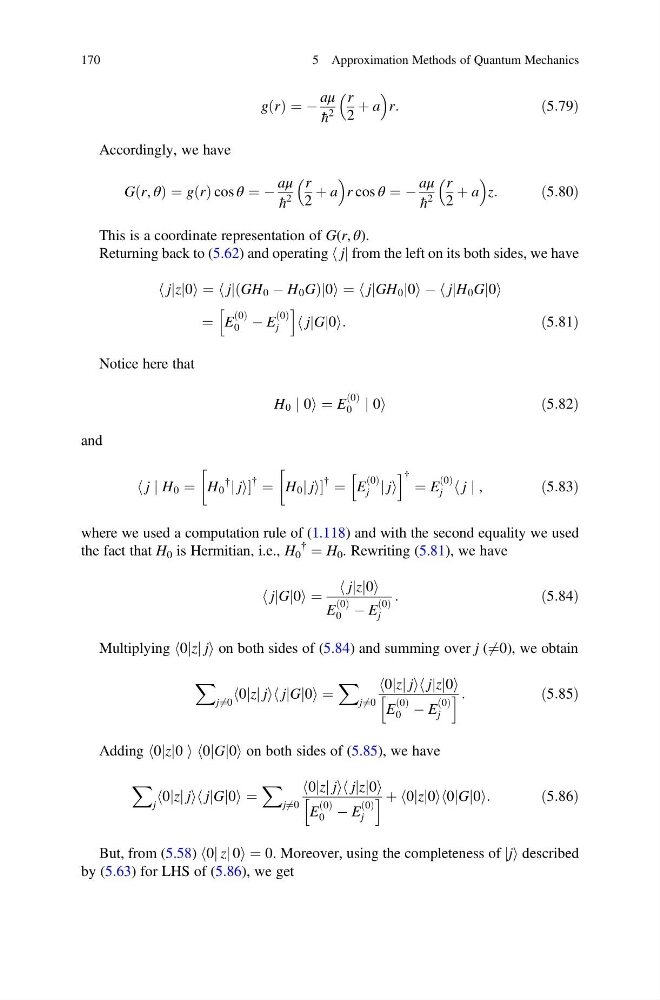
Accordingly, we have
G r, θ
ð Þ ¼ g r
ð Þ cos θ ¼ À
aμ
h
2
r
2
þ a
r cos θ ¼ À
aμ
h
2
r
2
þ a
z:
ð5:80Þ
This is a coordinate representation of G(r, θ).
Returning back to (5.62) and operating h jj from the left on its both sides, we have
j
h z
j j0i ¼ j
h GH 0 À H 0 G
ð
Þ
j
j 0i ¼ j
h GH 0
j
j0i À j
h H 0 G
j
j0i
¼ E
0
ð Þ
0 À E
0
ð Þ
j
h
i
j
h G
j j0i:
ð5:81Þ
Notice here that
H 0 j 0i ¼ E
0
ð Þ
0 j 0i
ð 5:82Þ
and
j
h j H 0 ¼ H 0
{ ji
j
{ ¼ H 0 ji
j
{ ¼ E
0
ð Þ
j j ji
h
i { ¼ E
0
ð Þ
j
j
h j ,
ð5:83Þ
where we used a computation rule of (1.118) and with the second equality we used
the fact that H 0 is Hermitian, i.e., H 0
{
¼ H 0 . Rewriting (5.81), we have
j
h G
j j0i ¼
j
h z
j j0i
E
0
ð Þ
0 À E
0
ð Þ
j
:
ð5:84Þ
Multiplying h0jzj ji on both sides of (5.84) and summing over j (6 ¼0), we obtain
X
j6 ¼0
0
h z
j j ji j
h G
j j0i ¼
X
j6 ¼0
0
h z
j j ji j
h z
j j0i
E
0
ð Þ
0 À E
0
ð Þ
j
h
i:
ð5:85Þ
Adding h0jzj0 i h0jGj0i on both sides of (5.85), we have
X
j
0
h z
j j ji j
h G
j j0i ¼
X
j6 ¼0
0
h z
j j ji j
h z
j j0i
E
0
ð Þ
0 À E
0
ð Þ
j
h
iþ 0
h z
j j0i 0
h G
j j0i:
ð5:86Þ
But, from (5.58) h0j zj 0i ¼ 0. Moreover, using the completeness of jji described
by (5.63) for LHS of (5.86), we get
170
5 Approximation Methods of Quantum Mechanics
ð Þ ¼ À
aμ
h
2
r
2
þ a
r:
ð5:79Þ
Accordingly, we have
G r, θ
ð Þ ¼ g r
ð Þ cos θ ¼ À
aμ
h
2
r
2
þ a
r cos θ ¼ À
aμ
h
2
r
2
þ a
z:
ð5:80Þ
This is a coordinate representation of G(r, θ).
Returning back to (5.62) and operating h jj from the left on its both sides, we have
j
h z
j j0i ¼ j
h GH 0 À H 0 G
ð
Þ
j
j 0i ¼ j
h GH 0
j
j0i À j
h H 0 G
j
j0i
¼ E
0
ð Þ
0 À E
0
ð Þ
j
h
i
j
h G
j j0i:
ð5:81Þ
Notice here that
H 0 j 0i ¼ E
0
ð Þ
0 j 0i
ð 5:82Þ
and
j
h j H 0 ¼ H 0
{ ji
j
{ ¼ H 0 ji
j
{ ¼ E
0
ð Þ
j j ji
h
i { ¼ E
0
ð Þ
j
j
h j ,
ð5:83Þ
where we used a computation rule of (1.118) and with the second equality we used
the fact that H 0 is Hermitian, i.e., H 0
{
¼ H 0 . Rewriting (5.81), we have
j
h G
j j0i ¼
j
h z
j j0i
E
0
ð Þ
0 À E
0
ð Þ
j
:
ð5:84Þ
Multiplying h0jzj ji on both sides of (5.84) and summing over j (6 ¼0), we obtain
X
j6 ¼0
0
h z
j j ji j
h G
j j0i ¼
X
j6 ¼0
0
h z
j j ji j
h z
j j0i
E
0
ð Þ
0 À E
0
ð Þ
j
h
i:
ð5:85Þ
Adding h0jzj0 i h0jGj0i on both sides of (5.85), we have
X
j
0
h z
j j ji j
h G
j j0i ¼
X
j6 ¼0
0
h z
j j ji j
h z
j j0i
E
0
ð Þ
0 À E
0
ð Þ
j
h
iþ 0
h z
j j0i 0
h G
j j0i:
ð5:86Þ
But, from (5.58) h0j zj 0i ¼ 0. Moreover, using the completeness of jji described
by (5.63) for LHS of (5.86), we get
170
5 Approximation Methods of Quantum Mechanics