

j Ψ 0 i %j 0i þ λ j ϕ
1
ð Þ
0 i ¼j 0i þ λ
X
k6 ¼0
j ki
kjVj0
h
i
E
0
ð Þ
0 À E
0
ð Þ
k
h
i¼j 0i þ λ j 1i
1jVj0
h
i
E
0
ð Þ
0 À E
0
ð Þ
1
h
i
¼ 0i À eF
j
j 1i
1jxj0
h
i
E
0
ð Þ
0 À E
0
ð Þ
1
h
i¼j 0i þ
ffiffiffiffiffiffiffiffiffiffiffiffiffi ffi
e 2 F
2
2mω 3 h
r
j 1i:
ð5:47Þ
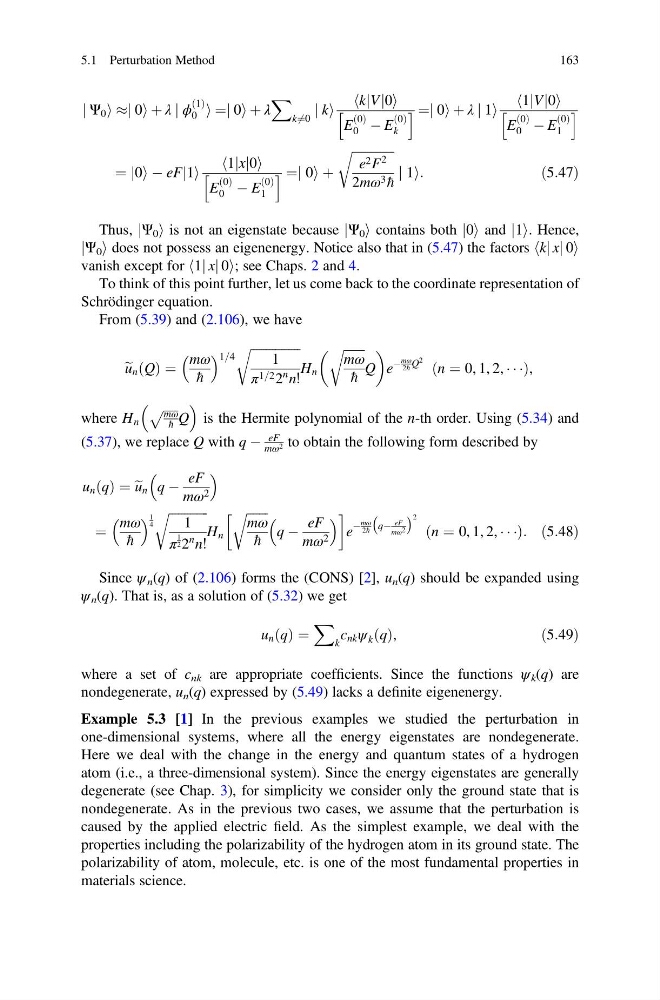
Thus, jΨ 0 i is not an eigenstate because jΨ 0 i contains both j0i and j1i. Hence,
jΨ 0 i does not possess an eigenenergy. Notice also that in (5.47) the factors hkj xj 0i
vanish except for h1j xj 0i; see Chaps. 2 and 4.
To think of this point further, let us come back to the coordinate representation of
Schrödinger equation.
From (5.39) and (2.106), we have
e u n Q
ð Þ ¼
mω
h
1=4
ffiffiffiffiffiffiffiffiffiffiffiffiffiffiffiffi
1
π 1=2 2
n n!
r
H n
ffiffiffiffiffiffiffi
mω
h
r
Q
e
À
mω
2h Q
2
n ¼ 0, 1, 2, Á Á Á
ð
Þ ,
where H n
ffiffiffiffiffi mω
h
p
Q
is the Hermite polynomial of the n-th order. Using (5.34) and
(5.37), we replace Q with q À
eF
mω 2 to obtain the following form described by
u n q
ð Þ ¼ e u n q À
eF
mω 2
¼
mω
h
1
4
ffiffiffiffiffiffiffiffiffiffiffiffi ffi
1
π
1
2 2
n n!
r
H n
ffiffiffiffiffiffiffi
mω
h
r
q À
eF
mω 2
!
e
À
mω
2h qÀ
eF
mω 2
À
Á 2
n ¼ 0, 1, 2, Á Á Á
ð
Þ : ð5:48Þ
Since ψ n (q) of (2.106) forms the (CONS) [2], u n (q) should be expanded using
ψ n (q). That is, as a solution of (5.32) we get
u n q
ð Þ ¼
X
k
c nk ψ k q
ð Þ,
ð5:49Þ
where a set of c nk are appropriate coefficients. Since the functions ψ k (q) are
nondegenerate, u n (q) expressed by (5.49) lacks a definite eigenenergy.
Example 5.3 [1] In the previous examples we studied the perturbation in
one-dimensional systems, where all the energy eigenstates are nondegenerate.
Here we deal with the change in the energy and quantum states of a hydrogen
atom (i.e., a three-dimensional system). Since the energy eigenstates are generally
degenerate (see Chap. 3), for simplicity we consider only the ground state that is
nondegenerate. As in the previous two cases, we assume that the perturbation is
caused by the applied electric field. As the simplest example, we deal with the
properties including the polarizability of the hydrogen atom in its ground state. The
polarizability of atom, molecule, etc. is one of the most fundamental properties in
materials science.
5.1 Perturbation Method
163
1
ð Þ
0 i ¼j 0i þ λ
X
k6 ¼0
j ki
kjVj0
h
i
E
0
ð Þ
0 À E
0
ð Þ
k
h
i¼j 0i þ λ j 1i
1jVj0
h
i
E
0
ð Þ
0 À E
0
ð Þ
1
h
i
¼ 0i À eF
j
j 1i
1jxj0
h
i
E
0
ð Þ
0 À E
0
ð Þ
1
h
i¼j 0i þ
ffiffiffiffiffiffiffiffiffiffiffiffiffi ffi
e 2 F
2
2mω 3 h
r
j 1i:
ð5:47Þ
Thus, jΨ 0 i is not an eigenstate because jΨ 0 i contains both j0i and j1i. Hence,
jΨ 0 i does not possess an eigenenergy. Notice also that in (5.47) the factors hkj xj 0i
vanish except for h1j xj 0i; see Chaps. 2 and 4.
To think of this point further, let us come back to the coordinate representation of
Schrödinger equation.
From (5.39) and (2.106), we have
e u n Q
ð Þ ¼
mω
h
1=4
ffiffiffiffiffiffiffiffiffiffiffiffiffiffiffiffi
1
π 1=2 2
n n!
r
H n
ffiffiffiffiffiffiffi
mω
h
r
Q
e
À
mω
2h Q
2
n ¼ 0, 1, 2, Á Á Á
ð
Þ ,
where H n
ffiffiffiffiffi mω
h
p
Q
is the Hermite polynomial of the n-th order. Using (5.34) and
(5.37), we replace Q with q À
eF
mω 2 to obtain the following form described by
u n q
ð Þ ¼ e u n q À
eF
mω 2
¼
mω
h
1
4
ffiffiffiffiffiffiffiffiffiffiffiffi ffi
1
π
1
2 2
n n!
r
H n
ffiffiffiffiffiffiffi
mω
h
r
q À
eF
mω 2
!
e
À
mω
2h qÀ
eF
mω 2
À
Á 2
n ¼ 0, 1, 2, Á Á Á
ð
Þ : ð5:48Þ
Since ψ n (q) of (2.106) forms the (CONS) [2], u n (q) should be expanded using
ψ n (q). That is, as a solution of (5.32) we get
u n q
ð Þ ¼
X
k
c nk ψ k q
ð Þ,
ð5:49Þ
where a set of c nk are appropriate coefficients. Since the functions ψ k (q) are
nondegenerate, u n (q) expressed by (5.49) lacks a definite eigenenergy.
Example 5.3 [1] In the previous examples we studied the perturbation in
one-dimensional systems, where all the energy eigenstates are nondegenerate.
Here we deal with the change in the energy and quantum states of a hydrogen
atom (i.e., a three-dimensional system). Since the energy eigenstates are generally
degenerate (see Chap. 3), for simplicity we consider only the ground state that is
nondegenerate. As in the previous two cases, we assume that the perturbation is
caused by the applied electric field. As the simplest example, we deal with the
properties including the polarizability of the hydrogen atom in its ground state. The
polarizability of atom, molecule, etc. is one of the most fundamental properties in
materials science.
5.1 Perturbation Method
163