

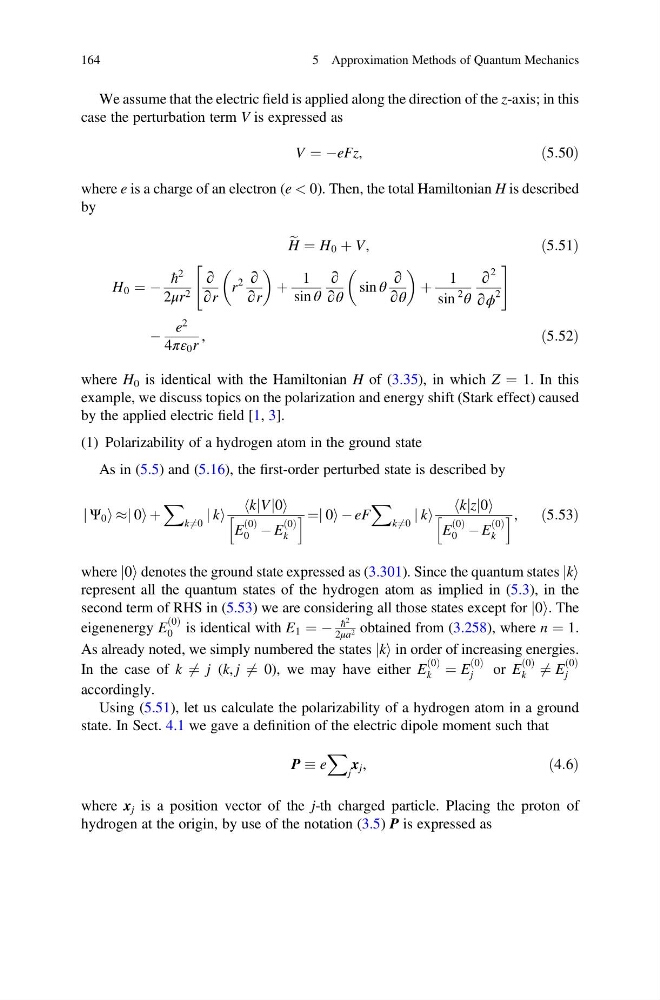
We assume that the electric field is applied along the direction of the z-axis; in this
case the perturbation term V is expressed as
V ¼ ÀeFz,
ð5:50Þ
where e is a charge of an electron (e < 0). Then, the total Hamiltonian H is described
by
e
H ¼ H 0 þ V,
ð5:51Þ
H 0 ¼ À
h
2
2μr 2
∂
∂r
r
2 ∂
∂r
þ
1
sin θ
∂
∂θ
sin θ
∂
∂θ
þ
1
sin
2
θ
∂
2
∂ϕ
2
"
#
À
e
2
4πε 0 r
,
ð5:52Þ
where H 0 is identical with the Hamiltonian H of (3.35), in which Z ¼ 1. In this
example, we discuss topics on the polarization and energy shift (Stark effect) caused
by the applied electric field [1, 3].
(1) Polarizability of a hydrogen atom in the ground state
As in (5.5) and (5.16), the first-order perturbed state is described by
j Ψ 0 i %j 0i þ
X
k6 ¼0
j ki
kjVj0
h
i
E
0
ð Þ
0 À E
0
ð Þ
k
h
i¼j 0i À eF
X
k6 ¼0
j ki
kjzj0
h
i
E
0
ð Þ
0 À E
0
ð Þ
k
h
i ,
ð5:53Þ
where j0i denotes the ground state expressed as (3.301). Since the quantum states jki
represent all the quantum states of the hydrogen atom as implied in (5.3), in the
second term of RHS in (5.53) we are considering all those states except for j0i. The
eigenenergy E
0
ð Þ
0 is identical with E 1 ¼ À
h
2
2μa 2 obtained from (3.258), where n ¼ 1.
As already noted, we simply numbered the states jki in order of increasing energies.
In the case of k 6 ¼ j (k, j 6 ¼ 0), we may have either E
0
ð Þ
k ¼ E
0
ð Þ
j
or E
0
ð Þ
k 6 ¼ E
0
ð Þ
j
accordingly.
Using (5.51), let us calculate the polarizability of a hydrogen atom in a ground
state. In Sect. 4.1 we gave a definition of the electric dipole moment such that
P e
X
j
x j ,
ð4:6Þ
where x j is a position vector of the j-th charged particle. Placing the proton of
hydrogen at the origin, by use of the notation (3.5) P is expressed as
164
5 Approximation Methods of Quantum Mechanics
case the perturbation term V is expressed as
V ¼ ÀeFz,
ð5:50Þ
where e is a charge of an electron (e < 0). Then, the total Hamiltonian H is described
by
e
H ¼ H 0 þ V,
ð5:51Þ
H 0 ¼ À
h
2
2μr 2
∂
∂r
r
2 ∂
∂r
þ
1
sin θ
∂
∂θ
sin θ
∂
∂θ
þ
1
sin
2
θ
∂
2
∂ϕ
2
"
#
À
e
2
4πε 0 r
,
ð5:52Þ
where H 0 is identical with the Hamiltonian H of (3.35), in which Z ¼ 1. In this
example, we discuss topics on the polarization and energy shift (Stark effect) caused
by the applied electric field [1, 3].
(1) Polarizability of a hydrogen atom in the ground state
As in (5.5) and (5.16), the first-order perturbed state is described by
j Ψ 0 i %j 0i þ
X
k6 ¼0
j ki
kjVj0
h
i
E
0
ð Þ
0 À E
0
ð Þ
k
h
i¼j 0i À eF
X
k6 ¼0
j ki
kjzj0
h
i
E
0
ð Þ
0 À E
0
ð Þ
k
h
i ,
ð5:53Þ
where j0i denotes the ground state expressed as (3.301). Since the quantum states jki
represent all the quantum states of the hydrogen atom as implied in (5.3), in the
second term of RHS in (5.53) we are considering all those states except for j0i. The
eigenenergy E
0
ð Þ
0 is identical with E 1 ¼ À
h
2
2μa 2 obtained from (3.258), where n ¼ 1.
As already noted, we simply numbered the states jki in order of increasing energies.
In the case of k 6 ¼ j (k, j 6 ¼ 0), we may have either E
0
ð Þ
k ¼ E
0
ð Þ
j
or E
0
ð Þ
k 6 ¼ E
0
ð Þ
j
accordingly.
Using (5.51), let us calculate the polarizability of a hydrogen atom in a ground
state. In Sect. 4.1 we gave a definition of the electric dipole moment such that
P e
X
j
x j ,
ð4:6Þ
where x j is a position vector of the j-th charged particle. Placing the proton of
hydrogen at the origin, by use of the notation (3.5) P is expressed as
164
5 Approximation Methods of Quantum Mechanics