

E
0
ð Þ
n ¼ hω n þ
1
2
:
ð5:43Þ
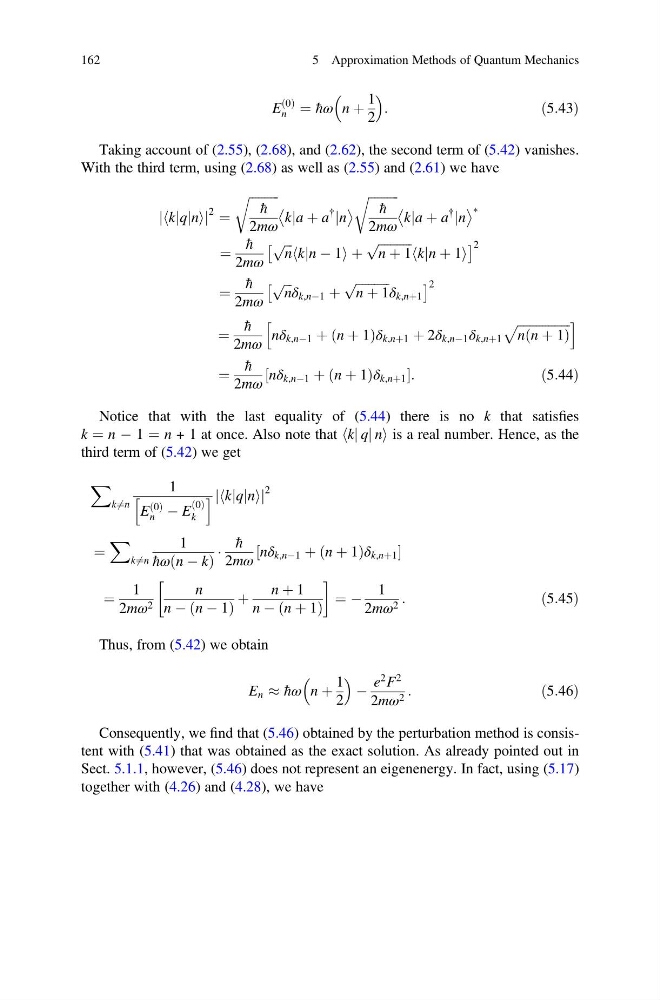
Taking account of (2.55), (2.68), and (2.62), the second term of (5.42) vanishes.
With the third term, using (2.68) as well as (2.55) and (2.61) we have
kjqjn
h
i
j
j
2 ¼
ffiffiffiffiffiffiffiffiffi ffi
h
2mω
r
kja þ a
{
jn
ffiffiffiffiffiffiffiffiffi ffi
h
2mω
r
kja þ a
{
jn
Ã
¼
h
2mω
ffiffi ffi
n
p
kjn À 1
h
iþ
ffiffiffiffiffiffiffiffiffiffiffi
n þ 1
p
kjn þ 1
h
i
Â
à 2
¼
h
2mω
ffiffi ffi
n
p δ k,nÀ1 þ
ffiffiffiffiffiffiffiffiffiffiffi
n þ 1
p
δ k,nþ1
Â
à 2
¼
h
2mω
nδ k,nÀ1 þ n þ 1
ð
Þδ k,nþ1 þ 2δ k,nÀ1 δ k,nþ1
ffiffiffiffiffiffiffiffiffiffiffiffiffiffiffiffiffi
n n þ 1
ð
Þ
p
h
i
¼
h
2mω
nδ k,nÀ1 þ n þ 1
ð
Þδ k,nþ1
½
:
ð5:44Þ
Notice that with the last equality of (5.44) there is no k that satisfies
k ¼ n À 1 ¼ n + 1 at once. Also note that hkj qj ni is a real number. Hence, as the
third term of (5.42) we get
X
k6 ¼n
1
E
0
ð Þ
n À E
0
ð Þ
k
h
i kjqjn
h
i
j
j
2
¼
X
k6 ¼n
1
hω n À k
ð
Þ
Á
h
2mω
nδ k,nÀ1 þ n þ 1
ð
Þδ k,nþ1
½
¼
1
2mω 2
n
n À n À 1
ð
Þ
þ
n þ 1
n À n þ 1
ð
Þ
!
¼ À
1
2mω 2 :
ð5:45Þ
Thus, from (5.42) we obtain
E n % hω n þ
1
2
À
e
2 F
2
2mω 2 :
ð5:46Þ
Consequently, we find that (5.46) obtained by the perturbation method is consistent with (5.41) that was obtained as the exact solution. As already pointed out in
Sect. 5.1.1, however, (5.46) does not represent an eigenenergy. In fact, using (5.17)
together with (4.26) and (4.28), we have
162
5 Approximation Methods of Quantum Mechanics
0
ð Þ
n ¼ hω n þ
1
2
:
ð5:43Þ
Taking account of (2.55), (2.68), and (2.62), the second term of (5.42) vanishes.
With the third term, using (2.68) as well as (2.55) and (2.61) we have
kjqjn
h
i
j
j
2 ¼
ffiffiffiffiffiffiffiffiffi ffi
h
2mω
r
kja þ a
{
jn
ffiffiffiffiffiffiffiffiffi ffi
h
2mω
r
kja þ a
{
jn
Ã
¼
h
2mω
ffiffi ffi
n
p
kjn À 1
h
iþ
ffiffiffiffiffiffiffiffiffiffiffi
n þ 1
p
kjn þ 1
h
i
Â
à 2
¼
h
2mω
ffiffi ffi
n
p δ k,nÀ1 þ
ffiffiffiffiffiffiffiffiffiffiffi
n þ 1
p
δ k,nþ1
Â
à 2
¼
h
2mω
nδ k,nÀ1 þ n þ 1
ð
Þδ k,nþ1 þ 2δ k,nÀ1 δ k,nþ1
ffiffiffiffiffiffiffiffiffiffiffiffiffiffiffiffiffi
n n þ 1
ð
Þ
p
h
i
¼
h
2mω
nδ k,nÀ1 þ n þ 1
ð
Þδ k,nþ1
½
:
ð5:44Þ
Notice that with the last equality of (5.44) there is no k that satisfies
k ¼ n À 1 ¼ n + 1 at once. Also note that hkj qj ni is a real number. Hence, as the
third term of (5.42) we get
X
k6 ¼n
1
E
0
ð Þ
n À E
0
ð Þ
k
h
i kjqjn
h
i
j
j
2
¼
X
k6 ¼n
1
hω n À k
ð
Þ
Á
h
2mω
nδ k,nÀ1 þ n þ 1
ð
Þδ k,nþ1
½
¼
1
2mω 2
n
n À n À 1
ð
Þ
þ
n þ 1
n À n þ 1
ð
Þ
!
¼ À
1
2mω 2 :
ð5:45Þ
Thus, from (5.42) we obtain
E n % hω n þ
1
2
À
e
2 F
2
2mω 2 :
ð5:46Þ
Consequently, we find that (5.46) obtained by the perturbation method is consistent with (5.41) that was obtained as the exact solution. As already pointed out in
Sect. 5.1.1, however, (5.46) does not represent an eigenenergy. In fact, using (5.17)
together with (4.26) and (4.28), we have
162
5 Approximation Methods of Quantum Mechanics