

À
h
2
2m
d
2
e u Q
ð Þ
dQ
2
þ
1
2
mω
2 Q
2
e u Q
ð Þ ¼ E þ
1
2
mω
2 eF
mω 2
2 !
e u Q
ð Þ,
ð5:36Þ
where
u q
ð Þ ¼ u Q þ
eF
mω 2
e u Q
ð Þ:
ð5:37Þ
Defining e
E as
e
E E þ
1
2
mω
2 eF
mω 2
2
¼ E þ
e
2 F
2
2mω 2 ,
ð5:38Þ
we get
À
h
2
2m
d
2
e u Q
ð Þ
dQ
2
þ
1
2
mω
2 Q
2
e u Q
ð Þ ¼ e
E e u Q
ð Þ:
ð5:39Þ
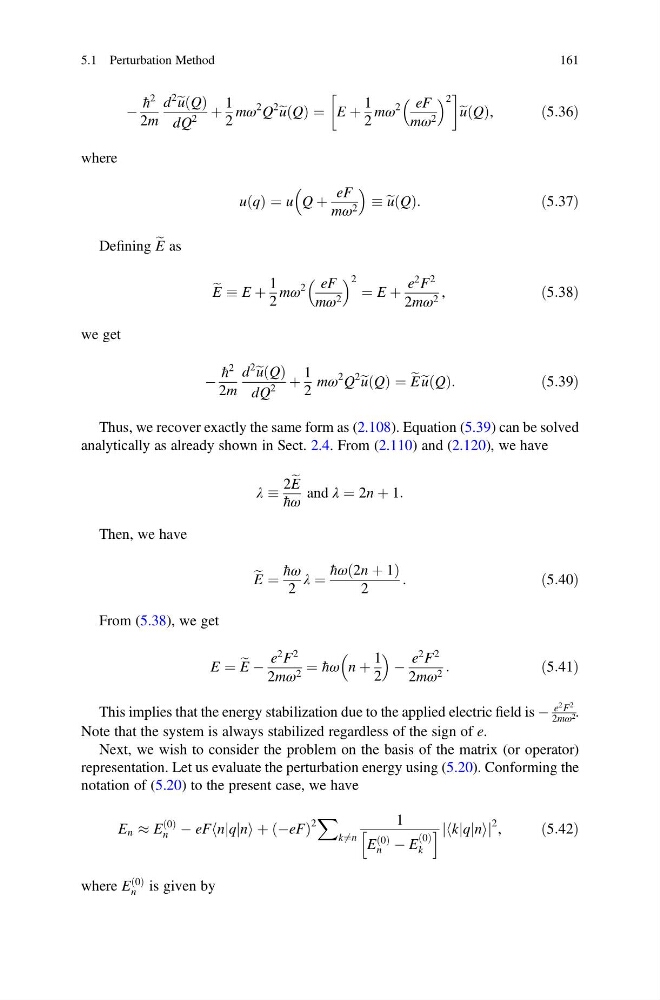
Thus, we recover exactly the same form as (2.108). Equation (5.39) can be solved
analytically as already shown in Sect. 2.4. From (2.110) and (2.120), we have
λ
2 e
E
hω
and λ ¼ 2n þ 1:
Then, we have
e
E ¼
hω
2
λ ¼
hω 2n þ 1
ð
Þ
2
:
ð5:40Þ
From (5.38), we get
E ¼ e
E À
e
2 F
2
2mω 2 ¼ hω n þ
1
2
À
e
2 F
2
2mω 2 :
ð5:41Þ
This implies that the energy stabilization due to the applied electric field is À
e
2 F
2
2mω 2 .
Note that the system is always stabilized regardless of the sign of e.
Next, we wish to consider the problem on the basis of the matrix (or operator)
representation. Let us evaluate the perturbation energy using (5.20). Conforming the
notation of (5.20) to the present case, we have
E n % E
0
ð Þ
n À eF njqjn
h
iþ ÀeF
ð
Þ
2
X
k6 ¼n
1
E
0
ð Þ
n À E
0
ð Þ
k
h
i kjqjn
h
i
j
j
2 ,
ð5:42Þ
where E
0
ð Þ
n is given by
5.1 Perturbation Method
161
h
2
2m
d
2
e u Q
ð Þ
dQ
2
þ
1
2
mω
2 Q
2
e u Q
ð Þ ¼ E þ
1
2
mω
2 eF
mω 2
2 !
e u Q
ð Þ,
ð5:36Þ
where
u q
ð Þ ¼ u Q þ
eF
mω 2
e u Q
ð Þ:
ð5:37Þ
Defining e
E as
e
E E þ
1
2
mω
2 eF
mω 2
2
¼ E þ
e
2 F
2
2mω 2 ,
ð5:38Þ
we get
À
h
2
2m
d
2
e u Q
ð Þ
dQ
2
þ
1
2
mω
2 Q
2
e u Q
ð Þ ¼ e
E e u Q
ð Þ:
ð5:39Þ
Thus, we recover exactly the same form as (2.108). Equation (5.39) can be solved
analytically as already shown in Sect. 2.4. From (2.110) and (2.120), we have
λ
2 e
E
hω
and λ ¼ 2n þ 1:
Then, we have
e
E ¼
hω
2
λ ¼
hω 2n þ 1
ð
Þ
2
:
ð5:40Þ
From (5.38), we get
E ¼ e
E À
e
2 F
2
2mω 2 ¼ hω n þ
1
2
À
e
2 F
2
2mω 2 :
ð5:41Þ
This implies that the energy stabilization due to the applied electric field is À
e
2 F
2
2mω 2 .
Note that the system is always stabilized regardless of the sign of e.
Next, we wish to consider the problem on the basis of the matrix (or operator)
representation. Let us evaluate the perturbation energy using (5.20). Conforming the
notation of (5.20) to the present case, we have
E n % E
0
ð Þ
n À eF njqjn
h
iþ ÀeF
ð
Þ
2
X
k6 ¼n
1
E
0
ð Þ
n À E
0
ð Þ
k
h
i kjqjn
h
i
j
j
2 ,
ð5:42Þ
where E
0
ð Þ
n is given by
5.1 Perturbation Method
161