

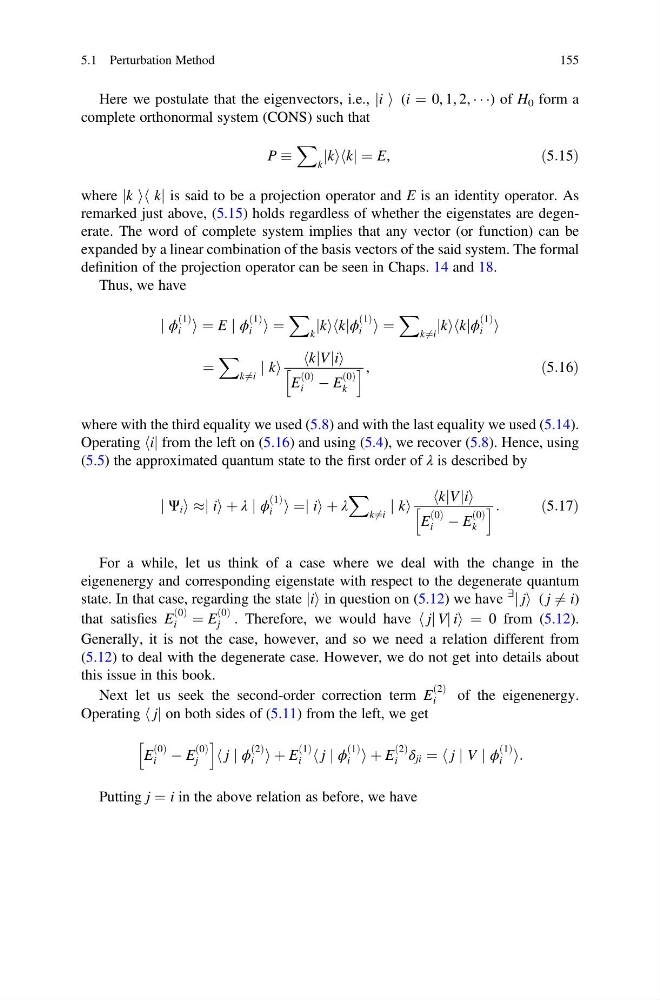
Here we postulate that the eigenvectors, i.e., ji i (i ¼ 0, 1, 2, Á Á Á) of H 0 form a
complete orthonormal system (CONS) such that
P
X
k
kihk
j
j ¼ E,
ð5:15Þ
where jk ih kj is said to be a projection operator and E is an identity operator. As
remarked just above, (5.15) holds regardless of whether the eigenstates are degenerate. The word of complete system implies that any vector (or function) can be
expanded by a linear combination of the basis vectors of the said system. The formal
definition of the projection operator can be seen in Chaps. 14 and 18.
Thus, we have
j ϕ
1
ð Þ
i i ¼ E j ϕ
1
ð Þ
i i ¼
X
k
kihk
j
jϕ
1
ð Þ
i i ¼
X
k6 ¼i
kihk
j
jϕ
1
ð Þ
i i
¼
X
k6 ¼i
j ki
kjVji
h
i
E
0
ð Þ
i À E
0
ð Þ
k
h
i,
ð5:16Þ
where with the third equality we used (5.8) and with the last equality we used (5.14).
Operating hij from the left on (5.16) and using (5.4), we recover (5.8). Hence, using
(5.5) the approximated quantum state to the first order of λ is described by
j Ψ i i %j ii þ λ j ϕ
1
ð Þ
i i ¼j ii þ λ
X
k6 ¼i
j ki
kjVji
h
i
E
0
ð Þ
i À E
0
ð Þ
k
h
i:
ð5:17Þ
For a while, let us think of a case where we deal with the change in the
eigenenergy and corresponding eigenstate with respect to the degenerate quantum
state. In that case, regarding the state jii in question on (5.12) we have
∃
j ji ( j 6 ¼ i)
that satisfies E
0
ð Þ
i ¼ E
0
ð Þ
j . Therefore, we would have h jj Vj ii ¼ 0 from (5.12).
Generally, it is not the case, however, and so we need a relation different from
(5.12) to deal with the degenerate case. However, we do not get into details about
this issue in this book.
Next let us seek the second-order correction term E
2
ð Þ
i
of the eigenenergy.
Operating h jj on both sides of (5.11) from the left, we get
E
0
ð Þ
i À E
0
ð Þ
j
h
i
j
h j ϕ
2
ð Þ
i i þ E
1
ð Þ
i
j
h j ϕ
1
ð Þ
i i þ E
2
ð Þ
i δ ji ¼ j
h j V j ϕ
1
ð Þ
i i:
Putting j ¼ i in the above relation as before, we have
5.1 Perturbation Method
155
complete orthonormal system (CONS) such that
P
X
k
kihk
j
j ¼ E,
ð5:15Þ
where jk ih kj is said to be a projection operator and E is an identity operator. As
remarked just above, (5.15) holds regardless of whether the eigenstates are degenerate. The word of complete system implies that any vector (or function) can be
expanded by a linear combination of the basis vectors of the said system. The formal
definition of the projection operator can be seen in Chaps. 14 and 18.
Thus, we have
j ϕ
1
ð Þ
i i ¼ E j ϕ
1
ð Þ
i i ¼
X
k
kihk
j
jϕ
1
ð Þ
i i ¼
X
k6 ¼i
kihk
j
jϕ
1
ð Þ
i i
¼
X
k6 ¼i
j ki
kjVji
h
i
E
0
ð Þ
i À E
0
ð Þ
k
h
i,
ð5:16Þ
where with the third equality we used (5.8) and with the last equality we used (5.14).
Operating hij from the left on (5.16) and using (5.4), we recover (5.8). Hence, using
(5.5) the approximated quantum state to the first order of λ is described by
j Ψ i i %j ii þ λ j ϕ
1
ð Þ
i i ¼j ii þ λ
X
k6 ¼i
j ki
kjVji
h
i
E
0
ð Þ
i À E
0
ð Þ
k
h
i:
ð5:17Þ
For a while, let us think of a case where we deal with the change in the
eigenenergy and corresponding eigenstate with respect to the degenerate quantum
state. In that case, regarding the state jii in question on (5.12) we have
∃
j ji ( j 6 ¼ i)
that satisfies E
0
ð Þ
i ¼ E
0
ð Þ
j . Therefore, we would have h jj Vj ii ¼ 0 from (5.12).
Generally, it is not the case, however, and so we need a relation different from
(5.12) to deal with the degenerate case. However, we do not get into details about
this issue in this book.
Next let us seek the second-order correction term E
2
ð Þ
i
of the eigenenergy.
Operating h jj on both sides of (5.11) from the left, we get
E
0
ð Þ
i À E
0
ð Þ
j
h
i
j
h j ϕ
2
ð Þ
i i þ E
1
ð Þ
i
j
h j ϕ
1
ð Þ
i i þ E
2
ð Þ
i δ ji ¼ j
h j V j ϕ
1
ð Þ
i i:
Putting j ¼ i in the above relation as before, we have
5.1 Perturbation Method
155