

m
0
j M z , Q
þ
½
jm
h
i¼ m
0
jM z Q
þ
À Q
þ M z jm
h
i ¼ m
0 m
0
jQ
þ
jm
h
iÀ m m
0
jQ
þ
jm
h
i
¼ m
0
jQ
þ
jm
h
i ,
ð4:68Þ
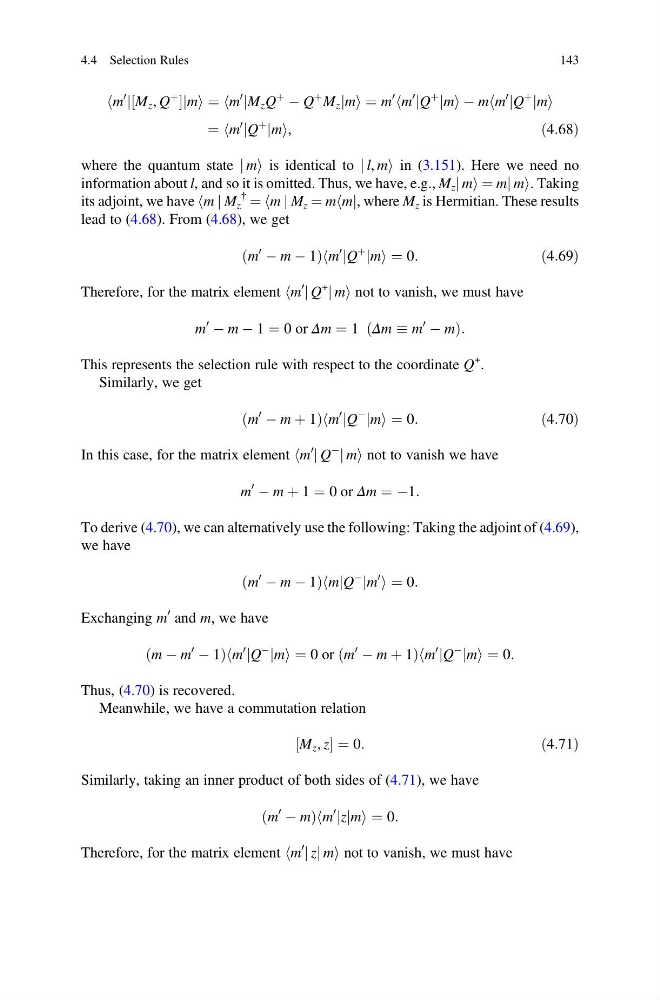
where the quantum state j mi is identical to j l, mi in (3.151). Here we need no
information about l, and so it is omitted. Thus, we have, e.g., M z j mi ¼ mj mi. Taking
its adjoint, we have hm j M z
{
¼ hm j M z ¼ mhmj, where M z is Hermitian. These results
lead to (4.68). From (4.68), we get
m
0
À m À 1
ð
Þm
0
jQ
þ
jm
h
i¼ 0:
ð4:69Þ
Therefore, for the matrix element hm
0 j Q
+
j mi not to vanish, we must have
m
0
À m À 1 ¼ 0 or Δm ¼ 1 Δm m
0
À m
ð
Þ :
This represents the selection rule with respect to the coordinate Q
+
.
Similarly, we get
m
0
À m þ 1
ð
Þm
0
jQ
À
jm
h
i¼ 0:
ð4:70Þ
In this case, for the matrix element hm
0
j Q
À
j mi not to vanish we have
m
0
À m þ 1 ¼ 0 or Δm ¼ À1:
To derive (4.70), we can alternatively use the following: Taking the adjoint of (4.69),
we have
m
0
À m À 1
ð
ÞmjQ
À
jm
0
h
i¼ 0:
Exchanging m
0 and m, we have
m À m
0
À 1
ð
Þm
0
jQ
À
jm
h
i¼ 0 or m
0
À m þ 1
ð
Þm
0
jQ
À
jm
h
i¼ 0:
Thus, (4.70) is recovered.
Meanwhile, we have a commutation relation
M z , z
½
¼0:
ð4:71Þ
Similarly, taking an inner product of both sides of (4.71), we have
m
0
À m
ð
Þm
0
jzjm
h
i¼ 0:
Therefore, for the matrix element hm
0
j zj mi not to vanish, we must have
4.4 Selection Rules
143
0
j M z , Q
þ
½
jm
h
i¼ m
0
jM z Q
þ
À Q
þ M z jm
h
i ¼ m
0 m
0
jQ
þ
jm
h
iÀ m m
0
jQ
þ
jm
h
i
¼ m
0
jQ
þ
jm
h
i ,
ð4:68Þ
where the quantum state j mi is identical to j l, mi in (3.151). Here we need no
information about l, and so it is omitted. Thus, we have, e.g., M z j mi ¼ mj mi. Taking
its adjoint, we have hm j M z
{
¼ hm j M z ¼ mhmj, where M z is Hermitian. These results
lead to (4.68). From (4.68), we get
m
0
À m À 1
ð
Þm
0
jQ
þ
jm
h
i¼ 0:
ð4:69Þ
Therefore, for the matrix element hm
0 j Q
+
j mi not to vanish, we must have
m
0
À m À 1 ¼ 0 or Δm ¼ 1 Δm m
0
À m
ð
Þ :
This represents the selection rule with respect to the coordinate Q
+
.
Similarly, we get
m
0
À m þ 1
ð
Þm
0
jQ
À
jm
h
i¼ 0:
ð4:70Þ
In this case, for the matrix element hm
0
j Q
À
j mi not to vanish we have
m
0
À m þ 1 ¼ 0 or Δm ¼ À1:
To derive (4.70), we can alternatively use the following: Taking the adjoint of (4.69),
we have
m
0
À m À 1
ð
ÞmjQ
À
jm
0
h
i¼ 0:
Exchanging m
0 and m, we have
m À m
0
À 1
ð
Þm
0
jQ
À
jm
h
i¼ 0 or m
0
À m þ 1
ð
Þm
0
jQ
À
jm
h
i¼ 0:
Thus, (4.70) is recovered.
Meanwhile, we have a commutation relation
M z , z
½
¼0:
ð4:71Þ
Similarly, taking an inner product of both sides of (4.71), we have
m
0
À m
ð
Þm
0
jzjm
h
i¼ 0:
Therefore, for the matrix element hm
0
j zj mi not to vanish, we must have
4.4 Selection Rules
143