

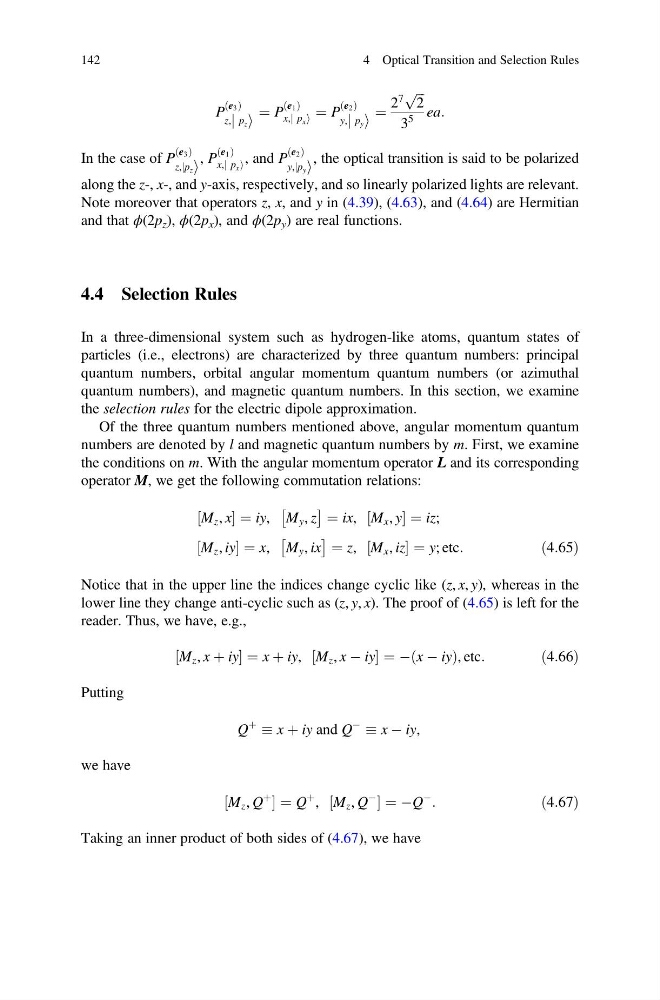
P
e 3
ð Þ
z, p z
j i
¼ P
e 1
ð Þ
x, p x
j i ¼ P
e 2
ð Þ
y, p y
j i
¼
2
7
ffiffi ffi
2
p
3
5
ea:
In the case of P
e 3
ð Þ
z,jp z i
, P
e 1
ð Þ
x, p x
j i , and P
e 2
ð Þ
y,jp yi
, the optical transition is said to be polarized
along the z-, x-, and y-axis, respectively, and so linearly polarized lights are relevant.
Note moreover that operators z, x, and y in (4.39), (4.63), and (4.64) are Hermitian
and that ϕ(2p z ), ϕ(2p x ), and ϕ(2p y ) are real functions.
4.4 Selection Rules
In a three-dimensional system such as hydrogen-like atoms, quantum states of
particles (i.e., electrons) are characterized by three quantum numbers: principal
quantum numbers, orbital angular momentum quantum numbers (or azimuthal
quantum numbers), and magnetic quantum numbers. In this section, we examine
the selection rules for the electric dipole approximation.
Of the three quantum numbers mentioned above, angular momentum quantum
numbers are denoted by l and magnetic quantum numbers by m. First, we examine
the conditions on m. With the angular momentum operator L and its corresponding
operator M, we get the following commutation relations:
M z , x
½
¼iy, M y , z
Â
à ¼ ix, M x , y
½
¼iz;
M z , iy
½
¼x, M y , ix
Â
à ¼ z, M x , iz
½
¼y; etc:
ð4:65Þ
Notice that in the upper line the indices change cyclic like (z, x, y), whereas in the
lower line they change anti-cyclic such as (z, y, x). The proof of (4.65) is left for the
reader. Thus, we have, e.g.,
M z , x þ iy
½
¼x þ iy, M z , x À iy
½
¼Àx À iy
ð
Þ, etc:
ð4:66Þ
Putting
Q
þ
x þ iy and Q
À
x À iy,
we have
M z , Q
þ
½
¼Q
þ , M z , Q
À
½
¼ÀQ
À
:
ð4:67Þ
Taking an inner product of both sides of (4.67), we have
142
4 Optical Transition and Selection Rules
e 3
ð Þ
z, p z
j i
¼ P
e 1
ð Þ
x, p x
j i ¼ P
e 2
ð Þ
y, p y
j i
¼
2
7
ffiffi ffi
2
p
3
5
ea:
In the case of P
e 3
ð Þ
z,jp z i
, P
e 1
ð Þ
x, p x
j i , and P
e 2
ð Þ
y,jp yi
, the optical transition is said to be polarized
along the z-, x-, and y-axis, respectively, and so linearly polarized lights are relevant.
Note moreover that operators z, x, and y in (4.39), (4.63), and (4.64) are Hermitian
and that ϕ(2p z ), ϕ(2p x ), and ϕ(2p y ) are real functions.
4.4 Selection Rules
In a three-dimensional system such as hydrogen-like atoms, quantum states of
particles (i.e., electrons) are characterized by three quantum numbers: principal
quantum numbers, orbital angular momentum quantum numbers (or azimuthal
quantum numbers), and magnetic quantum numbers. In this section, we examine
the selection rules for the electric dipole approximation.
Of the three quantum numbers mentioned above, angular momentum quantum
numbers are denoted by l and magnetic quantum numbers by m. First, we examine
the conditions on m. With the angular momentum operator L and its corresponding
operator M, we get the following commutation relations:
M z , x
½
¼iy, M y , z
Â
à ¼ ix, M x , y
½
¼iz;
M z , iy
½
¼x, M y , ix
Â
à ¼ z, M x , iz
½
¼y; etc:
ð4:65Þ
Notice that in the upper line the indices change cyclic like (z, x, y), whereas in the
lower line they change anti-cyclic such as (z, y, x). The proof of (4.65) is left for the
reader. Thus, we have, e.g.,
M z , x þ iy
½
¼x þ iy, M z , x À iy
½
¼Àx À iy
ð
Þ, etc:
ð4:66Þ
Putting
Q
þ
x þ iy and Q
À
x À iy,
we have
M z , Q
þ
½
¼Q
þ , M z , Q
À
½
¼ÀQ
À
:
ð4:67Þ
Taking an inner product of both sides of (4.67), we have
142
4 Optical Transition and Selection Rules