

m
0
À m ¼ 0 or Δm ¼ 0:
ð4:72Þ
These results are fully consistent with Example 4.3 of Sect. 4.3. That is, if
circularly polarized light takes part in the optical transition, Δm ¼ Æ 1. For instance,
using the present notation we rewrite (4.48) as
ϕ 1s
ð Þj
1
ffiffi ffi
2
p x À iy
ð
Þjϕ 2p xþiy
À
Á
(
)
¼
1
ffiffi ffi
2
p 0jQ
À
j1
h
i¼ À
2
7
ffiffi ffi
2
p
3
5
a:
If linearly polarized light is related to the optical transition, we have Δm ¼ 0.
Next, we examine the conditions on l. To this end, we calculate a following
commutator [5]:
M
2 , z
Â
à ¼ M x
2
þ M y
2
þ M z
2 , z
Â
à ¼ M x
2 , z
Â
à þ M y
2 , z
Â
Ã
¼ M x M x z À zM x
ð
ÞþM x zM x À zM x
2
þ M y M y z À zM y
À
Á
þ M y zM y À zM y
2
¼ M x M x , z
½
þ M x , z
½
M x þ M y M y , z
Â
à þ M y , z
Â
Ã
M y
¼ i M y x þ xM y À M x y À yM x
À
Á
¼ i M x y À yM x À M y x þ xM y þ 2M y x À 2M x y
À
Á
¼ i 2iz þ 2M y x À 2M x y
À
Á ¼ 2i M y x À M x y þ iz
À
Á :
ð4:73Þ
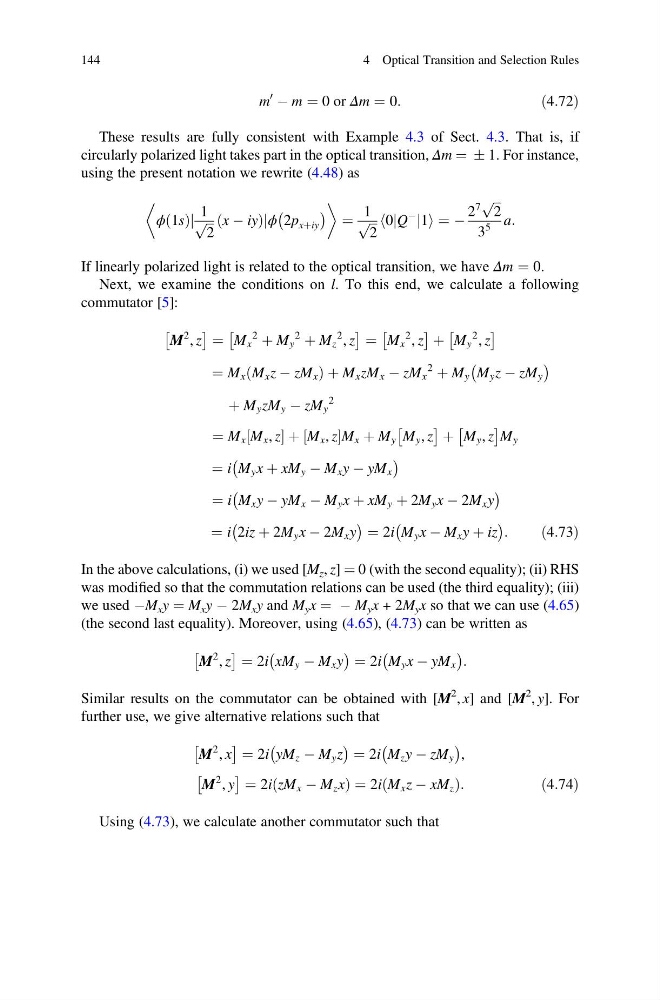
In the above calculations, (i) we used [M z , z] ¼ 0 (with the second equality); (ii) RHS
was modified so that the commutation relations can be used (the third equality); (iii)
we used ÀM x y ¼ M x y À 2M x y and M y x ¼ À M y x + 2M y x so that we can use (4.65)
(the second last equality). Moreover, using (4.65), (4.73) can be written as
M
2 , z
Â
à ¼ 2i xM y À M x y
À
Á ¼ 2i M y x À yM x
À
Á
:
Similar results on the commutator can be obtained with [M
2 , x] and [M
2 , y]. For
further use, we give alternative relations such that
M
2 , x
Â
à ¼ 2i yM z À M y z
À
Á ¼ 2i M z y À zM y
À
Á
,
M
2 , y
Â
à ¼ 2i zM x À M z x
ð
Þ¼2i M x z À xM z
ð
Þ :
ð4:74Þ
Using (4.73), we calculate another commutator such that
144
4 Optical Transition and Selection Rules
0
À m ¼ 0 or Δm ¼ 0:
ð4:72Þ
These results are fully consistent with Example 4.3 of Sect. 4.3. That is, if
circularly polarized light takes part in the optical transition, Δm ¼ Æ 1. For instance,
using the present notation we rewrite (4.48) as
ϕ 1s
ð Þj
1
ffiffi ffi
2
p x À iy
ð
Þjϕ 2p xþiy
À
Á
(
)
¼
1
ffiffi ffi
2
p 0jQ
À
j1
h
i¼ À
2
7
ffiffi ffi
2
p
3
5
a:
If linearly polarized light is related to the optical transition, we have Δm ¼ 0.
Next, we examine the conditions on l. To this end, we calculate a following
commutator [5]:
M
2 , z
Â
à ¼ M x
2
þ M y
2
þ M z
2 , z
Â
à ¼ M x
2 , z
Â
à þ M y
2 , z
Â
Ã
¼ M x M x z À zM x
ð
ÞþM x zM x À zM x
2
þ M y M y z À zM y
À
Á
þ M y zM y À zM y
2
¼ M x M x , z
½
þ M x , z
½
M x þ M y M y , z
Â
à þ M y , z
Â
Ã
M y
¼ i M y x þ xM y À M x y À yM x
À
Á
¼ i M x y À yM x À M y x þ xM y þ 2M y x À 2M x y
À
Á
¼ i 2iz þ 2M y x À 2M x y
À
Á ¼ 2i M y x À M x y þ iz
À
Á :
ð4:73Þ
In the above calculations, (i) we used [M z , z] ¼ 0 (with the second equality); (ii) RHS
was modified so that the commutation relations can be used (the third equality); (iii)
we used ÀM x y ¼ M x y À 2M x y and M y x ¼ À M y x + 2M y x so that we can use (4.65)
(the second last equality). Moreover, using (4.65), (4.73) can be written as
M
2 , z
Â
à ¼ 2i xM y À M x y
À
Á ¼ 2i M y x À yM x
À
Á
:
Similar results on the commutator can be obtained with [M
2 , x] and [M
2 , y]. For
further use, we give alternative relations such that
M
2 , x
Â
à ¼ 2i yM z À M y z
À
Á ¼ 2i M z y À zM y
À
Á
,
M
2 , y
Â
à ¼ 2i zM x À M z x
ð
Þ¼2i M x z À xM z
ð
Þ :
ð4:74Þ
Using (4.73), we calculate another commutator such that
144
4 Optical Transition and Selection Rules