

P
e À
ð Þ
xþiy, p À
j i
2
or P
e þ
ð Þ
xÀiy, p þ
j i
2
. Some literature [3, 4] uses À(x + iy) instead of x + iy.
This is because simply of the inclusion of the Condon–Shortley phase; see (3.304).
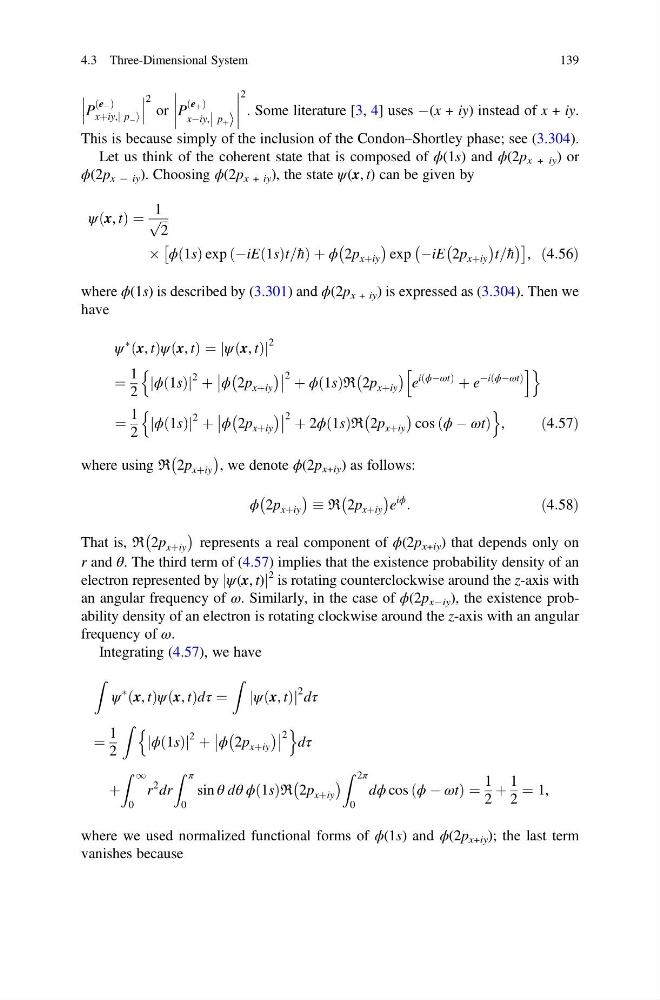
Let us think of the coherent state that is composed of ϕ(1s) and ϕ(2p x + iy ) or
ϕ(2p x À iy ). Choosing ϕ(2p x + iy ), the state ψ(x, t) can be given by
ψ x, t
ð Þ ¼
1
ffiffi ffi
2
p
 ϕ 1s
ð Þexp ÀiE 1s
ð Þt=h
ð
Þþϕ 2p xþiy
À
Á
exp ÀiE 2p xþiy
À
Á
t=h
À
Á
Â
Ã
, ð4:56Þ
where ϕ(1s) is described by (3.301) and ϕ(2p x + iy ) is expressed as (3.304). Then we
have
ψ
Ã
x, t
ð Þψ x, t
ð Þ ¼ ψ x, t
ð Þ
j
j
2
¼
1
2
ϕ 1s
ð Þ
j
j
2 þ ϕ 2p xþiy
À
Á
2 þ ϕ 1s
ð ÞR 2p xþiy
À
Á
e
i ϕÀωt
ð
Þ
þ e
Ài ϕÀωt
ð
Þ
h
i
n
o
¼
1
2
ϕ 1s
ð Þ
j
j
2 þ ϕ 2p xþiy
À
Á
2 þ 2ϕ 1s
ð ÞR 2p xþiy
À
Á
cos ϕ À ωt
ð
Þ
n
o
,
ð4:57Þ
where using R 2p xþiy
À
Á
, we denote ϕ(2p x+iy ) as follows:
ϕ 2p xþiy
À
Á R 2p xþiy
À
Á
e
iϕ
:
ð4:58Þ
That is, R 2p xþiy
À
Á
represents a real component of ϕ(2p x+iy ) that depends only on
r and θ. The third term of (4.57) implies that the existence probability density of an
electron represented by jψ(x, t)j
2 is rotating counterclockwise around the z-axis with
an angular frequency of ω. Similarly, in the case of ϕ(2p xÀiy ), the existence probability density of an electron is rotating clockwise around the z-axis with an angular
frequency of ω.
Integrating (4.57), we have
Z
ψ
Ã
x, t
ð Þψ x, t
ð Þdτ ¼
Z
ψ x, t
ð Þ
j
j
2 dτ
¼
1
2
Z
ϕ 1s
ð Þ
j
j
2 þ ϕ 2p xþiy
À
Á
2
n
o
dτ
þ
Z 1
0
r
2 dr
Z π
0
sin θ dθ ϕ 1s
ð ÞR 2p xþiy
À
Á
Z 2π
0
dϕ cos ϕ À ωt
ð
Þ¼
1
2
þ
1
2
¼ 1,
where we used normalized functional forms of ϕ(1s) and ϕ(2p x+iy ); the last term
vanishes because
4.3 Three-Dimensional System
139
e À
ð Þ
xþiy, p À
j i
2
or P
e þ
ð Þ
xÀiy, p þ
j i
2
. Some literature [3, 4] uses À(x + iy) instead of x + iy.
This is because simply of the inclusion of the Condon–Shortley phase; see (3.304).
Let us think of the coherent state that is composed of ϕ(1s) and ϕ(2p x + iy ) or
ϕ(2p x À iy ). Choosing ϕ(2p x + iy ), the state ψ(x, t) can be given by
ψ x, t
ð Þ ¼
1
ffiffi ffi
2
p
 ϕ 1s
ð Þexp ÀiE 1s
ð Þt=h
ð
Þþϕ 2p xþiy
À
Á
exp ÀiE 2p xþiy
À
Á
t=h
À
Á
Â
Ã
, ð4:56Þ
where ϕ(1s) is described by (3.301) and ϕ(2p x + iy ) is expressed as (3.304). Then we
have
ψ
Ã
x, t
ð Þψ x, t
ð Þ ¼ ψ x, t
ð Þ
j
j
2
¼
1
2
ϕ 1s
ð Þ
j
j
2 þ ϕ 2p xþiy
À
Á
2 þ ϕ 1s
ð ÞR 2p xþiy
À
Á
e
i ϕÀωt
ð
Þ
þ e
Ài ϕÀωt
ð
Þ
h
i
n
o
¼
1
2
ϕ 1s
ð Þ
j
j
2 þ ϕ 2p xþiy
À
Á
2 þ 2ϕ 1s
ð ÞR 2p xþiy
À
Á
cos ϕ À ωt
ð
Þ
n
o
,
ð4:57Þ
where using R 2p xþiy
À
Á
, we denote ϕ(2p x+iy ) as follows:
ϕ 2p xþiy
À
Á R 2p xþiy
À
Á
e
iϕ
:
ð4:58Þ
That is, R 2p xþiy
À
Á
represents a real component of ϕ(2p x+iy ) that depends only on
r and θ. The third term of (4.57) implies that the existence probability density of an
electron represented by jψ(x, t)j
2 is rotating counterclockwise around the z-axis with
an angular frequency of ω. Similarly, in the case of ϕ(2p xÀiy ), the existence probability density of an electron is rotating clockwise around the z-axis with an angular
frequency of ω.
Integrating (4.57), we have
Z
ψ
Ã
x, t
ð Þψ x, t
ð Þdτ ¼
Z
ψ x, t
ð Þ
j
j
2 dτ
¼
1
2
Z
ϕ 1s
ð Þ
j
j
2 þ ϕ 2p xþiy
À
Á
2
n
o
dτ
þ
Z 1
0
r
2 dr
Z π
0
sin θ dθ ϕ 1s
ð ÞR 2p xþiy
À
Á
Z 2π
0
dϕ cos ϕ À ωt
ð
Þ¼
1
2
þ
1
2
¼ 1,
where we used normalized functional forms of ϕ(1s) and ϕ(2p x+iy ); the last term
vanishes because
4.3 Three-Dimensional System
139