

P
e þ
ð Þ
xÀiy, p þ
j i
! Ã
¼ e ϕ 2p xþiy
À
Á
j
1
ffiffi ffi
2
p x þ iy
ð
Þjϕ 1s
ð Þ
(
)
¼ À
2
7
ffiffi ffi
2
p
3
5
ea
ð4:54Þ
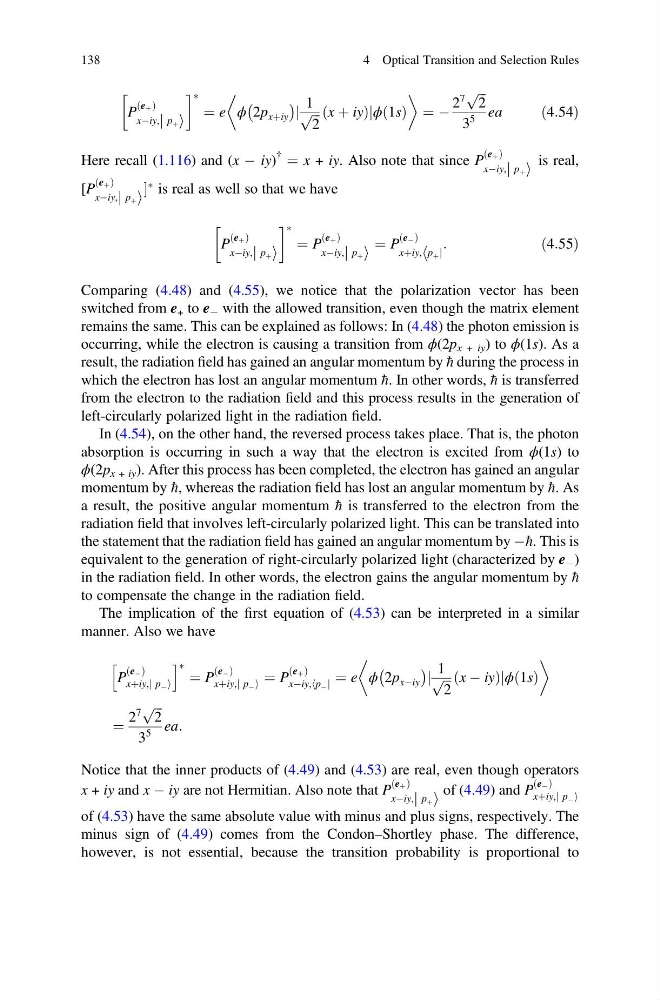
Here recall (1.116) and (x À iy)
{
¼ x + iy. Also note that since P
e þ
ð Þ
xÀiy, p þ
j i
is real,
[P
e þ
ð Þ
xÀiy, p þ
j i
à is real as well so that we have
P
e þ
ð Þ
xÀiy, p þ
j i
! Ã
¼ P
e þ
ð Þ
xÀiy, p þ
j i
¼ P
e À
ð Þ
xþiy, p þ j
h
:
ð4:55Þ
Comparing (4.48) and (4.55), we notice that the polarization vector has been
switched from e + to e À with the allowed transition, even though the matrix element
remains the same. This can be explained as follows: In (4.48) the photon emission is
occurring, while the electron is causing a transition from ϕ(2p x + iy ) to ϕ(1s). As a
result, the radiation field has gained an angular momentum by h during the process in
which the electron has lost an angular momentum h. In other words, h is transferred
from the electron to the radiation field and this process results in the generation of
left-circularly polarized light in the radiation field.
In (4.54), on the other hand, the reversed process takes place. That is, the photon
absorption is occurring in such a way that the electron is excited from ϕ(1s) to
ϕ(2p x + iy ). After this process has been completed, the electron has gained an angular
momentum by h, whereas the radiation field has lost an angular momentum by h. As
a result, the positive angular momentum h is transferred to the electron from the
radiation field that involves left-circularly polarized light. This can be translated into
the statement that the radiation field has gained an angular momentum by Àh. This is
equivalent to the generation of right-circularly polarized light (characterized by e À )
in the radiation field. In other words, the electron gains the angular momentum by h
to compensate the change in the radiation field.
The implication of the first equation of (4.53) can be interpreted in a similar
manner. Also we have
P
e À
ð Þ
xþiy, p À
j i
h
i à ¼ P
e À
ð Þ
xþiy, p À
j i ¼ P
e þ
ð Þ
xÀiy, p À j
h
¼ e ϕ 2p xÀiy
À
Á j
1
ffiffi ffi
2
p x À iy
ð
Þjϕ 1s
ð Þ
(
)
¼
2
7
ffiffi ffi
2
p
3
5
ea:
Notice that the inner products of (4.49) and (4.53) are real, even though operators
x + iy and x À iy are not Hermitian. Also note that P
e þ
ð Þ
xÀiy, p þ
j i
of (4.49) and P
e À
ð Þ
xþiy, p À
j i
of (4.53) have the same absolute value with minus and plus signs, respectively. The
minus sign of (4.49) comes from the Condon–Shortley phase. The difference,
however, is not essential, because the transition probability is proportional to
138
4 Optical Transition and Selection Rules
e þ
ð Þ
xÀiy, p þ
j i
! Ã
¼ e ϕ 2p xþiy
À
Á
j
1
ffiffi ffi
2
p x þ iy
ð
Þjϕ 1s
ð Þ
(
)
¼ À
2
7
ffiffi ffi
2
p
3
5
ea
ð4:54Þ
Here recall (1.116) and (x À iy)
{
¼ x + iy. Also note that since P
e þ
ð Þ
xÀiy, p þ
j i
is real,
[P
e þ
ð Þ
xÀiy, p þ
j i
à is real as well so that we have
P
e þ
ð Þ
xÀiy, p þ
j i
! Ã
¼ P
e þ
ð Þ
xÀiy, p þ
j i
¼ P
e À
ð Þ
xþiy, p þ j
h
:
ð4:55Þ
Comparing (4.48) and (4.55), we notice that the polarization vector has been
switched from e + to e À with the allowed transition, even though the matrix element
remains the same. This can be explained as follows: In (4.48) the photon emission is
occurring, while the electron is causing a transition from ϕ(2p x + iy ) to ϕ(1s). As a
result, the radiation field has gained an angular momentum by h during the process in
which the electron has lost an angular momentum h. In other words, h is transferred
from the electron to the radiation field and this process results in the generation of
left-circularly polarized light in the radiation field.
In (4.54), on the other hand, the reversed process takes place. That is, the photon
absorption is occurring in such a way that the electron is excited from ϕ(1s) to
ϕ(2p x + iy ). After this process has been completed, the electron has gained an angular
momentum by h, whereas the radiation field has lost an angular momentum by h. As
a result, the positive angular momentum h is transferred to the electron from the
radiation field that involves left-circularly polarized light. This can be translated into
the statement that the radiation field has gained an angular momentum by Àh. This is
equivalent to the generation of right-circularly polarized light (characterized by e À )
in the radiation field. In other words, the electron gains the angular momentum by h
to compensate the change in the radiation field.
The implication of the first equation of (4.53) can be interpreted in a similar
manner. Also we have
P
e À
ð Þ
xþiy, p À
j i
h
i à ¼ P
e À
ð Þ
xþiy, p À
j i ¼ P
e þ
ð Þ
xÀiy, p À j
h
¼ e ϕ 2p xÀiy
À
Á j
1
ffiffi ffi
2
p x À iy
ð
Þjϕ 1s
ð Þ
(
)
¼
2
7
ffiffi ffi
2
p
3
5
ea:
Notice that the inner products of (4.49) and (4.53) are real, even though operators
x + iy and x À iy are not Hermitian. Also note that P
e þ
ð Þ
xÀiy, p þ
j i
of (4.49) and P
e À
ð Þ
xþiy, p À
j i
of (4.53) have the same absolute value with minus and plus signs, respectively. The
minus sign of (4.49) comes from the Condon–Shortley phase. The difference,
however, is not essential, because the transition probability is proportional to
138
4 Optical Transition and Selection Rules