

¼
e
π
Z π=2
Àπ=2
x À cos x
ð
Þ
0 þ x À
1
3
cos 3x
0 !
dx ¼
16e
9π
,
ð4:17Þ
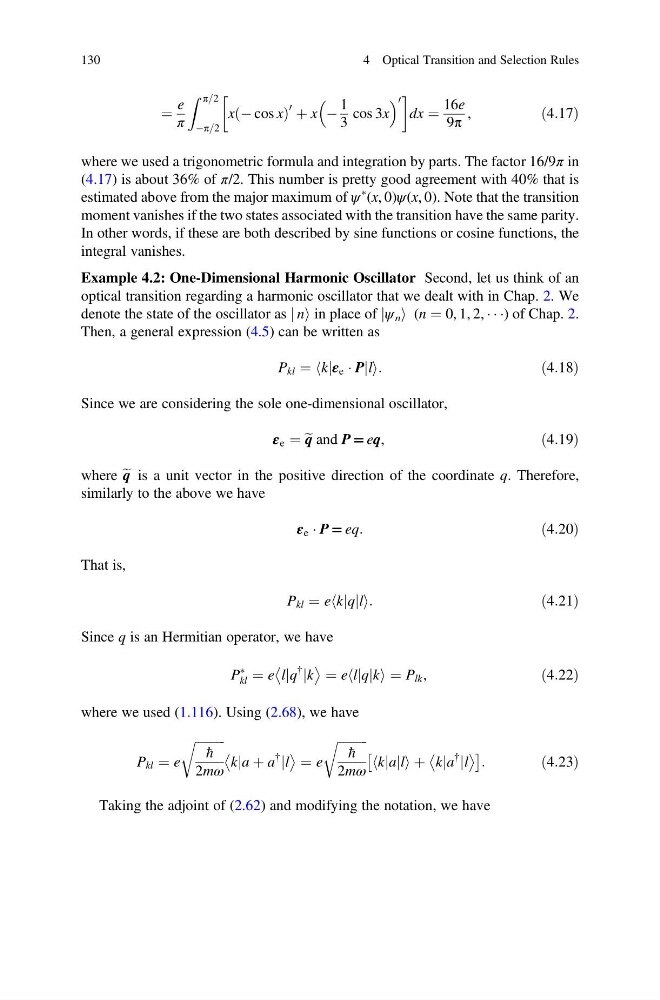
where we used a trigonometric formula and integration by parts. The factor 16/9π in
(4.17) is about 36% of π/2. This number is pretty good agreement with 40% that is
estimated above from the major maximum of ψ
à (x, 0)ψ(x, 0). Note that the transition
moment vanishes if the two states associated with the transition have the same parity.
In other words, if these are both described by sine functions or cosine functions, the
integral vanishes.
Example 4.2: One-Dimensional Harmonic Oscillator Second, let us think of an
optical transition regarding a harmonic oscillator that we dealt with in Chap. 2. We
denote the state of the oscillator as j ni in place of jψ n i (n ¼ 0, 1, 2, Á Á Á) of Chap. 2.
Then, a general expression (4.5) can be written as
P kl ¼ kjε e Á Pjl
h
i :
ð4:18Þ
Since we are considering the sole one-dimensional oscillator,
ε e ¼ e q and P = eq,
ð4:19Þ
where e q is a unit vector in the positive direction of the coordinate q. Therefore,
similarly to the above we have
ε e Á P = eq:
ð4:20Þ
That is,
P kl ¼ e kjqjl
h
i:
ð4:21Þ
Since q is an Hermitian operator, we have
P
Ã
kl ¼ e ljq
{
jk
¼ e ljqjk
h
i ¼ P lk ,
ð4:22Þ
where we used (1.116). Using (2.68), we have
P kl ¼ e
ffiffiffiffiffiffiffiffiffi ffi
h
2mω
r
kja þ a
{
jl
¼ e
ffiffiffiffiffiffiffiffiffi ffi
h
2mω
r
kjajl
h
iþ kja
{
jl
Â
à :
ð4:23Þ
Taking the adjoint of (2.62) and modifying the notation, we have
130
4 Optical Transition and Selection Rules
e
π
Z π=2
Àπ=2
x À cos x
ð
Þ
0 þ x À
1
3
cos 3x
0 !
dx ¼
16e
9π
,
ð4:17Þ
where we used a trigonometric formula and integration by parts. The factor 16/9π in
(4.17) is about 36% of π/2. This number is pretty good agreement with 40% that is
estimated above from the major maximum of ψ
à (x, 0)ψ(x, 0). Note that the transition
moment vanishes if the two states associated with the transition have the same parity.
In other words, if these are both described by sine functions or cosine functions, the
integral vanishes.
Example 4.2: One-Dimensional Harmonic Oscillator Second, let us think of an
optical transition regarding a harmonic oscillator that we dealt with in Chap. 2. We
denote the state of the oscillator as j ni in place of jψ n i (n ¼ 0, 1, 2, Á Á Á) of Chap. 2.
Then, a general expression (4.5) can be written as
P kl ¼ kjε e Á Pjl
h
i :
ð4:18Þ
Since we are considering the sole one-dimensional oscillator,
ε e ¼ e q and P = eq,
ð4:19Þ
where e q is a unit vector in the positive direction of the coordinate q. Therefore,
similarly to the above we have
ε e Á P = eq:
ð4:20Þ
That is,
P kl ¼ e kjqjl
h
i:
ð4:21Þ
Since q is an Hermitian operator, we have
P
Ã
kl ¼ e ljq
{
jk
¼ e ljqjk
h
i ¼ P lk ,
ð4:22Þ
where we used (1.116). Using (2.68), we have
P kl ¼ e
ffiffiffiffiffiffiffiffiffi ffi
h
2mω
r
kja þ a
{
jl
¼ e
ffiffiffiffiffiffiffiffiffi ffi
h
2mω
r
kjajl
h
iþ kja
{
jl
Â
à :
ð4:23Þ
Taking the adjoint of (2.62) and modifying the notation, we have
130
4 Optical Transition and Selection Rules