

1
2μ
À
ħ
2
r 2
∂
∂r
r
2 ∂R r
ð Þ
∂r
þ
ħ
2
λ
r 2
!
R r
ð Þ À
Ze
2
4πε 0 r
R r
ð Þ ¼ ER r
ð Þ:
ð3:51Þ
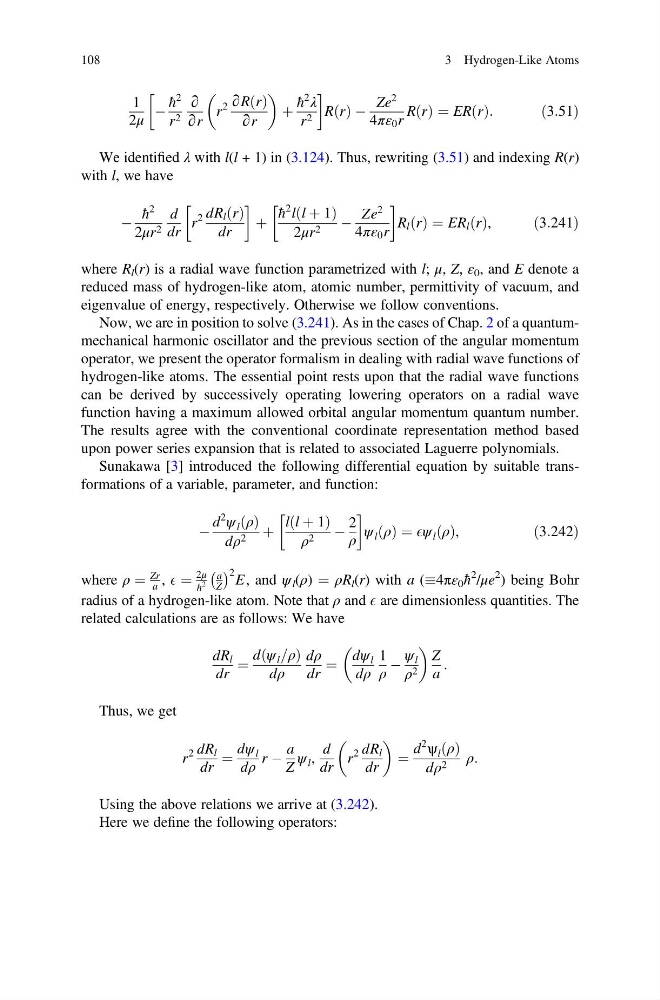
We identified λ with l(l + 1) in (3.124). Thus, rewriting (3.51) and indexing R(r)
with l, we have
À
ħ
2
2μr 2
d
dr
r
2 dR l r
ð Þ
dr
!
þ
ħ
2 l l þ 1
ð
Þ
2μr 2 À
Ze
2
4πε 0 r
!
R l r
ð Þ ¼ ER l r
ð Þ,
ð3:241Þ
where R l (r) is a radial wave function parametrized with l; μ, Z, ε 0 , and E denote a
reduced mass of hydrogen-like atom, atomic number, permittivity of vacuum, and
eigenvalue of energy, respectively. Otherwise we follow conventions.
Now, we are in position to solve (3.241). As in the cases of Chap. 2 of a quantummechanical harmonic oscillator and the previous section of the angular momentum
operator, we present the operator formalism in dealing with radial wave functions of
hydrogen-like atoms. The essential point rests upon that the radial wave functions
can be derived by successively operating lowering operators on a radial wave
function having a maximum allowed orbital angular momentum quantum number.
The results agree with the conventional coordinate representation method based
upon power series expansion that is related to associated Laguerre polynomials.
Sunakawa [3] introduced the following differential equation by suitable transformations of a variable, parameter, and function:
À
d
2
ψ l ρ
ð Þ
dρ 2 þ
l l þ 1
ð
Þ
ρ 2 À
2
ρ
!
ψ l ρ
ð Þ ¼ Eψ l ρ
ð Þ,
ð3:242Þ
where ρ ¼
Zr
a , E ¼
2μ
ħ
2
a
Z
À Á 2 E , and ψ l (ρ) ¼ ρR l (r) with a (4πε 0 ħ
2 /μe
2 ) being Bohr
radius of a hydrogen-like atom. Note that ρ and E are dimensionless quantities. The
related calculations are as follows: We have
dR l
dr
¼
d ψ l =ρ
ð
Þ
dρ
dρ
dr
¼
dψ l
dρ
1
ρ
À
ψ l
ρ 2
Z
a
:
Thus, we get
r
2 dR l
dr
¼
dψ l
dρ
r À
a
Z
ψ l ,
d
dr
r
2 dR l
dr
¼
d
2
ψ l ρ
ð Þ
dρ 2 ρ:
Using the above relations we arrive at (3.242).
Here we define the following operators:
108
3 Hydrogen-Like Atoms
2μ
À
ħ
2
r 2
∂
∂r
r
2 ∂R r
ð Þ
∂r
þ
ħ
2
λ
r 2
!
R r
ð Þ À
Ze
2
4πε 0 r
R r
ð Þ ¼ ER r
ð Þ:
ð3:51Þ
We identified λ with l(l + 1) in (3.124). Thus, rewriting (3.51) and indexing R(r)
with l, we have
À
ħ
2
2μr 2
d
dr
r
2 dR l r
ð Þ
dr
!
þ
ħ
2 l l þ 1
ð
Þ
2μr 2 À
Ze
2
4πε 0 r
!
R l r
ð Þ ¼ ER l r
ð Þ,
ð3:241Þ
where R l (r) is a radial wave function parametrized with l; μ, Z, ε 0 , and E denote a
reduced mass of hydrogen-like atom, atomic number, permittivity of vacuum, and
eigenvalue of energy, respectively. Otherwise we follow conventions.
Now, we are in position to solve (3.241). As in the cases of Chap. 2 of a quantummechanical harmonic oscillator and the previous section of the angular momentum
operator, we present the operator formalism in dealing with radial wave functions of
hydrogen-like atoms. The essential point rests upon that the radial wave functions
can be derived by successively operating lowering operators on a radial wave
function having a maximum allowed orbital angular momentum quantum number.
The results agree with the conventional coordinate representation method based
upon power series expansion that is related to associated Laguerre polynomials.
Sunakawa [3] introduced the following differential equation by suitable transformations of a variable, parameter, and function:
À
d
2
ψ l ρ
ð Þ
dρ 2 þ
l l þ 1
ð
Þ
ρ 2 À
2
ρ
!
ψ l ρ
ð Þ ¼ Eψ l ρ
ð Þ,
ð3:242Þ
where ρ ¼
Zr
a , E ¼
2μ
ħ
2
a
Z
À Á 2 E , and ψ l (ρ) ¼ ρR l (r) with a (4πε 0 ħ
2 /μe
2 ) being Bohr
radius of a hydrogen-like atom. Note that ρ and E are dimensionless quantities. The
related calculations are as follows: We have
dR l
dr
¼
d ψ l =ρ
ð
Þ
dρ
dρ
dr
¼
dψ l
dρ
1
ρ
À
ψ l
ρ 2
Z
a
:
Thus, we get
r
2 dR l
dr
¼
dψ l
dρ
r À
a
Z
ψ l ,
d
dr
r
2 dR l
dr
¼
d
2
ψ l ρ
ð Þ
dρ 2 ρ:
Using the above relations we arrive at (3.242).
Here we define the following operators:
108
3 Hydrogen-Like Atoms