

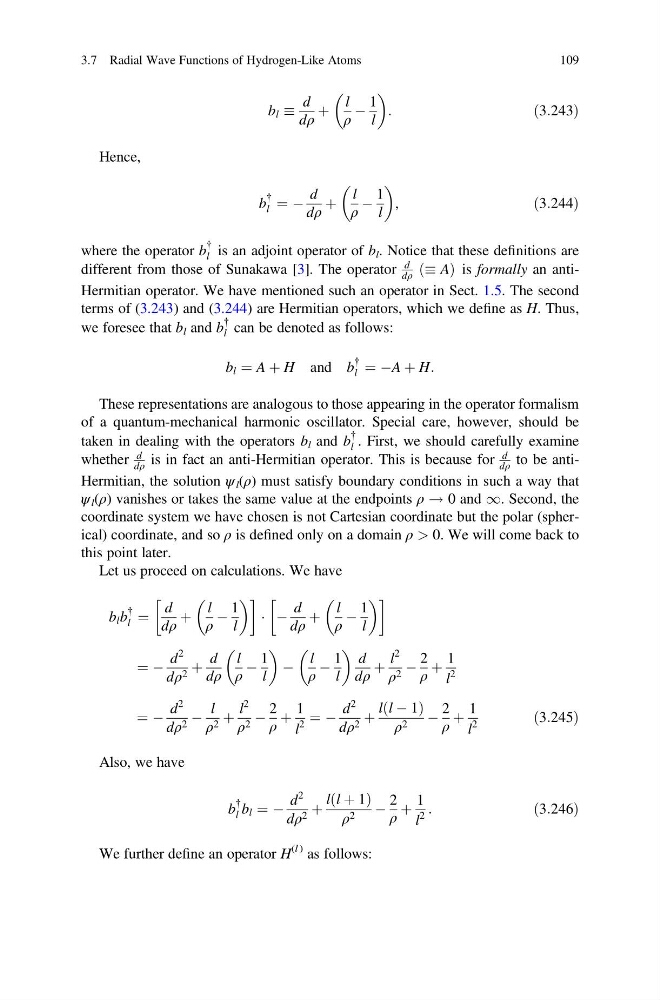
b l
d
dρ
þ
l
ρ
À
1
l
:
ð3:243Þ
Hence,
b
{
l ¼ À
d
dρ
þ
l
ρ
À
1
l
,
ð3:244Þ
where the operator b
{
l is an adjoint operator of b l . Notice that these definitions are
different from those of Sunakawa [3]. The operator
d
dρ A
ð
Þ is formally an antiHermitian operator. We have mentioned such an operator in Sect. 1.5. The second
terms of (3.243) and (3.244) are Hermitian operators, which we define as H. Thus,
we foresee that b l and b
{
l can be denoted as follows:
b l ¼ A þ H and b
{
l ¼ ÀA þ H:
These representations are analogous to those appearing in the operator formalism
of a quantum-mechanical harmonic oscillator. Special care, however, should be
taken in dealing with the operators b l and b
{
l . First, we should carefully examine
whether
d
dρ is in fact an anti-Hermitian operator. This is because for
d
dρ to be antiHermitian, the solution ψ l (ρ) must satisfy boundary conditions in such a way that
ψ l (ρ) vanishes or takes the same value at the endpoints ρ ! 0 and 1. Second, the
coordinate system we have chosen is not Cartesian coordinate but the polar (spherical) coordinate, and so ρ is defined only on a domain ρ > 0. We will come back to
this point later.
Let us proceed on calculations. We have
b l b
{
l ¼
d
dρ
þ
l
ρ
À
1
l
!
Á À
d
dρ
þ
l
ρ
À
1
l
!
¼ À
d
2
dρ 2 þ
d
dρ
l
ρ
À
1
l
À
l
ρ
À
1
l
d
dρ
þ
l
2
ρ 2 À
2
ρ
þ
1
l
2
¼ À
d
2
dρ 2 À
l
ρ 2 þ
l
2
ρ 2 À
2
ρ
þ
1
l
2
¼ À
d
2
dρ 2 þ
l l À 1
ð
Þ
ρ 2 À
2
ρ
þ
1
l
2
ð3:245Þ
Also, we have
b
{
l b l ¼ À
d
2
dρ 2 þ
l l þ 1
ð
Þ
ρ 2 À
2
ρ
þ
1
l
2
:
ð3:246Þ
We further define an operator H
(l ) as follows:
3.7 Radial Wave Functions of Hydrogen-Like Atoms
109
d
dρ
þ
l
ρ
À
1
l
:
ð3:243Þ
Hence,
b
{
l ¼ À
d
dρ
þ
l
ρ
À
1
l
,
ð3:244Þ
where the operator b
{
l is an adjoint operator of b l . Notice that these definitions are
different from those of Sunakawa [3]. The operator
d
dρ A
ð
Þ is formally an antiHermitian operator. We have mentioned such an operator in Sect. 1.5. The second
terms of (3.243) and (3.244) are Hermitian operators, which we define as H. Thus,
we foresee that b l and b
{
l can be denoted as follows:
b l ¼ A þ H and b
{
l ¼ ÀA þ H:
These representations are analogous to those appearing in the operator formalism
of a quantum-mechanical harmonic oscillator. Special care, however, should be
taken in dealing with the operators b l and b
{
l . First, we should carefully examine
whether
d
dρ is in fact an anti-Hermitian operator. This is because for
d
dρ to be antiHermitian, the solution ψ l (ρ) must satisfy boundary conditions in such a way that
ψ l (ρ) vanishes or takes the same value at the endpoints ρ ! 0 and 1. Second, the
coordinate system we have chosen is not Cartesian coordinate but the polar (spherical) coordinate, and so ρ is defined only on a domain ρ > 0. We will come back to
this point later.
Let us proceed on calculations. We have
b l b
{
l ¼
d
dρ
þ
l
ρ
À
1
l
!
Á À
d
dρ
þ
l
ρ
À
1
l
!
¼ À
d
2
dρ 2 þ
d
dρ
l
ρ
À
1
l
À
l
ρ
À
1
l
d
dρ
þ
l
2
ρ 2 À
2
ρ
þ
1
l
2
¼ À
d
2
dρ 2 À
l
ρ 2 þ
l
2
ρ 2 À
2
ρ
þ
1
l
2
¼ À
d
2
dρ 2 þ
l l À 1
ð
Þ
ρ 2 À
2
ρ
þ
1
l
2
ð3:245Þ
Also, we have
b
{
l b l ¼ À
d
2
dρ 2 þ
l l þ 1
ð
Þ
ρ 2 À
2
ρ
þ
1
l
2
:
ð3:246Þ
We further define an operator H
(l ) as follows:
3.7 Radial Wave Functions of Hydrogen-Like Atoms
109