

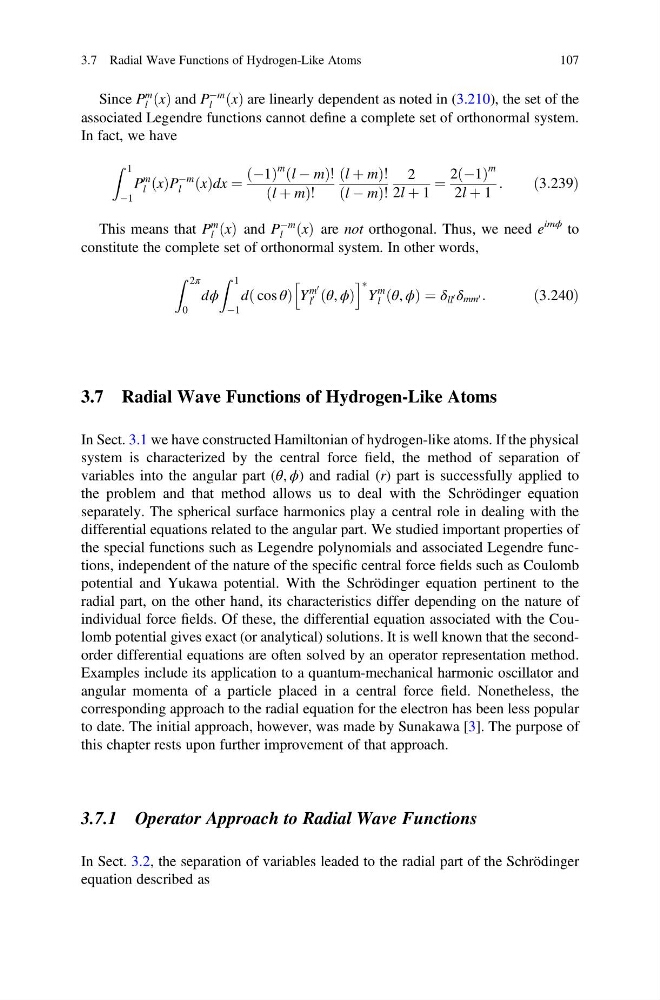
Since P
m
l x
ð Þ and P
Àm
l
x
ð Þ are linearly dependent as noted in (3.210), the set of the
associated Legendre functions cannot define a complete set of orthonormal system.
In fact, we have
Z 1
À1
P
m
l x
ð ÞP
Àm
l
x
ð Þdx ¼
À1
ð Þ
m l À m
ð
Þ!
l þ m
ð
Þ!
l þ m
ð
Þ!
l À m
ð
Þ!
2
2l þ 1
¼
2 À1
ð Þ
m
2l þ 1
:
ð3:239Þ
This means that P
m
l x
ð Þ and P
Àm
l
x
ð Þ are not orthogonal. Thus, we need e
imϕ to
constitute the complete set of orthonormal system. In other words,
Z 2π
0
dϕ
Z 1
À1
d cos θ
ð
Þ Y
m
0
l
0
θ, ϕ
ð
Þ
h
i Ã
Y
m
l θ, ϕ
ð
Þ ¼ δ ll
0 δ mm 0 :
ð3:240Þ
3.7 Radial Wave Functions of Hydrogen-Like Atoms
In Sect. 3.1 we have constructed Hamiltonian of hydrogen-like atoms. If the physical
system is characterized by the central force field, the method of separation of
variables into the angular part (θ, ϕ) and radial (r) part is successfully applied to
the problem and that method allows us to deal with the Schrödinger equation
separately. The spherical surface harmonics play a central role in dealing with the
differential equations related to the angular part. We studied important properties of
the special functions such as Legendre polynomials and associated Legendre functions, independent of the nature of the specific central force fields such as Coulomb
potential and Yukawa potential. With the Schrödinger equation pertinent to the
radial part, on the other hand, its characteristics differ depending on the nature of
individual force fields. Of these, the differential equation associated with the Coulomb potential gives exact (or analytical) solutions. It is well known that the secondorder differential equations are often solved by an operator representation method.
Examples include its application to a quantum-mechanical harmonic oscillator and
angular momenta of a particle placed in a central force field. Nonetheless, the
corresponding approach to the radial equation for the electron has been less popular
to date. The initial approach, however, was made by Sunakawa [3]. The purpose of
this chapter rests upon further improvement of that approach.
3.7.1 Operator Approach to Radial Wave Functions
In Sect. 3.2, the separation of variables leaded to the radial part of the Schrödinger
equation described as
3.7 Radial Wave Functions of Hydrogen-Like Atoms
107
m
l x
ð Þ and P
Àm
l
x
ð Þ are linearly dependent as noted in (3.210), the set of the
associated Legendre functions cannot define a complete set of orthonormal system.
In fact, we have
Z 1
À1
P
m
l x
ð ÞP
Àm
l
x
ð Þdx ¼
À1
ð Þ
m l À m
ð
Þ!
l þ m
ð
Þ!
l þ m
ð
Þ!
l À m
ð
Þ!
2
2l þ 1
¼
2 À1
ð Þ
m
2l þ 1
:
ð3:239Þ
This means that P
m
l x
ð Þ and P
Àm
l
x
ð Þ are not orthogonal. Thus, we need e
imϕ to
constitute the complete set of orthonormal system. In other words,
Z 2π
0
dϕ
Z 1
À1
d cos θ
ð
Þ Y
m
0
l
0
θ, ϕ
ð
Þ
h
i Ã
Y
m
l θ, ϕ
ð
Þ ¼ δ ll
0 δ mm 0 :
ð3:240Þ
3.7 Radial Wave Functions of Hydrogen-Like Atoms
In Sect. 3.1 we have constructed Hamiltonian of hydrogen-like atoms. If the physical
system is characterized by the central force field, the method of separation of
variables into the angular part (θ, ϕ) and radial (r) part is successfully applied to
the problem and that method allows us to deal with the Schrödinger equation
separately. The spherical surface harmonics play a central role in dealing with the
differential equations related to the angular part. We studied important properties of
the special functions such as Legendre polynomials and associated Legendre functions, independent of the nature of the specific central force fields such as Coulomb
potential and Yukawa potential. With the Schrödinger equation pertinent to the
radial part, on the other hand, its characteristics differ depending on the nature of
individual force fields. Of these, the differential equation associated with the Coulomb potential gives exact (or analytical) solutions. It is well known that the secondorder differential equations are often solved by an operator representation method.
Examples include its application to a quantum-mechanical harmonic oscillator and
angular momenta of a particle placed in a central force field. Nonetheless, the
corresponding approach to the radial equation for the electron has been less popular
to date. The initial approach, however, was made by Sunakawa [3]. The purpose of
this chapter rests upon further improvement of that approach.
3.7.1 Operator Approach to Radial Wave Functions
In Sect. 3.2, the separation of variables leaded to the radial part of the Schrödinger
equation described as
3.7 Radial Wave Functions of Hydrogen-Like Atoms
107