

M
2
¼
l l þ 1
ð
Þ
l l þ 1
ð
Þ
⋱
l l þ 1
ð
Þ
⋱
l l þ 1
ð
Þ
l l þ 1
ð
Þ
0
B
B
B
B
B
B
B
B
B
B
B
B
B
@
1
C
C
C
C
C
C
C
C
C
C
C
C
C
A
:
ð3:159Þ
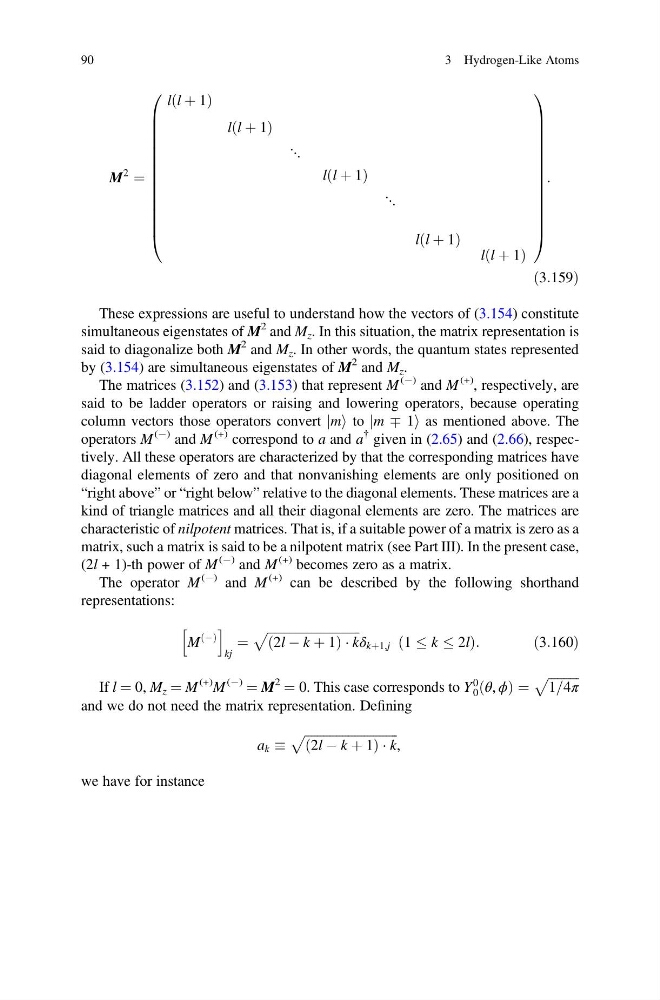
These expressions are useful to understand how the vectors of (3.154) constitute
simultaneous eigenstates of M
2 and M z . In this situation, the matrix representation is
said to diagonalize both M
2 and M z . In other words, the quantum states represented
by (3.154) are simultaneous eigenstates of M
2 and M z .
The matrices (3.152) and (3.153) that represent M
(À) and M
(+) , respectively, are
said to be ladder operators or raising and lowering operators, because operating
column vectors those operators convert jmi to jm Ç 1i as mentioned above. The
operators M
(À) and M
(+) correspond to a and a
{ given in (2.65) and (2.66), respectively. All these operators are characterized by that the corresponding matrices have
diagonal elements of zero and that nonvanishing elements are only positioned on
“right above” or “right below” relative to the diagonal elements. These matrices are a
kind of triangle matrices and all their diagonal elements are zero. The matrices are
characteristic of nilpotent matrices. That is, if a suitable power of a matrix is zero as a
matrix, such a matrix is said to be a nilpotent matrix (see Part III). In the present case,
(2l + 1)-th power of M
(À) and M
(+) becomes zero as a matrix.
The operator M
(À) and M
(+) can be described by the following shorthand
representations:
M
À
ð Þ
h
i
kj
¼
ffiffiffiffiffiffiffiffiffiffiffiffiffiffiffiffiffiffiffiffiffiffiffiffiffiffiffiffiffi ffi
2l À k þ 1
ð
ÞÁk
p
δ kþ1,j 1 k 2l
ð
Þ :
ð3:160Þ
If l ¼ 0, M z ¼ M
(+) M
(À)
¼ M
2
¼ 0. This case corresponds to Y
0
0 θ, ϕ
ð
Þ ¼
ffiffiffiffiffiffiffiffiffiffi
1=4π
p
and we do not need the matrix representation. Defining
a k
ffiffiffiffiffiffiffiffiffiffiffiffiffiffiffiffiffiffiffiffiffiffiffiffiffiffiffiffiffi ffi
2l À k þ 1
ð
ÞÁk
p
,
we have for instance
90
3 Hydrogen-Like Atoms
2
¼
l l þ 1
ð
Þ
l l þ 1
ð
Þ
⋱
l l þ 1
ð
Þ
⋱
l l þ 1
ð
Þ
l l þ 1
ð
Þ
0
B
B
B
B
B
B
B
B
B
B
B
B
B
@
1
C
C
C
C
C
C
C
C
C
C
C
C
C
A
:
ð3:159Þ
These expressions are useful to understand how the vectors of (3.154) constitute
simultaneous eigenstates of M
2 and M z . In this situation, the matrix representation is
said to diagonalize both M
2 and M z . In other words, the quantum states represented
by (3.154) are simultaneous eigenstates of M
2 and M z .
The matrices (3.152) and (3.153) that represent M
(À) and M
(+) , respectively, are
said to be ladder operators or raising and lowering operators, because operating
column vectors those operators convert jmi to jm Ç 1i as mentioned above. The
operators M
(À) and M
(+) correspond to a and a
{ given in (2.65) and (2.66), respectively. All these operators are characterized by that the corresponding matrices have
diagonal elements of zero and that nonvanishing elements are only positioned on
“right above” or “right below” relative to the diagonal elements. These matrices are a
kind of triangle matrices and all their diagonal elements are zero. The matrices are
characteristic of nilpotent matrices. That is, if a suitable power of a matrix is zero as a
matrix, such a matrix is said to be a nilpotent matrix (see Part III). In the present case,
(2l + 1)-th power of M
(À) and M
(+) becomes zero as a matrix.
The operator M
(À) and M
(+) can be described by the following shorthand
representations:
M
À
ð Þ
h
i
kj
¼
ffiffiffiffiffiffiffiffiffiffiffiffiffiffiffiffiffiffiffiffiffiffiffiffiffiffiffiffiffi ffi
2l À k þ 1
ð
ÞÁk
p
δ kþ1,j 1 k 2l
ð
Þ :
ð3:160Þ
If l ¼ 0, M z ¼ M
(+) M
(À)
¼ M
2
¼ 0. This case corresponds to Y
0
0 θ, ϕ
ð
Þ ¼
ffiffiffiffiffiffiffiffiffiffi
1=4π
p
and we do not need the matrix representation. Defining
a k
ffiffiffiffiffiffiffiffiffiffiffiffiffiffiffiffiffiffiffiffiffiffiffiffiffiffiffiffiffi ffi
2l À k þ 1
ð
ÞÁk
p
,
we have for instance
90
3 Hydrogen-Like Atoms