

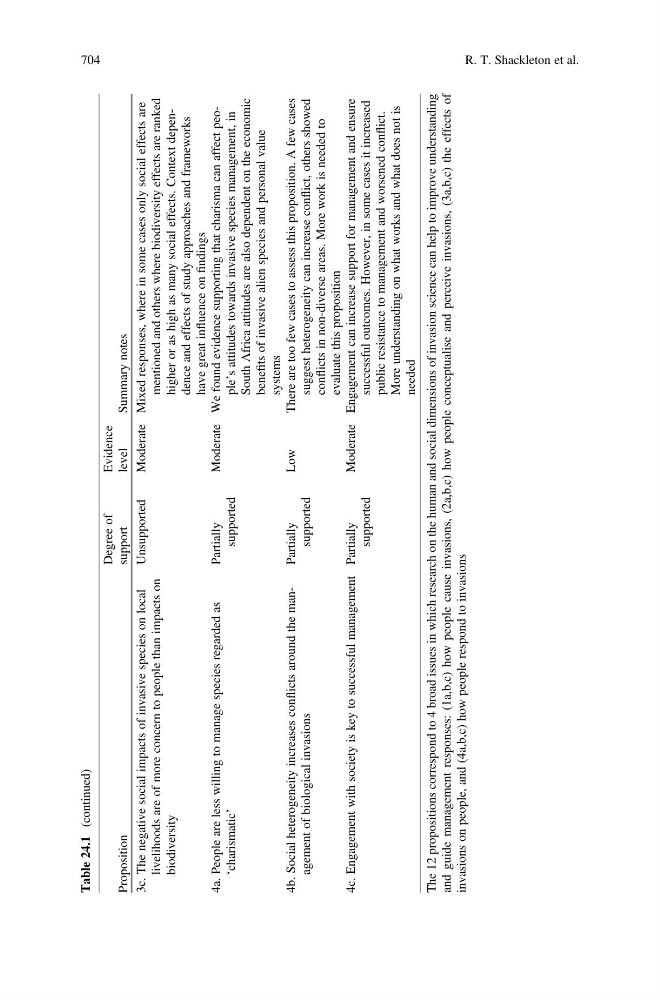
Table 24.1
(continued)
Proposition
Degree of
support
Evidence
level
Summary notes
3c. The negative social impacts of invasive species on local
livelihoods are of more concern to people than impacts on
biodiversity
Unsupported
Moderate Mixed responses, where in some cases only social effects are
mentioned and others where biodiversity effects are ranked
higher or as high as many social effects. Context dependence and effects of study approaches and frameworks
have great influence on
findings
4a. People are less willing to manage species regarded as
‘charismatic’
Partially
supported
Moderate We found evidence supporting that charisma can affect people’s attitudes towards invasive species management, in
South Africa attitudes are also dependent on the economic
benefits of invasive alien species and personal value
systems
4b. Social heterogeneity increases conflicts around the management of biological invasions
Partially
supported
Low
There are too few cases to assess this proposition. A few cases
suggest heterogeneity can increase conflict, others showed
conflicts in non-diverse areas. More work is needed to
evaluate this proposition
4c. Engagement with society is key to successful management Partially
supported
Moderate Engagement can increase support for management and ensure
successful outcomes. However, in some cases it increased
public resistance to management and worsened conflict.
More understanding on what works and what does not is
needed
The 12 propositions correspond to 4 broad issues in which research on the human and social dimensions of invasion science can help to improve understanding
and guide management responses: (1a,b,c) how people cause invasions, (2a,b,c) how people conceptualise and perceive invasions, (3a,b,c) the effects of
invasions on people, and (4a,b,c) how people respond to invasions
704
R. T. Shackleton et al.