

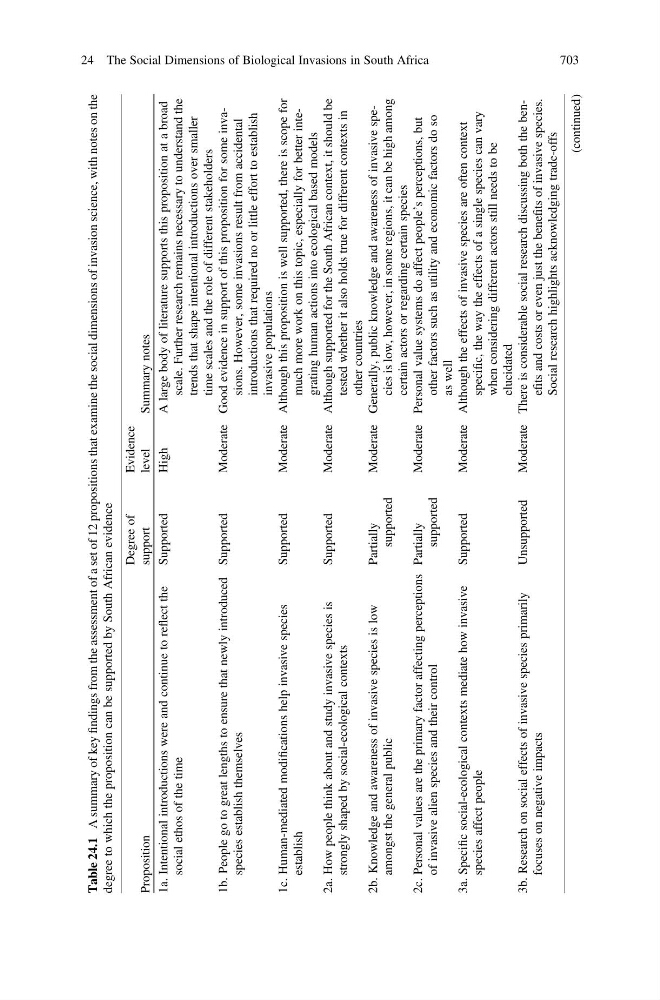
Table 24.1
A summary of key
findings from the assessment of a set of 12 propositions that examine the social dimensions of invasion science, with notes on the
degree to which the proposition can be supported by South African evidence
Proposition
Degree of
support
Evidence
level
Summary notes
1a. Intentional introductions were and continue to reflect the
social ethos of the time
Supported
High
A large body of literature supports this proposition at a broad
scale. Further research remains necessary to understand the
trends that shape intentional introductions over smaller
time scales and the role of different stakeholders
1b. People go to great lengths to ensure that newly introduced
species establish themselves
Supported
Moderate Good evidence in support of this proposition for some invasions. However, some invasions result from accidental
introductions that required no or little effort to establish
invasive populations
1c. Human-mediated modifications help invasive species
establish
Supported
Moderate Although this proposition is well supported, there is scope for
much more work on this topic, especially for better integrating human actions into ecological based models
2a. How people think about and study invasive species is
strongly shaped by social-ecological contexts
Supported
Moderate Although supported for the South African context, it should be
tested whether it also holds true for different contexts in
other countries
2b. Knowledge and awareness of invasive species is low
amongst the general public
Partially
supported
Moderate Generally, public knowledge and awareness of invasive species is low, however, in some regions, it can be high among
certain actors or regarding certain species
2c. Personal values are the primary factor affecting perceptions
of invasive alien species and their control
Partially
supported
Moderate Personal value systems do affect people’s perceptions, but
other factors such as utility and economic factors do so
as well
3a. Specific social-ecological contexts mediate how invasive
species affect people
Supported
Moderate Although the effects of invasive species are often context
specific, the way the effects of a single species can vary
when considering different actors still needs to be
elucidated
3b. Research on social effects of invasive species primarily
focuses on negative impacts
Unsupported
Moderate There is considerable social research discussing both the benefits and costs or even just the benefits of invasive species.
Social research highlights acknowledging trade-offs
(continued)
24 The Social Dimensions of Biological Invasions in South Africa
703