

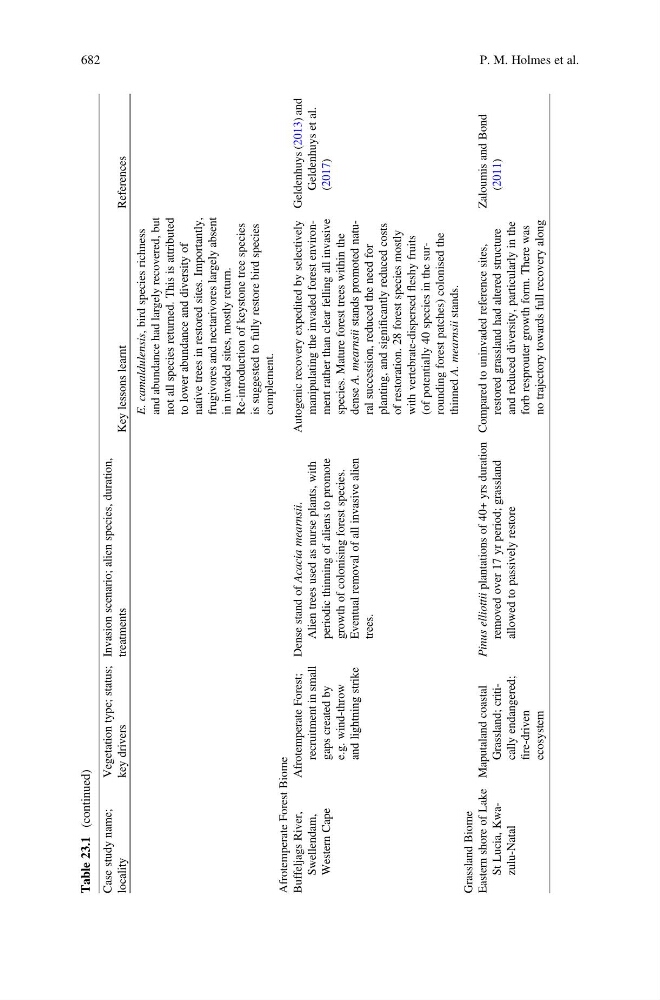
Table 23.1
(continued)
Case study name;
locality
Vegetation type; status;
key drivers
Invasion scenario; alien species, duration,
treatments
Key lessons learnt
References
E. camaldulensis,
bird species richness
and abundance had largely recovered, but
not all species returned. This is attributed
to lower abundance and diversity of
native trees in restored sites. Importantly,
frugivores and nectarivores largely absent
in invaded sites, mostly return.
Re-introduction of keystone tree species
is suggested to fully restore bird species
complement.
Afrotemperate Forest Biome
Buffeljags River,
Swellendam,
Western Cape
Afrotemperate Forest;
recruitment in small
gaps created by
e.g. wind-throw
and lightning strike
Dense stand of Acacia mearnsii.
Alien trees used as nurse plants, with
periodic thinning of aliens to promote
growth of colonising forest species.
Eventual removal of all invasive alien
trees.
Autogenic recovery expedited by selectively
manipulating the invaded forest environment rather than clear felling all invasive
species. Mature forest trees within the
dense A. mearnsii
stands promoted natural succession, reduced the need for
planting, and significantly reduced costs
of restoration. 28 forest species mostly
with vertebrate-dispersed
fleshy fruits
(of potentially 40 species in the surrounding forest patches) colonised the
thinned A. mearnsii
stands.
Geldenhuys (2013) and
Geldenhuys et al.
(2017)
Grassland Biome
Eastern shore of Lake
St Lucia, Kwazulu-Natal
Maputaland coastal
Grassland; critically endangered;
fire-driven
ecosystem
Pinus elliottii
plantations of 40+ yrs duration
removed over 17 yr period; grassland
allowed to passively restore
Compared to uninvaded reference sites,
restored grassland had altered structure
and reduced diversity, particularly in the
forb resprouter growth form. There was
no trajectory towards full recovery along
Zaloumis and Bond
(2011)
682
P. M. Holmes et al.