

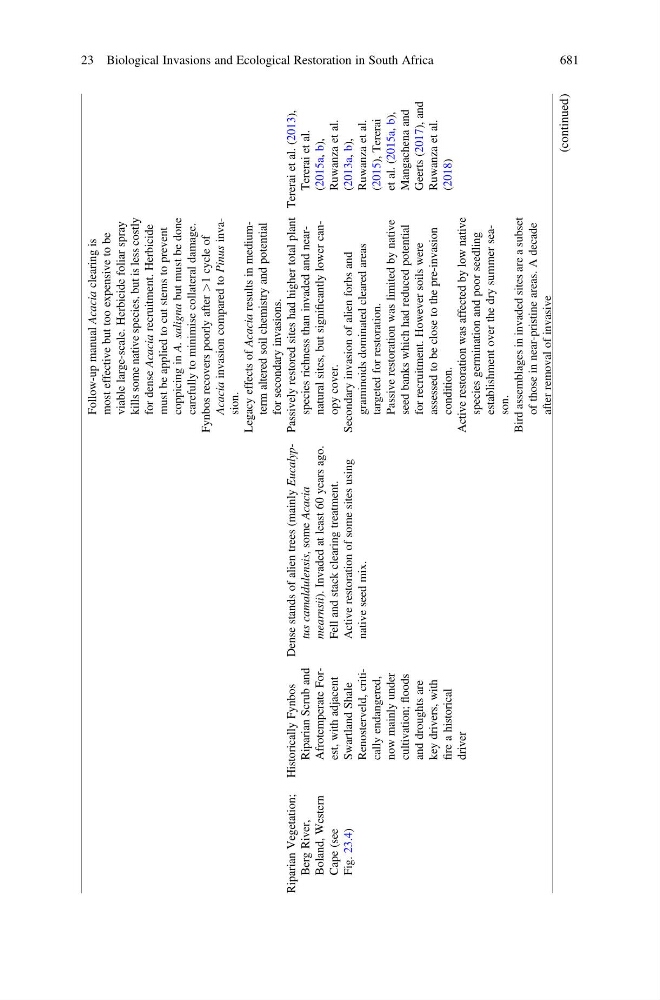
Follow-up manual Acacia
clearing is
most effective but too expensive to be
viable large-scale. Herbicide foliar spray
kills some native species, but is less costly
for dense Acacia
recruitment. Herbicide
must be applied to cut stems to prevent
coppicing in A. saligna
but must be done
carefully to minimise collateral damage.
Fynbos recovers poorly after
>1 cycle of
Acacia
invasion compared to Pinus
invasion.
Legacy effects of Acacia
results in mediumterm altered soil chemistry and potential
for secondary invasions.
Riparian Vegetation;
Berg River,
Boland, Western
Cape (see
Fig. 23.4)
Historically Fynbos
Riparian Scrub and
Afrotemperate Forest, with adjacent
Swartland Shale
Renosterveld, critically endangered,
now mainly under
cultivation;
floods
and droughts are
key drivers, with
fire a historical
driver
Dense stands of alien trees (mainly Eucalyptus camaldulensis,
some Acacia
mearnsii).
Invaded at least 60 years ago.
Fell and stack clearing treatment.
Active restoration of some sites using
native seed mix.
Passively restored sites had higher total plant
species richness than invaded and nearnatural sites, but significantly lower canopy cover.
Secondary invasion of alien forbs and
graminoids dominated cleared areas
targeted for restoration.
Passive restoration was limited by native
seed banks which had reduced potential
for recruitment. However soils were
assessed to be close to the pre-invasion
condition.
Active restoration was affected by low native
species germination and poor seedling
establishment over the dry summer season.
Bird assemblages in invaded sites are a subset
of those in near-pristine areas. A decade
after removal of invasive
Tererai et al. (2013),
Tererai et al.
(2015a, b),
Ruwanza et al.
(2013a, b),
Ruwanza et al.
(2015), Tererai
et al. (2015a, b),
Mangachena and
Geerts (2017), and
Ruwanza et al.
(2018)
(continued)
23 Biological Invasions and Ecological Restoration in South Africa
681