

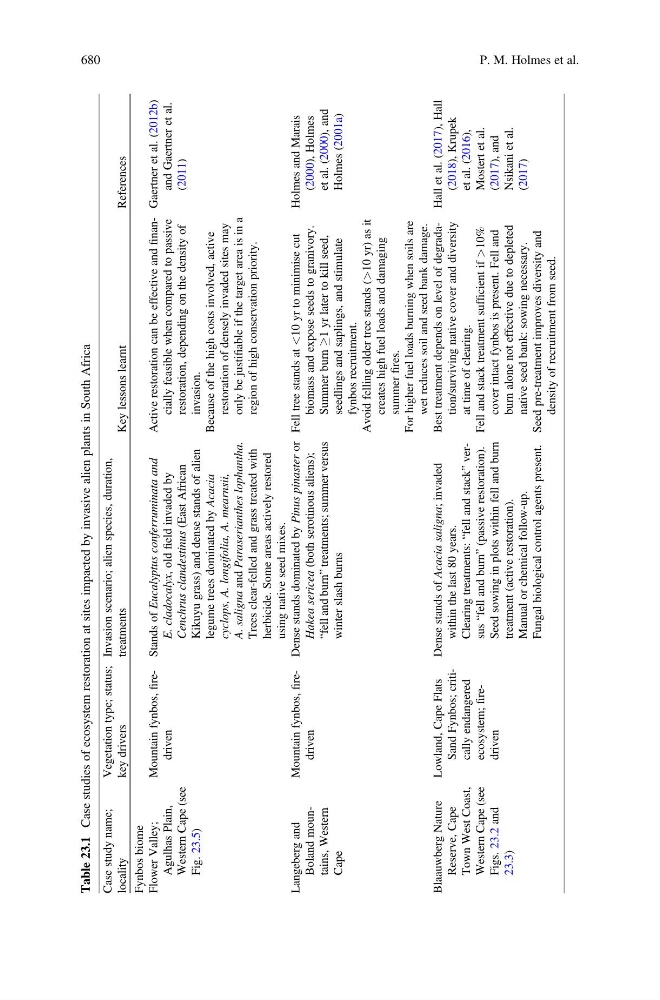
Table 23.1
Case studies of ecosystem restoration at sites impacted by invasive alien plants in South Africa
Case study name;
locality
Vegetation type; status;
key drivers
Invasion scenario; alien species, duration,
treatments
Key lessons learnt
References
Fynbos biome
Flower Valley;
Agulhas Plain,
Western Cape (see
Fig. 23.5)
Mountain fynbos,
firedriven
Stands of Eucalyptus conferruminata and
E. cladocalyx,
old
field invaded by
Cenchrus clandestinus
(East African
Kikuyu grass) and dense stands of alien
legume trees dominated by Acacia
cyclops, A. longifolia, A. mearnsii,
A. saligna
and Paraserianthes lophantha.
Trees clear-felled and grass treated with
herbicide. Some areas actively restored
using native seed mixes.
Active restoration can be effective and
financially feasible when compared to passive
restoration, depending on the density of
invasion.
Because of the high costs involved, active
restoration of densely invaded sites may
only be justifiable if the target area is in a
region of high conservation priority.
Gaertner et al. (2012b)
and Gaertner et al.
(2011)
Langeberg and
Boland mountains, Western
Cape
Mountain fynbos,
firedriven
Dense stands dominated by Pinus pinaster
or
Hakea sericea
(both serotinous aliens);
“fell and burn” treatments; summer versus
winter slash burns
Fell tree stands at
<10 yr to minimise cut
biomass and expose seeds to granivory.
Summer burn
1 yr later to kill seed,
seedlings and saplings, and stimulate
fynbos recruitment.
Avoid felling older tree stands (>10 yr) as it
creates high fuel loads and damaging
summer
fires.
For higher fuel loads burning when soils are
wet reduces soil and seed bank damage.
Holmes and Marais
(2000), Holmes
et al. (2000), and
Holmes (2001a)
Blaauwberg Nature
Reserve, Cape
Town West Coast,
Western Cape (see
Figs. 23.2 and
23.3)
Lowland, Cape Flats
Sand Fynbos; critically endangered
ecosystem;
firedriven
Dense stands of Acacia saligna;
invaded
within the last 80 years.
Clearing treatments:
“fell and stack” versus
“fell and burn” (passive restoration).
Seed sowing in plots within fell and burn
treatment (active restoration).
Manual or chemical follow-up.
Fungal biological control agents present.
Best treatment depends on level of degradation/surviving native cover and diversity
at time of clearing.
Fell and stack treatment sufficient if
>10%
cover intact fynbos is present. Fell and
burn alone not effective due to depleted
native seed bank: sowing necessary.
Seed pre-treatment improves diversity and
density of recruitment from seed.
Hall et al. (2017), Hall
(2018), Krupek
et al. (2016),
Mostert et al.
(2017), and
Nsikani et al.
(2017)
680
P. M. Holmes et al.