

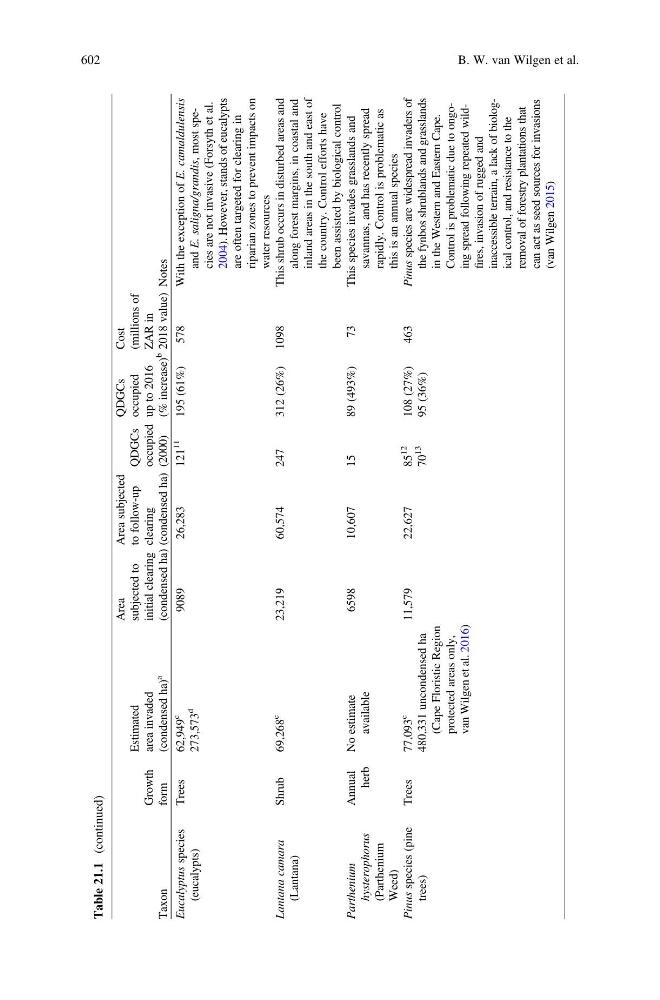
Table 21.1
(continued)
Taxon
Growth
form
Estimated
area invaded
(condensed ha)
a
Area
subjected to
initial clearing
(condensed ha)
Area subjected
to follow-up
clearing
(condensed ha)
QDGCs
occupied
(2000)
QDGCs
occupied
up to 2016
(% increase)
b
Cost
(millions of
ZAR in
2018 value) Notes
Eucalyptus
species
(eucalypts)
Trees
62,949
c
273,573
d
9089
26,283
121
11
195 (61%)
578
With the exception of E. camaldulensis
and E. saligna/grandis,
most species are not invasive (Forsyth et al.
2004). However, stands of eucalypts
are often targeted for clearing in
riparian zones to prevent impacts on
water resources
Lantana camara
(Lantana)
Shrub
69,268
c
23,219
60,574
247
312 (26%) 1098
This shrub occurs in disturbed areas and
along forest margins, in coastal and
inland areas in the south and east of
the country. Control efforts have
been assisted by biological control
Parthenium
hysterophorus
(Parthenium
Weed)
Annual
herb
No estimate
available
6598
10,607
15
89 (493%)
73
This species invades grasslands and
savannas, and has recently spread
rapidly. Control is problematic as
this is an annual species
Pinus
species (pine
trees)
Trees
77,093
c
480,331 uncondensed ha
(Cape Floristic Region
protected areas only,
van Wilgen et al. 2016)
11,579
22,627
85
12
70
13
108 (27%)
95 (36%)
463
Pinus
species are widespread invaders of
the fynbos shrublands and grasslands
in the Western and Eastern Cape.
Control is problematic due to ongoing spread following repeated wildfires, invasion of rugged and
inaccessible terrain, a lack of biological control, and resistance to the
removal of forestry plantations that
can act as seed sources for invasions
(van Wilgen 2015)
602
B. W. van Wilgen et al.