

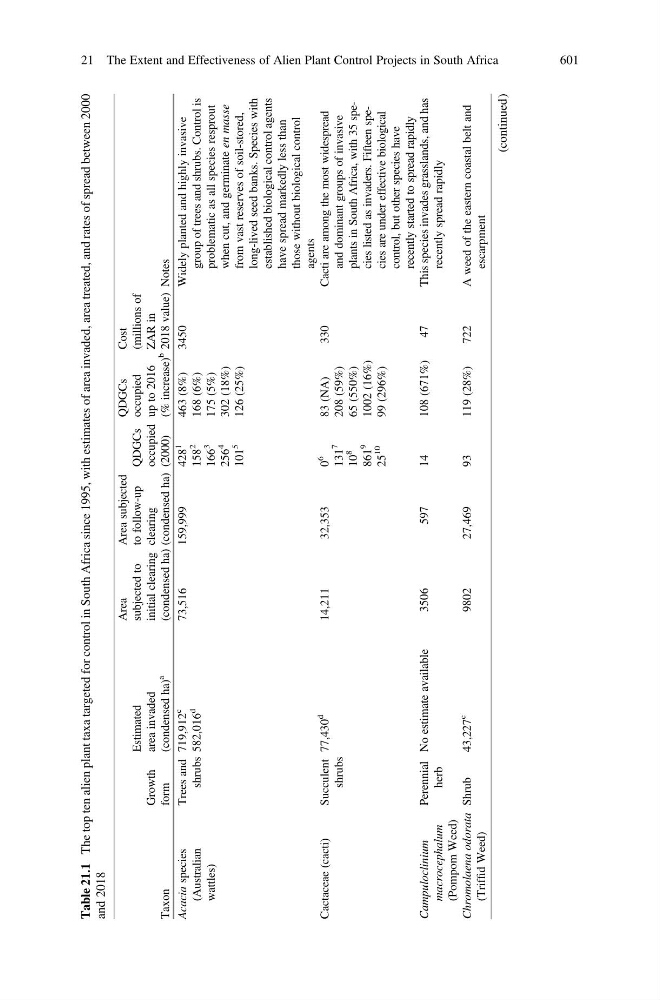
Table 21.1
The top ten alien plant taxa targeted for control in South Africa since 1995, with estimates of area invaded, area treated, and rates of spread between 2000
and 2018
Taxon
Growth
form
Estimated
area invaded
(condensed ha)
a
Area
subjected to
initial clearing
(condensed ha)
Area subjected
to follow-up
clearing
(condensed ha)
QDGCs
occupied
(2000)
QDGCs
occupied
up to 2016
(% increase)
b
Cost
(millions of
ZAR in
2018 value) Notes
Acacia
species
(Australian
wattles)
Trees and
shrubs
719,912
c
582,016
d
73,516
159,999
428
1
158
2
166
3
256
4
101
5
463 (8%)
168 (6%)
175 (5%)
302 (18%)
126 (25%)
3450
Widely planted and highly invasive
group of trees and shrubs. Control is
problematic as all species resprout
when cut, and germinate en masse
from vast reserves of soil-stored,
long-lived seed banks. Species with
established biological control agents
have spread markedly less than
those without biological control
agents
Cactaceae (cacti)
Succulent
shrubs
77,430
d
14,211
32,353
0
6
131
7
10
8
861
9
25
10
83 (NA)
208 (59%)
65 (550%)
1002 (16%)
99 (296%)
330
Cacti are among the most widespread
and dominant groups of invasive
plants in South Africa, with 35 species listed as invaders. Fifteen species are under effective biological
control, but other species have
recently started to spread rapidly
Campuloclinium
macrocephalum
(Pompom Weed)
Perennial
herb
No estimate available
3506
597
14
108 (671%)
47
This species invades grasslands, and has
recently spread rapidly
Chromolaena odorata
(Triffid Weed)
Shrub
43,227
c
9802
27,469
93
119 (28%)
722
A weed of the eastern coastal belt and
escarpment
(continued)
21 The Extent and Effectiveness of Alien Plant Control Projects in South Africa
601