

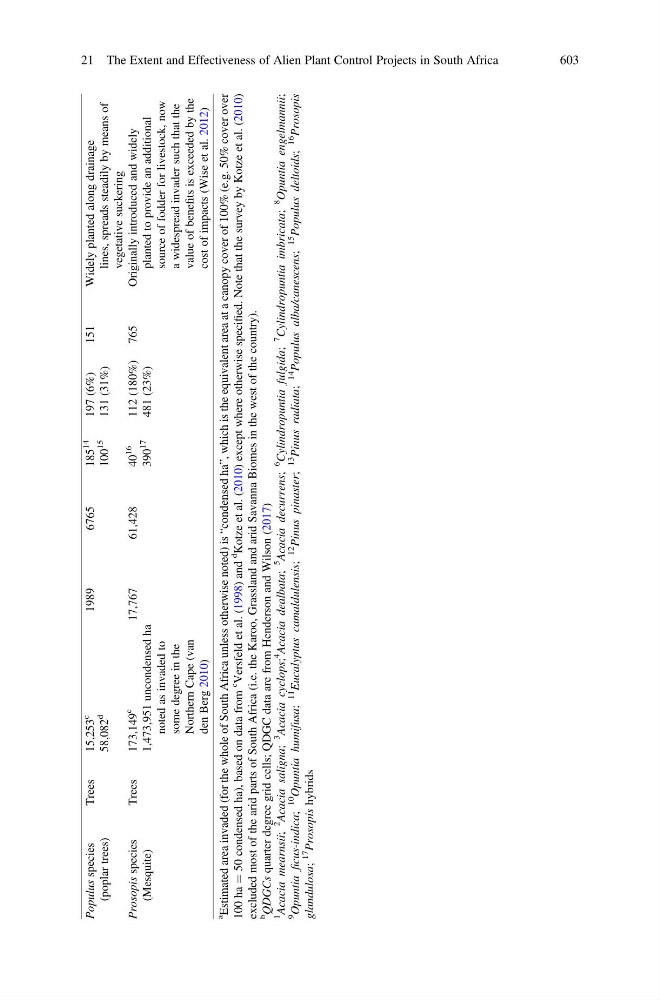
Populus
species
(poplar trees)
Trees
15,253
c
58,082
d
1989
6765
185
14
100
15
197 (6%)
131 (31%)
151
Widely planted along drainage
lines, spreads steadily by means of
vegetative suckering
Prosopis
species
(Mesquite)
Trees
173,149
c
1,473,951 uncondensed ha
noted as invaded to
some degree in the
Northern Cape (van
den Berg 2010)
17,767
61,428
40
16
390
17
112 (180%)
481 (23%)
765
Originally introduced and widely
planted to provide an additional
source of fodder for livestock, now
a widespread invader such that the
value of benefits is exceeded by the
cost of impacts (Wise et al. 2012)
a
Estimated area invaded (for the whole of South Africa unless otherwise noted) is
“condensed ha”, which is the equivalent area at a canopy cover of 100% (e.g. 50% cover over
100 ha
¼ 50 condensed ha), based on data from
c
Versfeld et al. (1998) and
d
Kotze et al. (2010) except where otherwise specified. Note that the survey by Kotze et al. (2010)
excluded most of the arid parts of South Africa (i.e. the Karoo, Grassland and arid Savanna Biomes in the west of the country).
b
QDGCs
quarter degree grid cells; QDGC data are from Henderson and Wilson (2017)
1
Acacia mearnsii;
2
Acacia saligna;
3
Acacia cyclops;
4
Acacia dealbata;
5
Acacia decurrens;
6
Cylindropuntia fulgida;
7
Cylindropuntia imbricata;
8
Opuntia engelmannii;
9
Opuntia
ficus-indica;
10
Opuntia humifusa;
11
Eucalyptus camaldulensis;
12
Pinus pinaster;
13
Pinus radiata;
14
Populus alba/canescens;
15
Populus deltoids;
16
Prosopis
glandulosa;
17
Prosopis
hybrids
21 The Extent and Effectiveness of Alien Plant Control Projects in South Africa
603
species
(poplar trees)
Trees
15,253
c
58,082
d
1989
6765
185
14
100
15
197 (6%)
131 (31%)
151
Widely planted along drainage
lines, spreads steadily by means of
vegetative suckering
Prosopis
species
(Mesquite)
Trees
173,149
c
1,473,951 uncondensed ha
noted as invaded to
some degree in the
Northern Cape (van
den Berg 2010)
17,767
61,428
40
16
390
17
112 (180%)
481 (23%)
765
Originally introduced and widely
planted to provide an additional
source of fodder for livestock, now
a widespread invader such that the
value of benefits is exceeded by the
cost of impacts (Wise et al. 2012)
a
Estimated area invaded (for the whole of South Africa unless otherwise noted) is
“condensed ha”, which is the equivalent area at a canopy cover of 100% (e.g. 50% cover over
100 ha
¼ 50 condensed ha), based on data from
c
Versfeld et al. (1998) and
d
Kotze et al. (2010) except where otherwise specified. Note that the survey by Kotze et al. (2010)
excluded most of the arid parts of South Africa (i.e. the Karoo, Grassland and arid Savanna Biomes in the west of the country).
b
QDGCs
quarter degree grid cells; QDGC data are from Henderson and Wilson (2017)
1
Acacia mearnsii;
2
Acacia saligna;
3
Acacia cyclops;
4
Acacia dealbata;
5
Acacia decurrens;
6
Cylindropuntia fulgida;
7
Cylindropuntia imbricata;
8
Opuntia engelmannii;
9
Opuntia
ficus-indica;
10
Opuntia humifusa;
11
Eucalyptus camaldulensis;
12
Pinus pinaster;
13
Pinus radiata;
14
Populus alba/canescens;
15
Populus deltoids;
16
Prosopis
glandulosa;
17
Prosopis
hybrids
21 The Extent and Effectiveness of Alien Plant Control Projects in South Africa
603